Songs in the Austrian Region, c. 1450–c. 1520
Historical Preconditions
The geopolitical territory that produced “German songs” in the second half of the fifteenth and the early sixteenth century was far from a consolidated population and power structure. In the creation and dissemination of German-language songs, the German-speaking community naturally plays a central role. This community was distinct from the neighbouring Romance and Slavic areas of Europe, but was in itself linguistically diverse, encompassing a wide range of southern or Upper German dialects and others that transitioned seamlessly into Dutch. Travelling and immigrated Flemish composers left traces of songs originally written in their language on the northern side of the Alps. The texts of Flemish songs were often hastily Germanised, or their original titles were still recognisable in the Germanised versions.[1] The titles of French, Italian and Czech songs, by contrast, were often distorted to the point of nonsense.[2] Consequently, the original texts of the latter foreign songs were often replaced by German texts or Latin contrafacta. In some problematic cases, songs by foreign composers survive only with German texts, such as Elend du hast umfangen mich by Robert Morton, who worked at the Burgundian court. Nevertheless, the majority of this repertoire can be identified as genuinely “German-language song”.
Many factors made the south of the Holy Roman Empire of the German Nation a region that offered highly diverse conditions for the development of music, especially non-public music, as songs usually are: unstable territorial power relations, shifting political hostilities and erratic alliances, fluctuating fortunes of capital, educational and commercial cities, unequal economic conditions, and the existence of multilingual zones. Such instability need not be viewed solely in a negative light, as though it hindered the formation of a strong concept of song. On the contrary, it encouraged original approaches to song writing and enabled lively currents of exchange. It evidently suited the cultural-political agenda of Emperor Maximilian I that his reign provided a stable foundation for German song as an art form, as part of the framework of his imperial vision at the turn of the sixteenth century. Until his time, songs, including those composed with artistic intent, sprang up in various places, in different milieux, displaying musical or textual features that were typical or unique, in greater or lesser numbers, travelling orally or in writing, in whole or in part, consistently or in modified form. In short, before Maximilian’s reign, song was in the German-speaking area more a utilitarian good whose value lay in musical practice than in its quality as a distinct and internally differentiated genre.
On the Internal Geography of Song Cultivation
As far as we can tell from the current state of sources, there were no stable centres of song culture in the Austrian region, except - as far as we can tell from the present state of sources - at times in particular cities, notably Augsburg and Innsbruck. The historic Austrian hereditary lands, that is, the areas of Upper and Lower Austria, Styria, Carinthia and Carniola (now a large part of modern Slovenia) were only partially involved in the development of German song. We have little concrete evidence of a polyphonic song culture in the residences favoured by Frederick III, Wiener Neustadt and Graz. The cultural significance of Vienna rested primarily on the intellectual life of the university, whose role in the cultivation of song remains little researched (» B. Das Phänomen „Neidhart“). At Vienna, visited only occasionally by Frederick III and his son Maximilian I, there were evidently fewer of the kinds of interactions between the court and a broader courtly-patrician class that might have led to a lively cultivation of song. Signs of a culture of polyphonic song at Vienna emerge only in the early sixteenth century, when the administration of the Upper Austrian lands was moved there from Linz. By this time, the city had been elevated to an episcopal seat, and in this context, the institution of the ecclesiastical chapel was repeatedly stationed in Vienna and active at St Stephen’s. At the intersection of these developments stands the figure of Wolfgang Grefinger. He enrolled at the university in 1492, and moved in the humanist circle around Conrad Celtis and Joachim Vadianus. He composed settings for Latin odes (» I. Humanisten), and had his own settings of Prudentius printed in Vienna. He was also associated with the young Ludwig Senfl (» G. Ludwig Senfl). Grefinger, a former pupil and friend of Maximilian’s court organist Paul Hofhaimer (» I. Hofhaimer), also served as organist at St Stephen’s Cathedral. He primarily left behind songs, which, tellingly, are preserved in sources from Augsburg, probably taken there by members of the chapel.
Further west, the conditions for the production, reception, and preservation of songs were more favourable. The ecclesiastical principality of Trent, where a South-German dialect was spoken alongside Italian, developed an active musical life in the third quarter of the fifteenth century under its bishop Johannes Hinderbach, who had been educated at the University of Vienna. In the musical life of Trent, songs were by no means foreign. Swiss cities also emerged as hubs for the circulation of song repertoire. The so-called Buxheim Organ Book (» D-Mbs Mus. ms. 3725), which may have originated in St Gallen before 1470 and was based on merchant connections to Nuremberg, contains numerous song settings.[3] The singing and collecting of songs was in no way hindered by the gradual detachment of the Swiss Confederation from the Empire. On the contrary, beginning in the commercial, episcopal, university and humanist city of Basel, song corpora with interregional connections became increasingly dense, particularly after 1500. (» Fig. Basel 1493)
Abb. Basel 1493
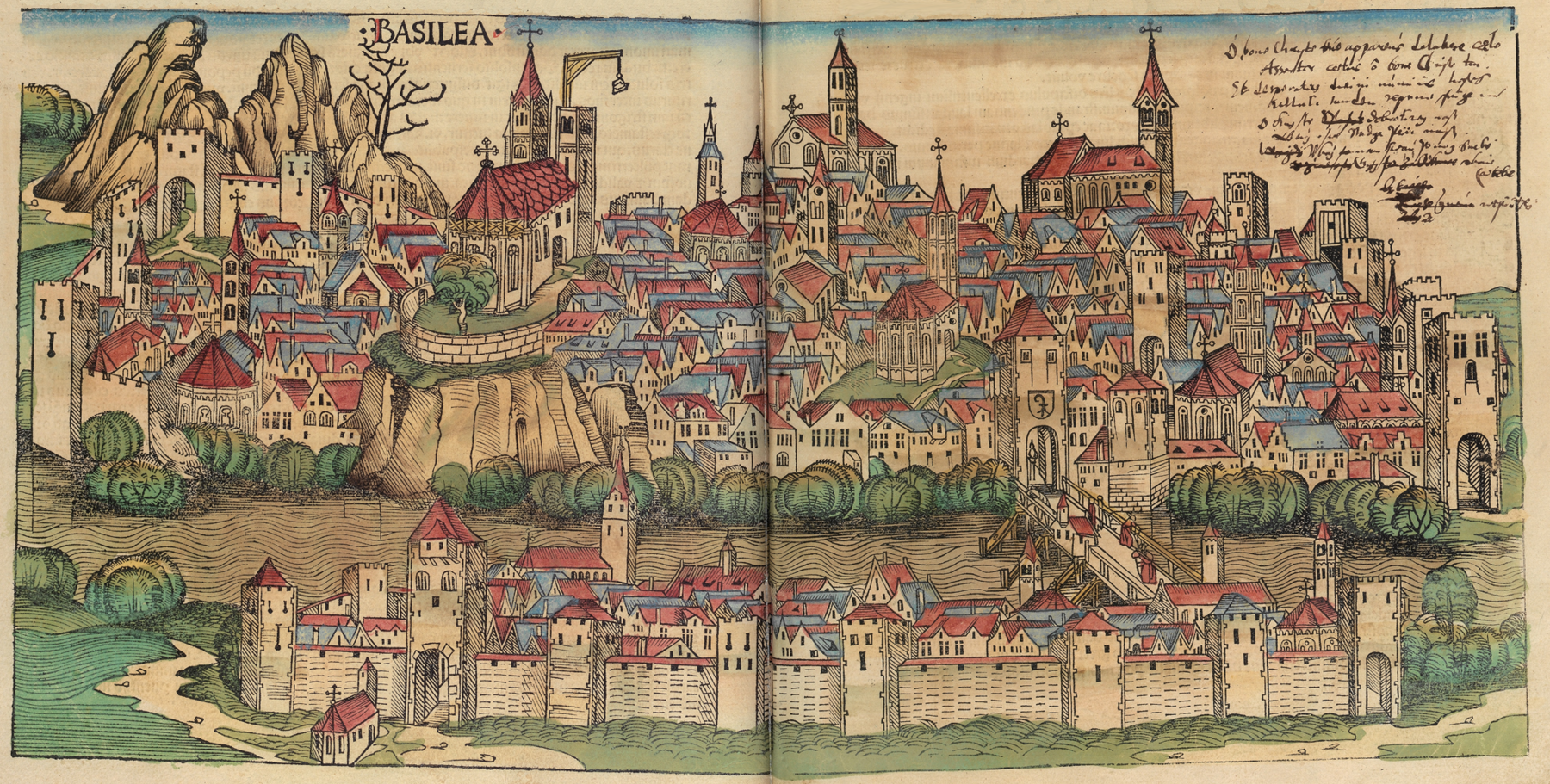
Basilea: Holzschnitt von Michael Wolgemut u. a. in der Weltchronik von Hartmann Schedel, Nürnberg 1493, fol. 243v–244r (© Wikimedia Commons).
Connections to Burgundy, Augsburg and Saxony
In the western part of the Empire, genealogical and topographical bridges to Burgundy existed via the intermediary Habsburg territories of the Vorlande of Further Austria. These Tyrolean or Habsburg possessions, some larger, some smaller, were scattered between the city of Constance and the Diocese of Constance, which extended far to the north in the southern Upper Rhine region, which included the university city of Freiburg, and Alsace. For Maximilian’s choirboys – including the later song composer Adam Rener – it was an alternative to be sent to Burgundy for study (presumably to the Alma mater in Dôle) rather than to Vienna like Senfl. Franco-Flemish singer-composers were present in the imperial chapel even before a dynastic connection between the House of Habsburg and the Duchy of Burgundy was established in 1477 through Maximilian’s marriage to the daughter of Charles the Bold (» F. Musiker aus anderen Ländern). Time and again, partly inextricable links appear between German songs and the names of Habsburg-Burgundian singer-composers (Johannes Tourout, Jean Puilloys, Nicolas Champion, Jacques Barbireau, Noël Bauldeweyn), revealing the permeability of territorial and linguistic boundaries. The best-known figure, however, is Henricus Isaac (» G. Henricus Isaac), whose considerable song output is relatively well documented, though not without contradictions. This musician from the Southern Low Countries visited the court of Archduke Sigismund at Innsbruck in 1484, and distinguished himself a good decade later as Maximilian’s court composer.
From 1488 onwards, the Swabian League formed an political framework that brought such diverse regions as Tyrol, Württemberg, and the imperial city of Augsburg into official contact. Other political units joined after 1500, including the Duchy of Bavaria-Munich and the imperial cities of Nuremberg and Strasbourg, to mention only locations significant in the history of song. Augsburg was Maximilian’s preferred place of residence, not least because, as one of the Empire’s most important centres of printing, it aligned with his media interests. Song, too, was propelled into a new dimension here by the brief but intense period of music printing between 1507 and 1517.[4] This was further supported by the fact that, after 1490, Maximilian’s musicians were often quartered in Augsburg for extended periods, with some even explicitly residing there, so that a large part of song production and transmission originated in this city. Although Bavaria and Tyrol experienced a peak in their political rivalry during the second third of the fifteenth century, the longstanding cultural and economic closeness between the Alpine foothills and the “land in the mountains” remained intact, with the transit route to Italy serving as a vital artery for both parties. Innsbruck, the administrative seat of the Upper Austrian lands, thus became an important residence and took over this role from the Danube city of Linz after 1490.
The extent to which personal connections can transcend regional conditions is illustrated by the Habsburg–Saxon connection. In 1484, the music-loving Katharina of Saxony became the wife of Emperor Maximilian’s cousin, Sigismund of Tyrol. Her cousin, Elector Frederick the Wise, served as a councillor and governor for his great-uncle King Maximilian between 1494 and 1498, during which time he was also continuously present at Maximilian’s court in Tyrol. The two court chapels also encountered one another – for instance, at the Imperial Diet in Freiburg in 1498. From these years, contacts between Elector Frederick and Paul Hofhaimer (» I. Hofhaimer) are documented, which also makes it likely that, through this connection, the songs of Adam of Fulda – who had been in Frederick’s service since 1489 – found their way into the South-German region. A continuous cultivation of song begins in the 1490s and is closely linked to Maximilian’s reign.
Song Collections of the Fifteenth Century
Three surviving musical manuscripts from the second half of the fifteenth century transmit polyphonic songs in German. In each, this genre is represented in considerable quantity and either dominates, significantly shapes, or at least heavily permeates the accumulated repertoire. Earlier scholars referred to this group of sources, not always entirely appropriately, as “songbooks”: the Lochamer Songbook (c. 1450–1460, » D-B Mus. ms. 40613), the Schedel Songbook (1459–1463, » D-Mbs Cgm 810), and the Glogau Songbook (or Sagan Partbooks, c. 1480, » PL-Kj Berol. Mus. ms. 40098.[5] The first two are closely associated with their Nuremberg owners, so that one may, in a certain sense, speak of a South German provenance, especially since the humanist physician Hartmann Schedel was also frequently in Augsburg. As a young man, he recorded songs that circulated widely, embedding them within a broader collection that also included Franco-Flemish chansons, insofar as these were accessible in the area north of the Alps. The remarkable number of concordances between the Buxheim Organ Book and the Schedel manuscript – and to a lesser extent also with the Lochamer Songbook – highlights the importance of the Free Imperial City of Nuremberg as a centre for the cultivation and documentation of song during this period.
The songs from the extensive three-part Głogów/Glogau partbooks, which originated in the Augustinian Canons’ monastery at Żagań/Sagan in Lower Silesia and, in keeping with its place of origin, are slanted towards sacred material. They include several settings that were also in circulation in the South German region, though it is difficult to determine where they originally came from, and in which direction they spread. The pool of Sagan manuscript songs transmitted in multiple sources represent a transregional phenomenon. As important and noteworthy as these three relatively self-contained compilations are, they probably do not convey a representative impression of the song culture of the time.
Scattered Transmission
German polyphonic song in the second half of the fifteenth century typically had a scattered transmission,which telling about the status of the polyphonically notated song at the time. The older tradition of courtly solo song was conceived primarily in literary terms. It is preserved in large song collections, more often than not without notation. This practice could not be easily transferred to polyphonic song. Rather, songs written down in multiple voices in the German lands initially appear only as a kind of “footnote” to sacred music. In the “mixed quarto manuscripts” or “small folio manuscripts” typical of musical transmission in the German-speaking world up to the end of the fifteenth century, song material are appended to the dominant sacred repertoire. Sometimes songs even blend into sacred repertoire through contrafact, that is, the substitution of Latin texts for use in liturgy and private devotion. In any case, the German-language songs in these sources appear as a peripheral phenomenon. This is often evident codicologically, since many were added as later insertions in blank spaces in their host volumes. These sources do not reveal any deliberate attempt to compile representatives of a functional or generic category of song.
The thousands of pages of music in the Trent Codices » I-TRbc 90, » I-TRcap 93*, » I-TRbc 88, and » I-TRbc 89, copied between roughly 1455 and 1470, primarily by Johannes Wiser, a native of Munich who became succentor and rector of the cathedral school in Trent, are particularly informative in this issue. These codices contain just eight songs, eight Leisen (» B. Geistliches Lied), and eight Masses based on cantus firmi derived from songs.[6] A similar yield is found in another convolute manuscript, the choirbook of the Innsbruck schoolmaster Nikolaus Leopold (» D-Mbs Mus. ms. 3154), a little later than the sources produced in Trent.[7] This choirbook, to which many hands contributed, was copied between around 1466 and 1511. It can be assumed – though not with absolute certainty – that the manuscript of over 800 pages reflects the repertoire of various Habsburg-Tyrolean chapel ensembles in the vicinity of Augsburg and Innsbruck before it came into the possession of the schoolmaster.[8] Here, German songs are as marginal as in the Trent manuscripts: in the fascicle completed in 1476, a scribe entered a cluster of five song settings and one standalone song (cf. » Audio example ♫ Ich sachs einsmals; » Audio example ♫ Gespile, liebe gespile gút; » Audio example ♫ Es sassen höld in ainer Stuben; » Audio example ♫ So steh ich hie; » Audio example ♫ Tannhauser). Presumably in the late 1480s, three Masses were added, which seem to be based on song material. (On the song underlying the Missa O Österreich, see » F. Musiker aus anderen Ländern). Several motet-like settings are combined with song melodies; three further songs are notated in the margins. The scarcity of material aligns with evidence from other regions: the Strahov Codex from Prague (» CZ-Ps D.G. IV. 47; » F. Bohemian Sources) records three German songs. Two extensive musical collections from Leipzig dating from before and around 1500 – the Berlin Mensural Codex » D-B Mus. ms. 40021 and the Nikolaus Apel Codex (» D-LEu Ms. 1494) – also each contain only a handful of songs.
It is not easy to determine when the tide began to turn in the South German–Austrian region, transforming secular polyphonic songs into a distinct object of collection, as further manuscripts containing song elements from the 1480s and 1490s have survived only in fragmentary form. This group includes the Augsburg fragment (» D-As Cod. 4° Mus. 25, c. 1492/93), the isolated Trento fascicle (» I-TRc Ms. 1947-4, c. 1495 to before 1500), or – particularly interesting – the Linz fragment (» A-LIb Hs. 529, c. 1490) with its three songs and additional related fragments. None of these are conceived in partbook format. Given its provenance, the Linz fragment may well owe its existence to those periods when the Habsburg court was resident in Linz. The connections to the court are especially evident in the song Heya, heya nun wie sie grollen hervor (» Audio example ♫ Heya, heya and » Audio example ♫ Heya ho, nun wie si grollen). This four-line feud call, which may even go back to Oswald von Wolkenstein or at least relate to an episode from his life (c. 1442–43),[9] is transmitted in one of the Trent Codices (I-TRbc 89) from around 1465, in the Braccesi Chansonnier (» I-Fn B.R. 229), compiled in 1492 in Florence, where Heinrich Isaac resided, and in the Linz fragment. It is also quoted in a quodlibet from the collection of Wolfgang Schmeltzl.[10] The schoolmaster of the Scots’ Monastery (Schottenstift) in Vienna drew heavily on old material for his 1544 edition, reaching back to the early Maximilian period and stored in the Scots’ Monastery.[11] Thus, he also combined Heya heya with the Tannhäuser song from the Nikolaus Leopold Codex. This configuration of transmission suggests that, within closer or broader court circles, the unruly Brixen knight-peasant affair remained a subject of interest for many decades (» Music example Heya, heya, nun wie si grollen).
Notenbsp. Heya heya, nun wie si grollen
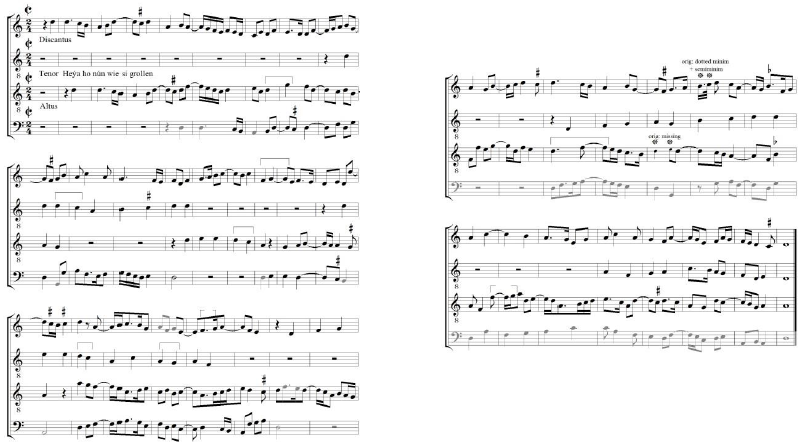
Rekonstruierte Transkription (Marc Lewon) des auf Oswald von Wolkenstein zurückgehenden Liedes nach Fragment Nr. 2 in » A-LIb Hs. 529. Die schattierten Noten, die im Linzer Fragment fehlen, sind ergänzt nach » I-TRbc 89, fol. 388v–389r.
The Rise of Art Song under Maximilian I
Maximilian’s intensified patronage of music embraced private or at least non-representational music-making. After he returned to the German lands in 1490, general awareness of composed song began to grow. This is evident in the new way in which songs from his immediate musical circle were stored in bundled form. The oldest known witness to this new interest is now accessible only indirectly and incompletely: the forty-five anonymous songs in the Zurich tenor partbook, the only surviving volume from an original set of three, copied in the 1520s by the Augsburg musician Bernhard Rem, organist to the Fugger. The repertoire, including as its only concordances two with the Sagan partbooks (Glogau Songbook, c. 1480), is stylistically rooted in the 1490s.[12] Like Rem’s two other song manuscripts from this period,[13] this was apparently part of an antiquarian project from after Maximilian’s death, in which copies were made from older sources or compiled from them. The other two manuscripts copied by Rem clearly belong to Maximilian’s musical entourage, and contain songs by court composers such as Isaac, Hofhaimer, Rener, Senfl and others. The collective authorship of the court chapel must remain speculative in the case of the Zurich manuscript. However, the transmission context suggests that it the repertoire it contains originated in Maximilian’s chapel. Singers circulated these songs, whether they were their own or by others.
This shift is indicative of the new function of the polyphonic song, which now became a compositional task actively pursued by members of the chapel and their associates, such as Wolfgang Grefinger in Vienna, or Hans Buchner and Sixt Dietrich in Constance and Freiburg. German songs and Franco-Flemish chansons stood side by side just as naturally as did motets by local or international composers. They were included in sources such as the musical “travel book”, the Augsburg Choirbook (» D-As Cod. 2° 142a, c. 1512–1514),[14] worked on until 1514. This source is connected to Maximilian’s Augsburg chamber secretary, councillor, and chief diplomat Matthäus Lang,[15] who himself had been trained as a choirboy. Also closely linked to the royal or imperial chancery is the extensive Munich manuscript » D-Mbs Mus. ms. 3155 (shortly after 1519). This manuscript contains only German songs, the lion’s share of which was composed by Isaac’s successor, the young Senfl.[16] The calligraphic script of the poems belongs to one of the secretaries involved in Maximilian’s major literary projects – possibly Marx Treitzsaurwein. Probably compiled shortly before the Viennese princely wedding of 1515 (» D. Royal Entry), it represents, as the final flourish of the almost anachronistic choirbook layout, the representative pinnacle of the documentation of courtly song culture in the Habsburg Empire.
The taste for polyphonic song that flared up around and after 1500 can be observed in many other places, although the practice of notating music in partbooks, which was increasingly adopted to notate this music, has taken a heavy toll on the transmission of sources. Nevertheless, the various fragmentary song manuscripts from the loosely defined Bavarian-Austrian region,[17] and especially the Swiss sources,[18] which survive in ever greater number from this time and provide tangible evidence of reciprocal connections to Augsburg, Freiburg, and Constance, confirm that polyphonic song had become an indispensable part of urban and educated culture.
Printed Songbooks
From the perspective of musical communication networks and source typology, the principal driver behind the dissemination of the German polyphonic song around 1500 was the new medium of music printing. In the final decade of Maximilian’s life, this gave the song a brief but brilliant moment of public prominence through printed partbooks and song pamphlets. In these sources, the media interests of Maximilian and his entourage converged with an accumulated song repertoire and the receptiveness of a widely dispersed audience. A representative example is the printed songbook » Aus sonderer künstlicher Art, issued in 1512 by the imperial printer Erhart Öglin in Augsburg (cf. » Fig. Hofhaimer, Ach lieb mit leid). Further sets of partbooks were published elsewhere between 1510 and 1517 by the presses of Johann Froschauer (?), Peter Schöffer the Younger, and Arnt von Aich.[19] These publications predominantly reflect the song repertoire available at the imperial court and the (at times allied, at times rival) Württemberg court – that is, works by Habsburg and Stuttgart composers. However, they also include pieces by figures such as the respected Saxon composer Adam von Fulda, whose songs are also found in the musical “travel dossier” of the Augsburg Choirbook and in Swiss sources. The overlap between polyphonic settings and the mostly monophonic melodies found in song pamphlets – usually limited to texts or melodic cues (“to be sung to the tune of …”) – remains small before 1520. We can only imagine how those songs sounded that were sung across the German lands without elaborate polyphonic arrangements and in everyday contexts.
Specialised printers interpreted the demand for song publications as indicative of a growing market. While this commercial calculation proved successful in the case of song pamphlets, the production of complex songbooks during the era of multi-phase printing evidently proved too labour-intensive to be economically viable. It was probably due to this financial consideration that the last surviving edition containing polyphonic German songs printed with multi-phase technology dates from 1517. The advent of an optimised technology, single impression music printing, in 1534, ushered in a new era of large-scale song publication.[20]
From Spruchsang to the Zeitungslied
In the second half of the fifteenth century, a significant shift occurred in both the social base and the performers of song, which also altered the nature of song performance itself. The traditions of Spruchsang from the fourteenth century and the now flourishing art of the Meistersinger existed side by side in the Austrian region around 1450 (» B. Traditionsbildungen des Liedes, » B. Spruchsang in den österreichischen Ländern, » B. Das Phänomen „Neidhart“). Monophonic songs of higher social status – what one might call “recital songs” – were still performed by a distinct professional group, the “speakers” (Sprecher) who appear in archival records. This designation already signals an emphasis on the literary aspect. Nevertheless, the musical side was occasionally documented, though only as solo performances. No written evidence survives of their polyphonic realisation with instrumental accompaniment. Among the most prominent Sprecher was Michel Beheim, who also served the Habsburgs: after 1454 at the court of Albrecht VI in Freiburg, and between 1459 and 1465 at the imperial court of Frederick III (» B. Das Phänomen „Neidhart“). Although successors in his role are known by name – Mangolt Groenwald[21] and, under Maximilian, Georg Sayler, who appears in records sometimes as “speaker,” sometimes as “singer” – Beheim already belonged to a dying breed, as he himself lamented at the end of his life. From 1490 onwards, the declining profession – which also served numerous noble estates in the form of itinerant singers, even occasionally female singers – merged with the peddlers of the newly emerging trade of printed broadsheets. Travelling singers could probably sell more song sheets if they had performed them beforehand.[22] The transition from Spruchsang to printed broadsheet, which used known melodies and therefore required no notation, occurred gradually. Occasionally, the latter songs (Zeitungslieder) formed an alliance with composed pieces when they included descriptions of historical events or local incidents. The story of a village dispute that got out of hand, attributed to the Bavarian singer and later district judge Hans Hesselloher, circulated not only from around 1450 as a multi-stanza text (Von üppiglichen Dingen), but also inspired various melodic variants. All of these share the distinctive rising fifth and the repeated reciting tones at the beginning, and several were set polyphonically. A three-part version, whose modest polyphony and triple metre suggests a neutral (and by no means dance-like) delivery of the text (harking back to the tradition of the solo performance song), survives in a manuscript compiled before 1500, once owned by the Mondsee monastery.[23] The fact that Schmeltzl also drew on it at the Scots’ Monastery in Vienna for one of his quodlibets[24] suggests that the melody spread through Benedictine channels. It might recall the long-standing culture of convivial song in monastic communities, to which the Glogauer Liederbuch attests.
Transformation of Courtly and Urban Song Practice
The practice of courtly song changed significantly in the second half of the fifteenth century. It increasingly exchanged its formerly clerical foundation for a secular context oriented toward courtly life. While no comparable evidence survives from the court of Frederick III, it is well documented that Maximilian, already during his Burgundian years around 1480, had adopted the habit of having chapel singers perform privately for him and his organist play for him. He evidently continued this practice into old age during his rule in southern Germany, albeit with different personnel. He even brought some musicians, such as the Franco-Flemish singer Philipp du Passaige, with him from the Low Countries as trusted companions (“cantori et Commensali continuo”).[25] Maximilian employed his organist Paul Hofhaimer and his singers not only for official occasions but also for his own private entertainment, sometimes having them follow him in small ensembles on his continuous travels, even to spa retreats (cf. also » D. Hofmusik. Innsbruck). The polyphonic song provided an ideal platform for his personal recreation, as well as for the smaller and larger gatherings of the mobile court. Thematically, love poetry in all its facets – ranging from declarations of affection to suggestive innuendo – predominated, accessible as it was to the middle and lower stylistic registers,[26] though moral instruction increasingly gained ground. This was counterbalanced by satirical content such as peasant satire, a popular motif at noble gatherings that not only provided amusement at costume balls and so-called Mummereien (masquerades), but also found expression in numerous songs of the time. It is no surprise that this environment spurred the composing chapel members to activity. The stationing of Habsburg chapel members in various cities of the Empire for months or years also blurred the boundaries between courtly and urban musical culture, allowing the court’s enthusiasm for song – originating with the ruler and his entourage – to spread into the patriciate and educated bourgeoisie of the cities. Economic prosperity, social advancement, and cultural ambition – as seen for example, in the circle of the Fuggers of Augsburg – or intellectual aspirations – as seen in the Amerbach family of Basel – combined with an increasingly relaxed and confident use of the German language to provide the cultural soil in which the flourishing genre could take root. As pure vocal music, as a small-scale art form adaptable for vocal and instrumental performance, and as a basis for lute and keyboard intabulations, it offered a wide-ranging repertoire suitable for various levels and life contexts. In particular, the urban youth, including students living in university colleges (bursae) or the young noble pages at court, were probably key target audiences.
The diligent production of printed broadsheets and song pamphlets, which began shortly before the turn of the century especially at the classic South German printing centres, also materially attests to the strong interest of broad segments of the population in singing songs, which presumably predated the development of this new medium. The dissemination of songs may have changed with the advent of this innovative medium. Collecting songs – possibly even just as printed texts – may have become an additional cultural practice, complementing the singing of songs, which undoubtedly remained central. The fact that songs were sung to specific, familiar melodies is vividly confirmed by the paratexts accompanying most song pamphlets. New song texts were offered with references to well-known melodies, such as “In dem Ton Ich stund an einem Morgen” (To the tune of Ich stund an einem Morgen). In this way, a not insignificant repertoire of melodies can be reconstructed – melodies that were evidently widely known at the time.
Monophonic Tune – Polyphonic Song
A polyphonically composed song is represented by a melody and a setting, to which a text usually – but not necessarily – belongs, whether sung or supplied mentally. The inherent tension between these components shapes the creation and reception of songs. This is even more pronounced in German songs of the fifteenth and sixteenth centuries than in those from other European regions. We can only speculate on the relationship between the composition of polyphonic songs and the older tradition of monophonic song. Today, it is generally assumed that monophonic songs – whose melodies were more or less well known, but in any case existed – were at some point (orally or in writing) transformed into polyphonic settings and then notated as such. This seemingly natural chronology (a monophonic melody later set polyphonically) suffers, in the case of secular polyphonic songs, from the flaw that no such prior melody has yet been found in written form predating the polyphonic setting or settings in question – not even for songs that appear particularly archaic, such as Elslein, liebes Elselein[27] or Ich stund an einem morgen.[28] One can therefore only assume that composers shaped polyphonic settings – songs, Masses, and instrumental pieces – on the basis of pre-existing monophonic songs. These monophonic melodies can be reconstructed, but they apparently cannot be documented. This peculiar situation may be due to the fact that secular monophonic songs in the fifteenth century were only sporadically notated, whereas this was far more common for sacred songs. It also cannot be ruled out that the melodies we know from polyphonic settings were, in fact, created specifically for those settings, and gained independent status only later. Indeed, there is ample evidence that melodies were extracted from song settings and came to be regarded as autonomous, even popular, songs. They were subsequently sung monophonically, sometimes with contrafact texts, or used as the basis for new compositions. The three-part Tagelied about the morning star rising on the horizon, Ich sachs einsmals (» Audio example ♫ Ich sachs einsmals), found in the Sagan partbooks, the Leopold Codex, and quoted by Schmeltzl, also appears without notation in the so-called Songbook of Anna of Cologne,[29] in which texts and melodies were compiled from 1500 onwards for sisters of the Devotio moderna and adapted for spiritual use. The melody of Innsbruck ich muss dich lassen, set polyphonically by Isaac and probably invented for that setting, was still being sung by Bavarian Prince Albrecht in 1593 on his way to study in Ingolstadt, adapted to the words “O München ihe muest dich lassen, Ich zeich dahin mein strassen.”[30] Likewise, from Hofhaimer’s song Ach lieb mit leid, first transmitted in the Augsburg manuscript » D-As Cod. 2° 142a and in Öglin’s first print (» Fig. Hofhaimer, Ach lieb mit leid), the Palatine councillor Philipp von Winnenberg extracted the tenor, removed the rests required for polyphony, and published it with a sacred text in his monophonic song collection » Christliche Reuter Lieder (Strasbourg 1582).
Abb. Ach lieb mit leid, Hofhaimer
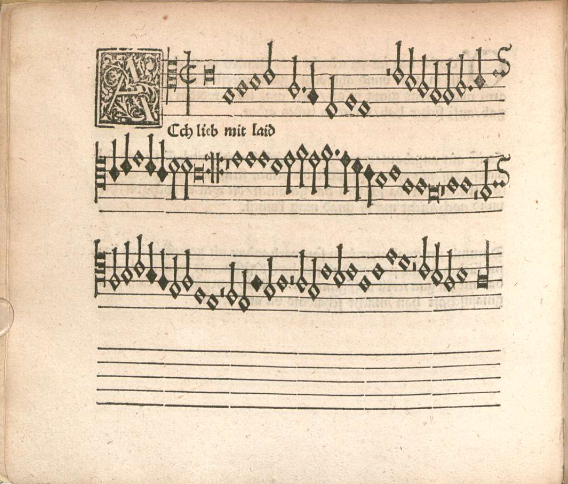
Tenorstimme aus Paul Hofhaimers Liedsatz Ach lieb mit leid im Druck von » Erhart Oeglin Aus sonderer künstlicher art…, Augsburg 19. Juli 1512. (München, Bayerische Staatsbibliothek, Rar. 27, Tenor-Stimmbuch, fol. 9v) Bild-Nr. 192. urn:nbn:de:bvb:12-bsb00082229-7.
“Tenor Song” and Voice Functions
The practice of making a placing a melody, whether actually sung as such or at least perceived as singable, as the structural core of a composition was even more characteristic of Renaissance song in the German-speaking lands than it was elsewhere. Entire families of songs, usually the more distinctive ones, developed from certain models. Since isolated melodies were already referred to by contemporaries as “tenores,” scholarship later coined the term “Tenorlied” for this compositional structure.[31] Initially, this was not without ideological undertones, subtly implying a kind of German tenor-mindedness. According to more recent understanding, however, the tenor orientation of the “Tenorlied genre” is seen as a characteristic way of engaging with musical material in general. Especially when comparing songs that appear in different places across various regions, the limited textual status of the sources becomes apparent. The desire to treat an existing song as a stimulus for further creative engagement often outweighs the intention to create immutable works. The primary aim was to have material available for new arrangements.
When songs clearly circulated in the fifteenth century, they rarely did so as unchanged polyphonic settings. More often, only the principal melody remained relatively stable, while its polyphonic arrangement varied from place to place. The principal melody was typically placed in the tenor voice, which referred both to its structural role in the polyphonic texture and to the natural high male vocal range. This disposition remained the norm in German song longer than in other European traditions. With the spread of the Franco-Flemish style, the upper voice increasingly carried the melody. That other options also existed is illustrated by several cases in the Glogau Songbook (Sagan partbooks, PL-Kj Berol. Mus. ms 40098). The song Ich sachs einsmals, also found in the Innsbruck Leopold Codex, is presented in a three-voice version with the melody in the middle voice. In the Altus partbook, however, the melody appears again separately, in a different mensuration and with halved note values, accompanied by the note “Tenor.” This entry seems to invite the creation of a version with a different distribution of voice functions. Similarly, for the Tenorlied setting of In feuers hitz (which is also set to the Latin text Mole gravati criminum mater), the Sagan source presents the monophonic melody in the Discantus partbook, though notated outside the typical “soprano” range. Yet in the three-part Sagan song Wes mich leydt, the highest voice indeed carries the cantus firmus. This is also its position in the paraphrase found in the Leopold Codex, where it forms the conclusion of a six-part motet set to the text O dulcis Maria. The song also appears in the two “antiquarian” song collections written by Bernhard Rem in Augsburg, though there the Sagan setting is reproduced in full, with only a newly fitted Altus voice brought up to modern standards and attributed to a certain Hans Sygler – presumably the author of the added voice.
Even when the contrapuntal discant-tenor framework remained intact during the transmission of a song, the third voice – the contratenor – was regularly replaced. This, however, was standard practice in the fifteenth century and no different in Italian and French compositions. The procedure can be observed when comparing the Sagan and Schedel versions of In feuers hitz, or the two variants of Mein hertz in staten trewen.
Mein hertz in staten trewen and Ja freylich halt wie pald
The case of Mein hertz in staten trewen is particularly interesting, as this song was entered almost simultaneously – probably toward the end of the 1450s – in the so-called Schedel Songbook and in » I-TRbc 90. A comparison (see » Music example Mein hertz in steten treuen) reveals that there was probably a shared understanding of the song’s melody, whose pitch and rhythmic contour largely coincide in both versions and can be regarded as the principal melody.
Notenbsp. Mein hertz in steten treuen
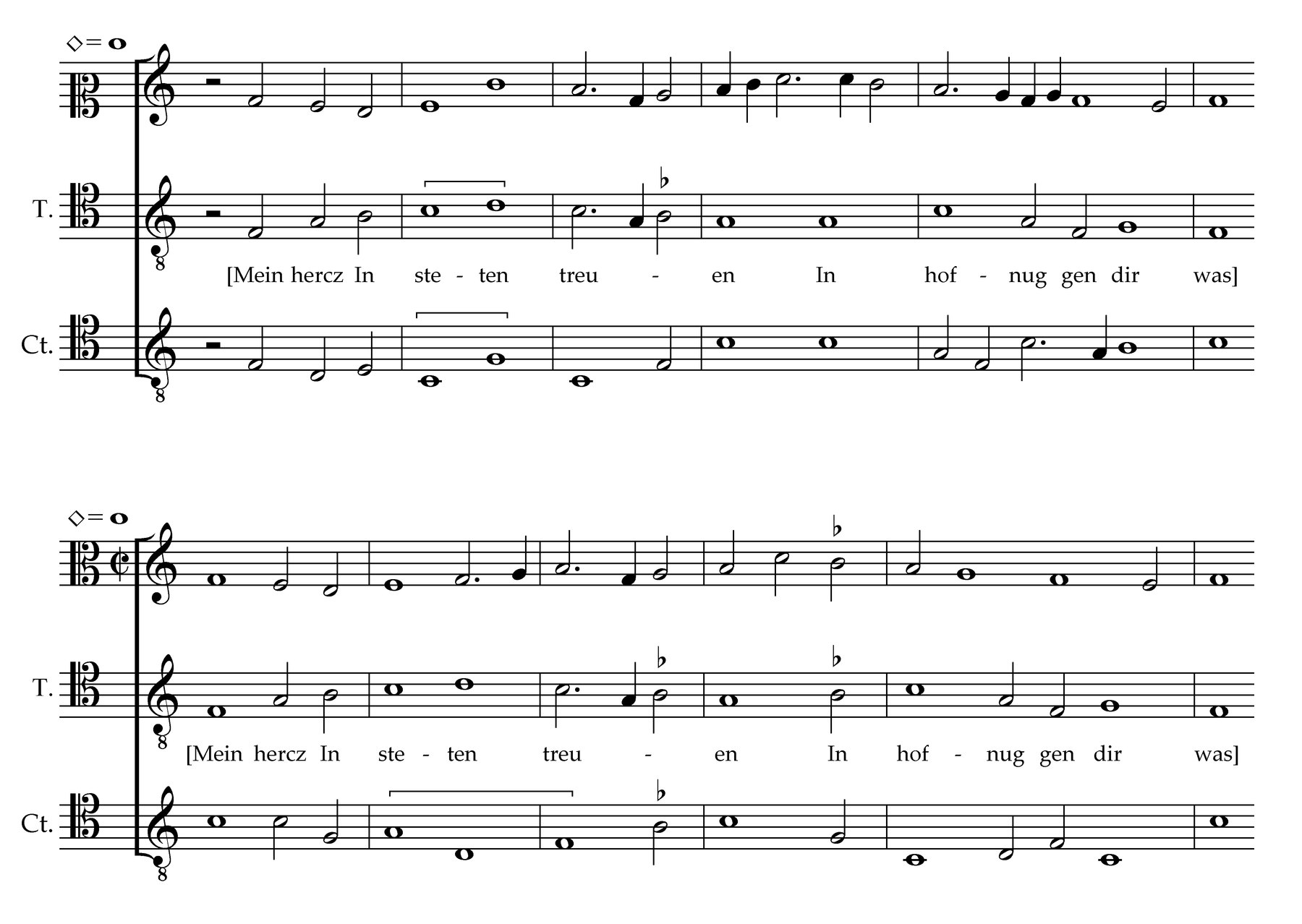
Vergleichende Transkription des Anfangs der in » I-TRbc 90, fol. 294v, und » D-Mbs Cgm 810 (Schedel- Liederbuch), fol. 30v–31r, überlieferten Versionen des Liedsatzes Mein hertz in steten treuen…
The discant as a contrapuntal counter-voice diverges at certain points in its progression, but overall employs essentially the same material in both versions. However, the accompanying contratenor voice differs and was almost certainly newly conceived for each realisation. The contratenor in I-TRbc 90 clearly bears the mark of an originally unwritten invention: the intervals fit the principal melody, which the singer probably had in mind, but with the discant they produce dissonances on the second and third chords – dissonances that were evidently not considered disruptive enough to prevent them from being written down. It would be easy to claim that I-TRbc 90 represents the more archaic version and the Schedel Songbook the more refined one – especially since the Trento source employs older parallel cadences, while the Nuremberg source uses more modern octave-leap cadences. However, this does not align with the fact that the Schedel version is notated in the older brevis-semibrevis metre, whereas the Trento source uses the more current semibrevis-minim rhythm. Thus, there is no linear development toward modernisation, but rather a variety of stylistic approaches.[32]
Even more profound were the alterations made to the song Ja freylich halt wie pald, which survives only with a textual incipit (» Music example Ja freylich halt wie pald).
Notenbsp. Ja freylich halt wie pald
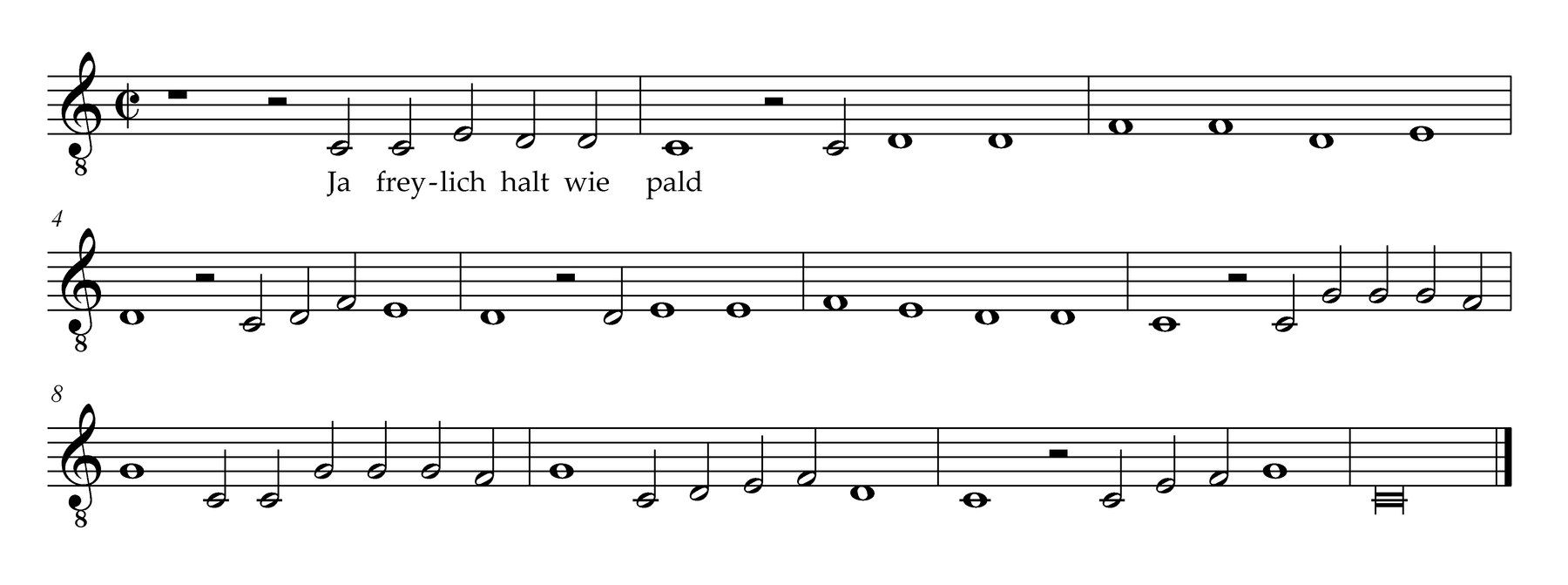
Tiefste Stimme, ohne weiteren Text, eines dreistimmigen Satzes in der Handschrift » I-TRc Ms. 1947-4, Nr. 3.
While the manuscript » I-TRc Ms. 1947-4, probably compiled in Trent before 1500, contains a complete three-part setting of this song, the manuscript D-W, Cod. Guelf. 292, a sole surviving partbook, probably produced in the Lake Constance region in the first quarter of the sixteenth century, preserves only the contratenor voice. Although this contratenor has the same rhythmic and motivic design, and the same line structure as the other lowest voice, it is slightly shorter than the other two voices from I-TRc Ms. 1947-4, and harmonises with them in very few places. The identity of the song remains recognisable, but it must have undergone a thorough permutation. This very song forms the backbone of the Missa carminum, formerly attributed to Isaac, which – though loosely structured and somewhat lacking in coherence – contains several other songs, including the Innsbruck song. The localisation of the surviving sources of the Mass in central Germany[33] once again illustrates the channels through which exchange occurred between the southern regions of the Empire and the circle surrounding Elector Frederick the Wise.
Variability of Songs in Form and Function
The multifunctionality of songs is based on the way they can guarantee something like a core substance, which is nourished by a text, a melody, a musical setting, in variable proportions. Each of these components can be dispensed with, each can be replaced, and every combination of individual elements can be further enriched. Songs function in the fifteenth and sixteenth centuries like a modular system.
In an intensified form, this applies to the delight in combination. Though not a “nationally typical” phenomenon, this finds a unique realisation in German songs. From a technical perspective, the creation of musical constructs highlights the craft or intellectual incentive of bringing together diverse elements. When they are performed, attention is on the recognition of what has been linked and the resulting emotional or intellectual added value. This increase in meaning can be humorous, atmospheric, or even exegetical in nature. Amusing or surprising effects arise from the quodlibet-like compilation of song openings or lines, which, after several instances in the Sagan partbooks, reached a peak in Schmelzl’s printed collection » Guter seltzamer und kunstreicher teutscher Gesang. It surely found delighted recipients in many places and can be reconstructed as a form of entertainment at the Scots’ Monastery in Vienna. The German song masses, which are particularly notable for not only quoting monophonic cantus firmi but often extracting entire polyphonic passages from songs and implanting them into the mass setting, clearly rely on the (conscious or unconscious) hearing of familiar sound passages.[34] A secondary message was added to the Tannhäuser song in the Leopold Codex (» Audio example ♫ Tannhauser): the theme of the three-part setting with the song melody in the tenor the story of Tannhäuser, who longs for redemption from the spell of Lady Venus. A hundred pages later, the song is placed in the bass of a four-part composition and united with a message of salvation in the form of the Pentecost hymn Veni creator spiritus, thereby anticipating the comforting end of the story.[35] The effectiveness of the “woven-in” (song) messages was apparently taken for granted. In 1488, the nobility and imperial cities, having just formed the Swabian League, passed measures intended to serve the spiritual welfare of the population. These included the provision “dasz ouch in allen stetten in den pfarr-kirchen und klöstern allwegen uff St. Jergen tag ain amt in der von der hailigen dreyfaltigkeit der Junfrowen Mariae und des lieben ritters St. Jergen um sig und gnad gesungen werd … so lang disz buntnusz weren wirdet” (that in all towns, in the parish churches and monasteries, a mass shall always be sung on St George’s Day in honour of the Holy Trinity, the Virgin Mary, and the beloved knight St George, for victory and grace … for as long as this alliance shall last).[36]
Victory and grace (Middle High German “sälde”) appear in the Missa Sig säld und heil,[37] which incorporates a song that Schedel included in his collection under the lemma “Von osterreich” (» Audio exmaple ♫ Sig, säld und hail and » Audio example ♫ Sig, säld und hail (Contratenor melior)).
Isaac’s Canonic Doubling
Both intentions – the artistic and the interpretative – are closely intertwined in Isaac’s work. In some of his four-voice songs, the song melody is set in canon (or quasi-canon) in the tenor and bassus. Isaac’s pupil Senfl would followed in his footsteps on several occasions. (When such a melody is kept short and concise and is set to terse texts drawn from everyday life, it is typically described in the literature as “folksy”.) The small corpus of songs of this kind attributable to Isaac is flanked by anonymous five-part pieces in the Leopold Codex: Der baur in dem grauen rock or Es wollt ein maidlein nach grase gan. The latter appears as a preliminary study for Isaac’s comparable song Dich muter gotes rüff wir an, first transmitted in the Swiss source » CH-Bu F X 5–9 (no later than 1510) and then in Öglin’s 1512 printed songbook (» Aus sonderer künstlicher Art) in the by-then standardised four-part setting. There was certainly a compositional incentive to realise even more sophisticated settings for the tenor song type newly practised since Heya, heya. In those, the individual lines of the song melody sounding in the tenor were preceded by imitative passages or even thematically anticipated. Comparable cases from the Leopold Codex include Ich sachs einsmals den lichten morgensterne and So steh ich hie auf dieser erd (» Audio example ♫ Ich sachs einsmals, » Audio example ♫ So steh ich hie). But now the song melody appears in canonic duplication. What may seem like an artificial contrast in a song with a crude text, such as that of the peasant in the grey smock, can go further in songs dealing with love and allude to interpretative depth. In the erotic pastourelle that describes a girl gathering hay and her friend Peter, the two-in-one analogy between musical canon and the lovers in the text may still amuse in a banal way. In the contrafactum Dich muter gotes rüff wir an, which opens Öglin’s songbook (surely not without Isaac’s knowledge), the quasi-canonic construction with a central switch between leading and following voice functions as a cipher for the believer’s invocation of Mary and the hope that she will reciprocate her love.[38]
Contents of Song Texts for Court and City
The songs of this period prove to be flexible both in terms of their musical design and their texts. This made them suitable for widespread cultivation across various social spaces. Otherwise, it would be hardly conceivable that contrafacta would hold such a prominent place in the (especially early) song repertoire, since they sometimes, as in the case of Dich muter gotes rüff wir an (» Ch. Isaac’s Canonic Doubling), underwent a radical shift in meaning. Nor could the sociocultural migration of these songs be easily understood. Even songs with clearly courtly themes were readily received in monastic life and urban bourgeois settings, and if necessary, interpreted metaphorically. For example, love songs whose texts include pledges of fidelity and laments of parting reflect the typical sentiment of a courtly society constantly on the move, where the sexes only met episodically. Such courtly songs do not always precisely match the experience of the bourgeois world, but they convey a general atmosphere. A similar case is the traditional Minnesang motif of the Tagelied, in which lovers part at dawn, an experience that would have been impossible in a city with strict controls. Some content that was specific to life at court, such as the complaints about the dangers of envy, which could also be interpreted in a more political sense. Such songs aimed to be more specific than simply moralising about the wickedness of the world. Sources for these songs from bourgeois contexts often transmit them with no text at all, or with a substitute text. Senfl’s resolute song Poch trutzen grausam sehen ist jetzt der lauf (“To assert one’s claims with force, to be hostile, to glare threateningly – this is now the custom”), which ventriloquises a courtier arming himself against intrigue, is fittingly found in the courtly song manuscript » D-Mbs Mus. ms. 3155. A few years later, in the Basel partbook » CH-Bu F X 1–4, the text is missing (as is often the case). The motto of the Basel printing office of Johann Bergmann von Olpe, “Nichts ohn Ursach” (“Nothing without cause”), which is both profound and general, functions as a textual placeholder. This replacement title is also rich in allusion, for this printer’s device was also found in Sebastian Brant’s famous Narrenschiff, although that source castigates human vices in general and not just those at court.
The connection between song texts and courtly ways of life led contemporaries to occasionally refer to songs as “courtly airs”. This term was adopted in twentieth-century scholarly literature to categorise songs that present themselves as ambitious in their choice of words, development of ideas and metre. Composers typically set such texts to music by paying closer attention to the linguistic character in the newly invented tenor voices and in the musical setting than was the case with song types that modern literature contrasts under the label “folk song”[39] (Cf. » B. Volkslieder?).
Kain höhers lebt and O edle frucht
Some songs refer explicitly to rulership. The Munich manuscript » D-Mbs Mus. ms. 3155, compiled not long after the death of Maximilian I, opens with a song by Ludwig Senfl that clearly addresses a panegyric address to Maximilian as Emperor of the Holy Roman Empire, represented by his heraldic animal (» Music example Kain höhers lebt). The first stanza reads:
Kain höhers lebt, noch schwebt,
dem Adler yetz auf erden gleich.
Jn aller welt hochgemellt,
vber das heilig Römisch reich.
Die flug außprait, hellt frid vnd Klaid,
den Jungen sein, mit grechtem schein,
groß miltigkait wilpanen vnd Glaid,
Zu Zaigen schon,
seiner edlen Kayserlichen Kron.
(Nothing higher on the earth lives or rises now above the Holy Roman Empire than the eagle, which is held in high esteem throughout the world. He spreads his wings, preserves peace for his children, and grants protection. In doing so, he demonstrates his great generosity to his followers with charters concerning game preserves and hunting grounds in his magnificent imperial crown lands.)[40]The final line of the fourth stanza quotes Maximilian’s motto: “halltu mas in allen dinngen” (“Tene mensuram” – Keep measure in all things).
Notenbsp. Kain höhers lebt
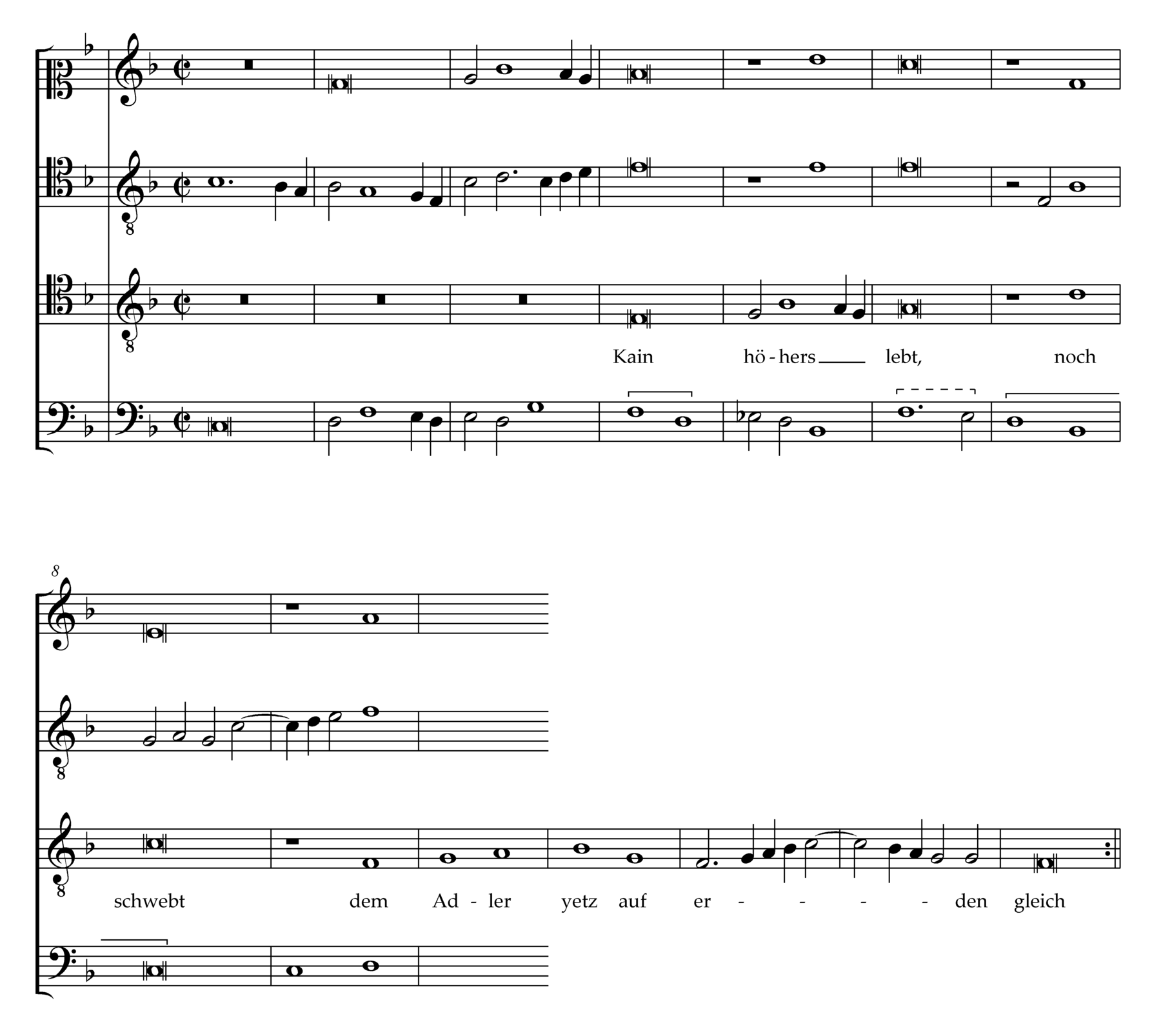
Ludwig Senfls Vertonung des Gedichts Kain höhers lebt auf Kaiser Maximilian I. und den Adler als sein Wappentier. Transkription nach » D-Mbs Mus. ms. 3155, fol. 1v–2r. Text: Siegmund von Dietrichstein (1484–1533) (?). » K. Senfls Vermächtnis, Kap. Hypothesen zum geplanten Projekt.
A very different tone was struck sixty years earlier by a poem whose opening is quoted in the three-part song noted in » I-TRbc 88, fol. 106r, under the text marker O edle frucht and the contrafactum text Martinus Abrahe sinu.[41] O edle frucht is a love song that pays homage to a figure who may be a metaphorical, or perhaps even a real, empress. The beginning of the second stanza addresses her directly:
Gantz ewencklichen in steter trew
Mein kayserin, beger jch dein.
Ich naig mich fur dich vff die knie,
Lauz uz meins hertzen senende pein!
(For all eternity I desire you, my empress, in everlasting loyalty. I bow before you on my knees, quenching the longing of my heart!)And in contrast to the more common comparison in songs of the beloved to an empress, the lover reveals himself in the third stanza:
Wann du mir büethst ain fruntlich wort
Dar fur ich lieb nit kayser wer.
(If you granted me a kind word, I would gladly give up my imperial status for it.)Unlike the melody of Senfl’s song, whose phrasing is already designed to integrate organically into the polyphonic texture, this song declaims its expressively constructed, emphatically expansive tenor in such a way that one can easily imagine it being performed monophonically, possibly with moderate accompaniment (» Notation example O edle frucht).
Notenbsp. O edle frucht
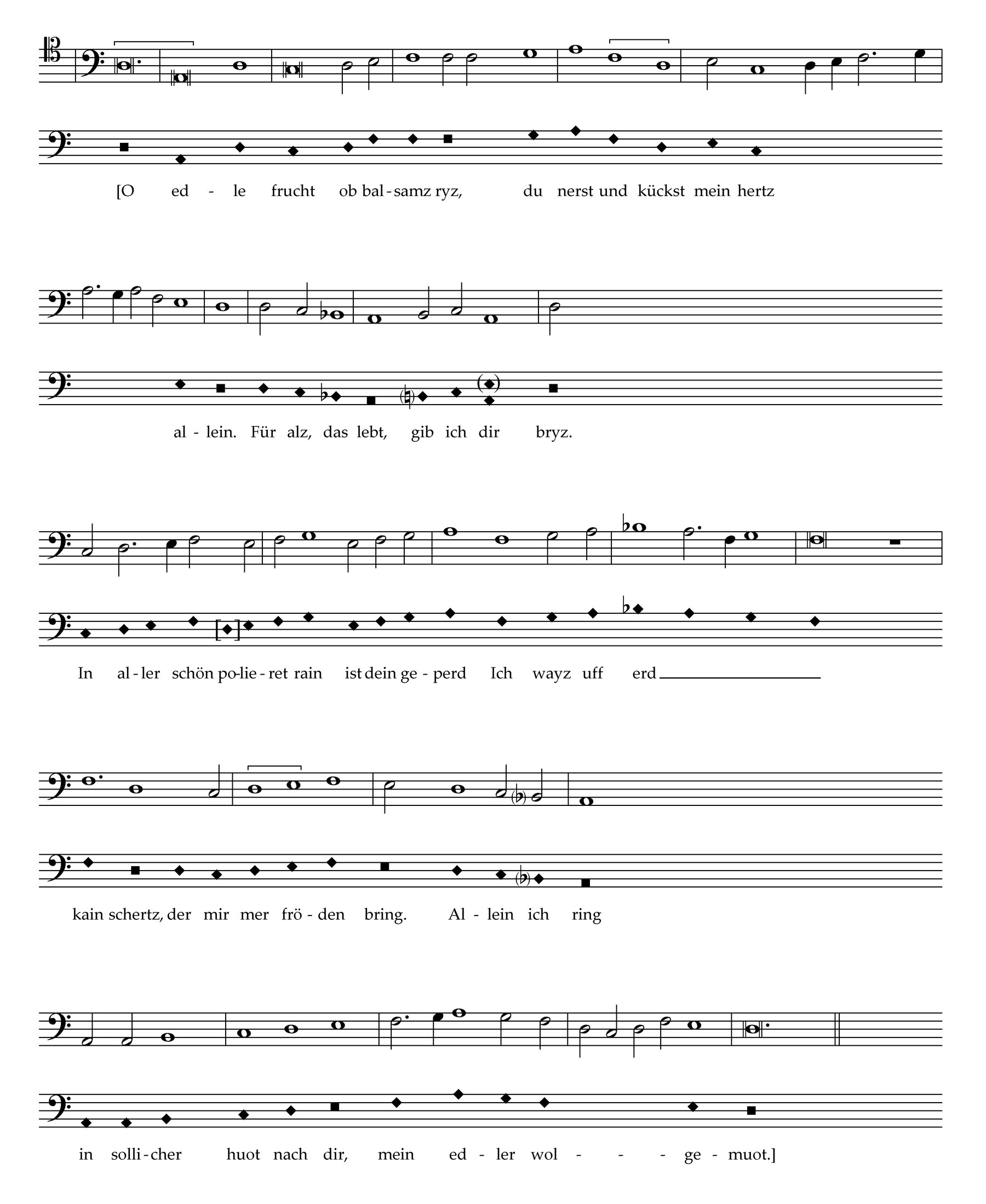
Nach einem dreistimmigen Liedsatz (um 1456–1460) in » I-TRbc 88, fol. 106r, mit der Textmarke O edle frucht und dem Kontrafakturtext Martinus Abrahae sinu laetus. Oberes System: Tenor des polyphonen Satzes; unteres System: rekonstruierte einstimmige Liedmelodie.
Admittedly, the evidence for a connection between O edle frucht and the imperial-courtly sphere is weak, especially since so little is known about Emperor Frederick III’s private musical practice. Yet it is a tempting thought to assume that the song notation from the late 1450s might be related to his 1452 marriage to Eleanor of Portugal. He need not have sung the song to her himself – there was a singer at court for that – but he made himself the medium of an updated form of “cultural action in conventionalised circumstances”,[42] the continual circling around the theme of love. Be that as it may: the comparison of the two songs illustrates the distance travelled by the courtly German tenor song in the Austrian region between 1450 and 1520, from the multi-voiced encasement of a weighty melody to a polyphonic conception.
[1] For example, So lanc so meer as So lang si mir (in I-TRbc 90, fol. 344v) or Een vraulic wesen as Ein frölich wesenn (in the songbook of Johannes Heer, CH-SGs Ms. 462, fol. 28v–30r).
[2] Binchois’ Dueil angoisseux becomes De langwesus in I-TRbc 88, fol. 204v, De langwesus; of the frottola line “Tente a l’ora, ruzinente, ch’io vo’ cantar” only “Dentelore” remains in the manuscript CH-Bu F X 1–4 (fol. 97), written by the Augsburg scribe Johann Wüst; a quodlibet from the Sagan partbooks (No. 118) quotes the songs Rabaßkadol and Panny, pany, baby (“Woman, woman, old woman”).
[4] These are RISM numbers 1512/1, 1513/2, [1513]/3, [1513]/3 (published in Mainz in 1517), and 1519]/5 (a woodcut reprint of a lost songbook originally published around 1510 in Augsburg, printed 1514/1515, see Schwindt 2008).
[5] On all three manuscripts, see Strohm 1993, 492–503.
[8] According to Strohm 1993, 519, and Strohm 2001, 23, the manuscript was originally in the possession of the choir school of St. Jakob, Innsbruck, whose members were employed for musical service at court. See also » G. Nicolaus Krombsdorfer.
[10] I-TRbc 89, fol. 388v–389r; I-Fn, B.R. 229, fol. 174v–175r; » Guter seltzamer und kunstreicher teutscher Gesangk; Nürnberg 1544, Nr. 8: “Heyaho nun wie sie grollen dort auff dem Ritten die geschwollen” in the Secunda pars, T. 76–85; textual reference at the beginning, bars 1–13: “Woll wir aber heben an den Danhauser zu singen” (DTÖ 147/148, 63 and 69 f.).
[11] Bienenfeld 1904/1905, 96, note 2.
[12] CH-Zz, Ms. G 438 (written c. 1524); Pfisterer 2013.
[13] A-Wn Mus.Hs. 18810 (c. 1524) and D-Mu, 8°Cod. ms. 328–331 (before 1527), also known as the “Welser Songbook”.
[14] Also known as the “Herwart” or “Augsburg Songbook”.
[15] Birkendorf 1994, vol. 1, 98.
[16] Schwindt 2013, 126–130.
[17] D-W, Cod. Guelf. 78.Quodl.4 (Southern Germany c. 1505); D-Mbs Mus. ms. 4483 (Southern Germany c. 1515); A-Wn Cod. 4337 (Vienna, early 1520s); D-W Cod. Guelf. 292 Musica hdschr. (Constance?, c. 1525).
[18] CH-Bu F X 10 (1510); CH-Bu F X 5–9 (Fascicle I: c. 1510); CH-Bu F X 1–4 (Fascicle I: c. 1517/1518, Fascicle II: c. 1524); CH-Bu F VI 26 (first quarter of the sixteenth century); CH-SGs Ms. 462 (1510–1516, 1530), also known as the “Heer Songbook”.
[19] See above note 4.
[20] RISM 1534/17: » Der erst teil. Hundert vnd ainundzweintzig newe Lieder…, hrsg. von Johann Ott, Nürnberg 1534.
[21] Sterl 1971, 24. Grünwald/Gruenwolt is documented as Persefant (under-herald) in Regensburg from 1483–1487.
[22] Grosch 2013, 48–54.
[23] A-Wn Cod. 3027 (Passau c. 1492–1494), fol. 174v–177r: “Von yppliklichen dingen”. Score reproduction in Curschmann 1970, 22 f.
[24] Quodlibet No. XX quotes the couplet “Da schalt sie jhn ein trollen, ein truncken vnd ein vollen” from the middle of the third Hesselloher stanza (Secunda pars, bars 133–137, rhythm corresponds to the song model, diastematic contour slightly modified, see DTÖ 147/148, 132).
[25] A-Whh RR V (1489-1492): Wien, Haus-, Hof- und Staatsarchiv, Reichsregister vol. V (1489–1492), fol. 60r.
[26] “Die situationsbasierten Thematisierungsverfahren lassen die Liebe vor allem als kulturelles Handeln in konventionalisierten Umständen erscheinen” (The situation-based methods of thematisation present love primarily as cultural action in conventionalised circumstances): Hübner 2013, 107.
[27] The earliest available source for the polyphonic Elslein song is the Sagan partbooks (PL-Kj Berol. Mus.ms. 40098). There is indeed an earlier transmission from around 1455 in the form of a monophonic melody, but with a Latin text Gaudeamus pariter (CZ-Pnm Vysehrad 376, fol. 39v; digitised in the database Melodiarum hymnologicum Bohemiae: http://tinyurl.com/gaudeamuspariter). It is very likely – or at least possible – that this is a sacred contrafactum of the secular monophonic Elslein song, though this cannot yet be documented.
[28] The earliest sources for this popular song are a broadside print of the text by Albert Kunne (Memmingen, c. 1501, see http://tinyurl.com/Ich-stund-Kunne, metadata at http://tinyurl.com/Kunne-meta) uand a freely paraphrased adaptation of melodic elements under the text marker in the tenor “Ich stund an einem Morgen”, entered around 1499/1500 on fols. 221v–222r in the Berlin mensural codex D-B Mus. ms. 40021. Both suggest a widely known song melody, although no earlier written version is currently documented.
[29] D-B Ms. germ. oct. 280, fol. 48b–49b (Nr. 33): Ich sien den morgenssterren.
[30] Bayerisches Hauptstaatsarchiv München, Geheimes Hausarchiv, 601, XXVI, letter from Duke Philipp to his father Wilhelm V dated 13.10.1593.
[31] On the history of the term, see Grosch 2013, 23–33. See also » B. Minnesang und alte Meister on the terminological tradition of “tenores”, which was initially not associated with polyphony.
[32] Complete transcription of both songs and further remarks in Strohm 1993, 496–499.
[34] Strohm 1989; Leverett 1995; Höink 2012. The overview should also include the Missa Ducis Saxsoniae Sing ich nit wol composed by Nicolas Champion dit Liegeois, whose song basis is already recorded before the South German manuscript D-WGl Lutherhalle Ms. 403/1048 (c. 1535/1536) in Bernhard Rem’s partbook setting D-Mu, 8°Cod. ms. 328–331 (before 1527).
[35] D-Mbs Mus. ms. 3154, fol. 53v: Tannhauser Ihr seid mir lieb (3v), fol. 151r: Veni creator spiritus, and Thanhauser jr seit mir lieb. Heidrich 2005, 54 ff.
[36] Klüpfel; Karl (ed.): Urkunden zur Geschichte des Schwäbischen Bundes (1488–1533), vol. 1, Stuttgart 1846, 24.
[37] On authorship, see Leverett 1995; on the musical style in the context of Frederick III, see Schmalz 1987; on the title, see Strohm 1989.
[38] Schwindt 2006, 51–56.
[40] See Schwindt 2013, 127 and 133.
[41] Edited in Adler/Koller 1900, 269. Further details on this song and its text in Schwindt 1999, 58–62.
[42] Hübner 2013, 107.
Recommended citation:
Nicole Schwindt: “Songs in the Austrian Region, c. 1450-c.1520”, in: Musical Life of the Late Middle Ages in the Austrian Region <https://musical-life.net/en/essays/songs-austrian-region-c-1450-c-1520> (2026); slightly revised AI-assisted translation of the original German essay (2016).