Mein hertz in staten trewen and Ja freylich halt wie pald
The case of Mein hertz in staten trewen is particularly interesting, as this song was entered almost simultaneously – probably toward the end of the 1450s – in the so-called Schedel Songbook and in » I-TRbc 90. A comparison (see » Music example Mein hertz in steten treuen) reveals that there was probably a shared understanding of the song’s melody, whose pitch and rhythmic contour largely coincide in both versions and can be regarded as the principal melody.
Notenbsp. Mein hertz in steten treuen
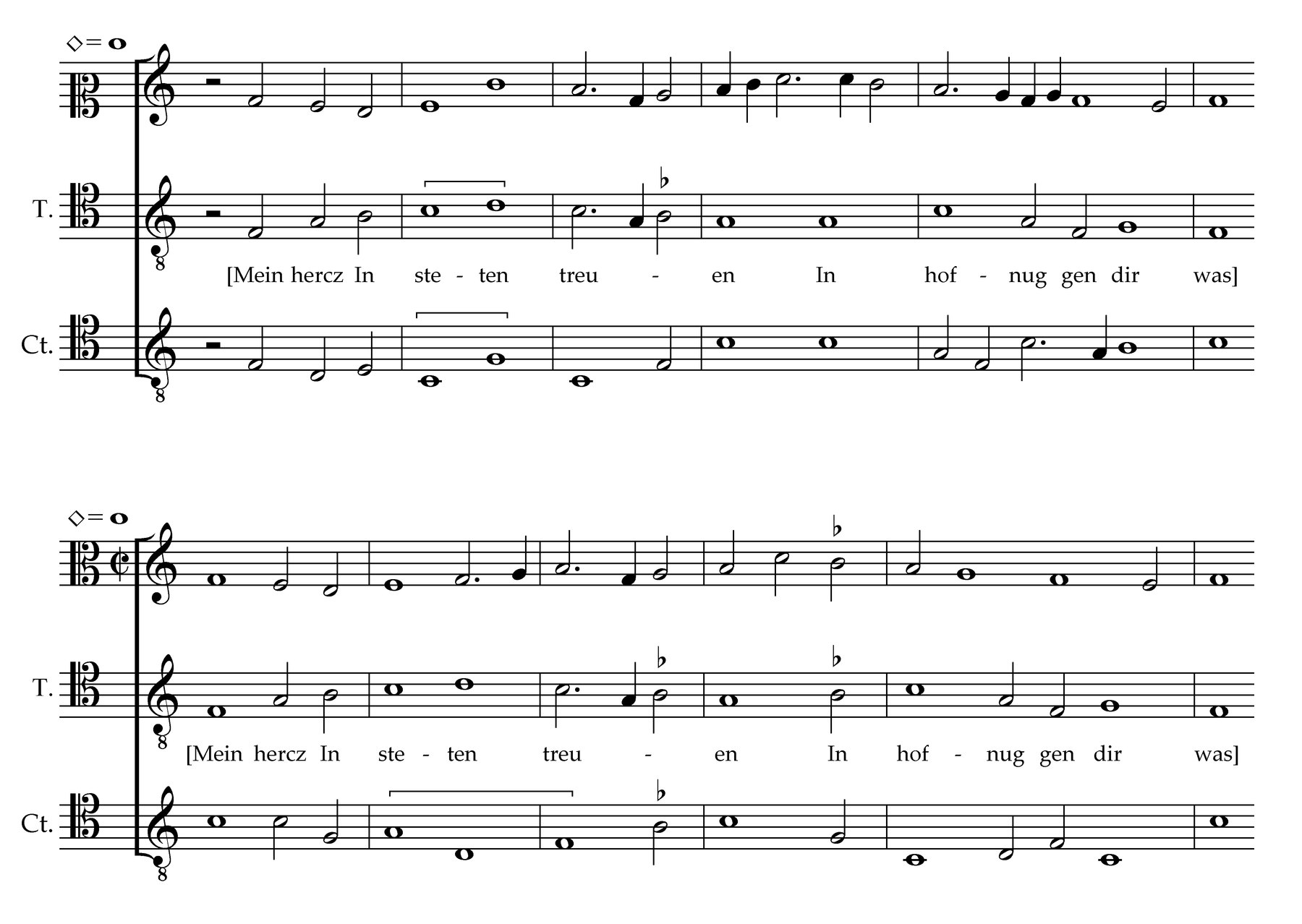
Vergleichende Transkription des Anfangs der in » I-TRbc 90, fol. 294v, und » D-Mbs Cgm 810 (Schedel- Liederbuch), fol. 30v–31r, überlieferten Versionen des Liedsatzes Mein hertz in steten treuen…
The discant as a contrapuntal counter-voice diverges at certain points in its progression, but overall employs essentially the same material in both versions. However, the accompanying contratenor voice differs and was almost certainly newly conceived for each realisation. The contratenor in I-TRbc 90 clearly bears the mark of an originally unwritten invention: the intervals fit the principal melody, which the singer probably had in mind, but with the discant they produce dissonances on the second and third chords – dissonances that were evidently not considered disruptive enough to prevent them from being written down. It would be easy to claim that I-TRbc 90 represents the more archaic version and the Schedel Songbook the more refined one – especially since the Trento source employs older parallel cadences, while the Nuremberg source uses more modern octave-leap cadences. However, this does not align with the fact that the Schedel version is notated in the older brevis-semibrevis metre, whereas the Trento source uses the more current semibrevis-minim rhythm. Thus, there is no linear development toward modernisation, but rather a variety of stylistic approaches.[32]
Even more profound were the alterations made to the song Ja freylich halt wie pald, which survives only with a textual incipit (» Music example Ja freylich halt wie pald).
Notenbsp. Ja freylich halt wie pald
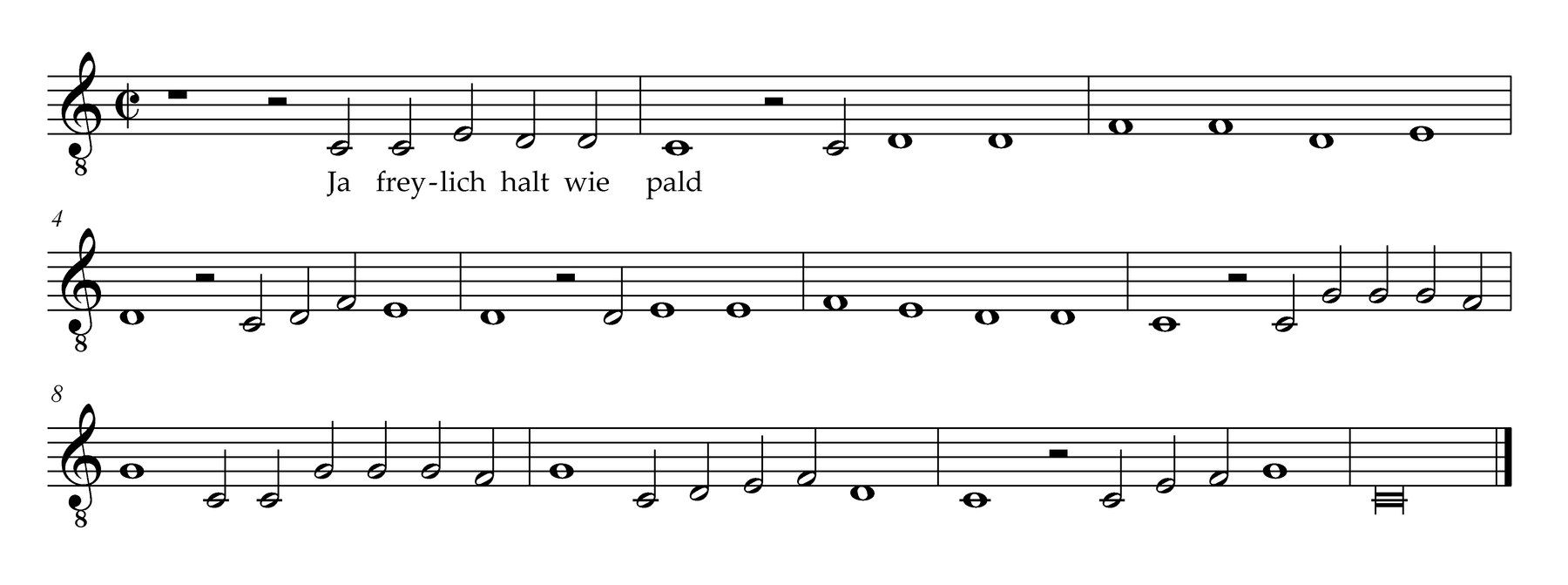
Tiefste Stimme, ohne weiteren Text, eines dreistimmigen Satzes in der Handschrift » I-TRc Ms. 1947-4, Nr. 3.
While the manuscript » I-TRc Ms. 1947-4, probably compiled in Trent before 1500, contains a complete three-part setting of this song, the manuscript D-W, Cod. Guelf. 292, a sole surviving partbook, probably produced in the Lake Constance region in the first quarter of the sixteenth century, preserves only the contratenor voice. Although this contratenor has the same rhythmic and motivic design, and the same line structure as the other lowest voice, it is slightly shorter than the other two voices from I-TRc Ms. 1947-4, and harmonises with them in very few places. The identity of the song remains recognisable, but it must have undergone a thorough permutation. This very song forms the backbone of the Missa carminum, formerly attributed to Isaac, which – though loosely structured and somewhat lacking in coherence – contains several other songs, including the Innsbruck song. The localisation of the surviving sources of the Mass in central Germany[33] once again illustrates the channels through which exchange occurred between the southern regions of the Empire and the circle surrounding Elector Frederick the Wise.
[32] Complete transcription of both songs and further remarks in Strohm 1993, 496–499.
[1] For example, So lanc so meer as So lang si mir (in I-TRbc 90, fol. 344v) or Een vraulic wesen as Ein frölich wesenn (in the songbook of Johannes Heer, CH-SGs Ms. 462, fol. 28v–30r).
[2] Binchois’ Dueil angoisseux becomes De langwesus in I-TRbc 88, fol. 204v, De langwesus; of the frottola line “Tente a l’ora, ruzinente, ch’io vo’ cantar” only “Dentelore” remains in the manuscript CH-Bu F X 1–4 (fol. 97), written by the Augsburg scribe Johann Wüst; a quodlibet from the Sagan partbooks (No. 118) quotes the songs Rabaßkadol and Panny, pany, baby (“Woman, woman, old woman”).
[4] These are RISM numbers 1512/1, 1513/2, [1513]/3, [1513]/3 (published in Mainz in 1517), and 1519]/5 (a woodcut reprint of a lost songbook originally published around 1510 in Augsburg, printed 1514/1515, see Schwindt 2008).
[5] On all three manuscripts, see Strohm 1993, 492–503.
[8] According to Strohm 1993, 519, and Strohm 2001, 23, the manuscript was originally in the possession of the choir school of St. Jakob, Innsbruck, whose members were employed for musical service at court. See also » G. Nicolaus Krombsdorfer.
[10] I-TRbc 89, fol. 388v–389r; I-Fn, B.R. 229, fol. 174v–175r; » Guter seltzamer und kunstreicher teutscher Gesangk; Nürnberg 1544, Nr. 8: “Heyaho nun wie sie grollen dort auff dem Ritten die geschwollen” in the Secunda pars, T. 76–85; textual reference at the beginning, bars 1–13: “Woll wir aber heben an den Danhauser zu singen” (DTÖ 147/148, 63 and 69 f.).
[11] Bienenfeld 1904/1905, 96, note 2.
[12] CH-Zz, Ms. G 438 (written c. 1524); Pfisterer 2013.
[13] A-Wn Mus.Hs. 18810 (c. 1524) and D-Mu, 8°Cod. ms. 328–331 (before 1527), also known as the “Welser Songbook”.
[14] Also known as the “Herwart” or “Augsburg Songbook”.
[15] Birkendorf 1994, vol. 1, 98.
[16] Schwindt 2013, 126–130.
[17] D-W, Cod. Guelf. 78.Quodl.4 (Southern Germany c. 1505); D-Mbs Mus. ms. 4483 (Southern Germany c. 1515); A-Wn Cod. 4337 (Vienna, early 1520s); D-W Cod. Guelf. 292 Musica hdschr. (Constance?, c. 1525).
[18] CH-Bu F X 10 (1510); CH-Bu F X 5–9 (Fascicle I: c. 1510); CH-Bu F X 1–4 (Fascicle I: c. 1517/1518, Fascicle II: c. 1524); CH-Bu F VI 26 (first quarter of the sixteenth century); CH-SGs Ms. 462 (1510–1516, 1530), also known as the “Heer Songbook”.
[19] See above note 4.
[20] RISM 1534/17: » Der erst teil. Hundert vnd ainundzweintzig newe Lieder…, hrsg. von Johann Ott, Nürnberg 1534.
[21] Sterl 1971, 24. Grünwald/Gruenwolt is documented as Persefant (under-herald) in Regensburg from 1483–1487.
[22] Grosch 2013, 48–54.
[23] A-Wn Cod. 3027 (Passau c. 1492–1494), fol. 174v–177r: “Von yppliklichen dingen”. Score reproduction in Curschmann 1970, 22 f.
[24] Quodlibet No. XX quotes the couplet “Da schalt sie jhn ein trollen, ein truncken vnd ein vollen” from the middle of the third Hesselloher stanza (Secunda pars, bars 133–137, rhythm corresponds to the song model, diastematic contour slightly modified, see DTÖ 147/148, 132).
[25] A-Whh RR V (1489-1492): Wien, Haus-, Hof- und Staatsarchiv, Reichsregister vol. V (1489–1492), fol. 60r.
[26] “Die situationsbasierten Thematisierungsverfahren lassen die Liebe vor allem als kulturelles Handeln in konventionalisierten Umständen erscheinen” (The situation-based methods of thematisation present love primarily as cultural action in conventionalised circumstances): Hübner 2013, 107.
[27] The earliest available source for the polyphonic Elslein song is the Sagan partbooks (PL-Kj Berol. Mus.ms. 40098). There is indeed an earlier transmission from around 1455 in the form of a monophonic melody, but with a Latin text Gaudeamus pariter (CZ-Pnm Vysehrad 376, fol. 39v; digitised in the database Melodiarum hymnologicum Bohemiae: http://tinyurl.com/gaudeamuspariter). It is very likely – or at least possible – that this is a sacred contrafactum of the secular monophonic Elslein song, though this cannot yet be documented.
[28] The earliest sources for this popular song are a broadside print of the text by Albert Kunne (Memmingen, c. 1501, see http://tinyurl.com/Ich-stund-Kunne, metadata at http://tinyurl.com/Kunne-meta) uand a freely paraphrased adaptation of melodic elements under the text marker in the tenor “Ich stund an einem Morgen”, entered around 1499/1500 on fols. 221v–222r in the Berlin mensural codex D-B Mus. ms. 40021. Both suggest a widely known song melody, although no earlier written version is currently documented.
[29] D-B Ms. germ. oct. 280, fol. 48b–49b (Nr. 33): Ich sien den morgenssterren.
[30] Bayerisches Hauptstaatsarchiv München, Geheimes Hausarchiv, 601, XXVI, letter from Duke Philipp to his father Wilhelm V dated 13.10.1593.
[31] On the history of the term, see Grosch 2013, 23–33. See also » B. Minnesang und alte Meister on the terminological tradition of “tenores”, which was initially not associated with polyphony.
[32] Complete transcription of both songs and further remarks in Strohm 1993, 496–499.
[34] Strohm 1989; Leverett 1995; Höink 2012. The overview should also include the Missa Ducis Saxsoniae Sing ich nit wol composed by Nicolas Champion dit Liegeois, whose song basis is already recorded before the South German manuscript D-WGl Lutherhalle Ms. 403/1048 (c. 1535/1536) in Bernhard Rem’s partbook setting D-Mu, 8°Cod. ms. 328–331 (before 1527).
[35] D-Mbs Mus. ms. 3154, fol. 53v: Tannhauser Ihr seid mir lieb (3v), fol. 151r: Veni creator spiritus, and Thanhauser jr seit mir lieb. Heidrich 2005, 54 ff.
[36] Klüpfel; Karl (ed.): Urkunden zur Geschichte des Schwäbischen Bundes (1488–1533), vol. 1, Stuttgart 1846, 24.
[37] On authorship, see Leverett 1995; on the musical style in the context of Frederick III, see Schmalz 1987; on the title, see Strohm 1989.
[38] Schwindt 2006, 51–56.
[40] See Schwindt 2013, 127 and 133.
[41] Edited in Adler/Koller 1900, 269. Further details on this song and its text in Schwindt 1999, 58–62.
[42] Hübner 2013, 107.
Recommended citation:
Nicole Schwindt: “Songs in the Austrian Region, c. 1450-c.1520”, in: Musical Life of the Late Middle Ages in the Austrian Region <https://musical-life.net/en/essays/songs-austrian-region-c-1450-c-1520> (2026); slightly revised AI-assisted translation of the original German essay (2016).