On the Internal Geography of Song Cultivation
As far as we can tell from the current state of sources, there were no stable centres of song culture in the Austrian region, except - as far as we can tell from the present state of sources - at times in particular cities, notably Augsburg and Innsbruck. The historic Austrian hereditary lands, that is, the areas of Upper and Lower Austria, Styria, Carinthia and Carniola (now a large part of modern Slovenia) were only partially involved in the development of German song. We have little concrete evidence of a polyphonic song culture in the residences favoured by Frederick III, Wiener Neustadt and Graz. The cultural significance of Vienna rested primarily on the intellectual life of the university, whose role in the cultivation of song remains little researched (» B. Das Phänomen „Neidhart“). At Vienna, visited only occasionally by Frederick III and his son Maximilian I, there were evidently fewer of the kinds of interactions between the court and a broader courtly-patrician class that might have led to a lively cultivation of song. Signs of a culture of polyphonic song at Vienna emerge only in the early sixteenth century, when the administration of the Upper Austrian lands was moved there from Linz. By this time, the city had been elevated to an episcopal seat, and in this context, the institution of the ecclesiastical chapel was repeatedly stationed in Vienna and active at St Stephen’s. At the intersection of these developments stands the figure of Wolfgang Grefinger. He enrolled at the university in 1492, and moved in the humanist circle around Conrad Celtis and Joachim Vadianus. He composed settings for Latin odes (» I. Humanisten), and had his own settings of Prudentius printed in Vienna. He was also associated with the young Ludwig Senfl (» G. Ludwig Senfl). Grefinger, a former pupil and friend of Maximilian’s court organist Paul Hofhaimer (» I. Hofhaimer), also served as organist at St Stephen’s Cathedral. He primarily left behind songs, which, tellingly, are preserved in sources from Augsburg, probably taken there by members of the chapel.
Further west, the conditions for the production, reception, and preservation of songs were more favourable. The ecclesiastical principality of Trent, where a South-German dialect was spoken alongside Italian, developed an active musical life in the third quarter of the fifteenth century under its bishop Johannes Hinderbach, who had been educated at the University of Vienna. In the musical life of Trent, songs were by no means foreign. Swiss cities also emerged as hubs for the circulation of song repertoire. The so-called Buxheim Organ Book (» D-Mbs Mus. ms. 3725), which may have originated in St Gallen before 1470 and was based on merchant connections to Nuremberg, contains numerous song settings.[3] The singing and collecting of songs was in no way hindered by the gradual detachment of the Swiss Confederation from the Empire. On the contrary, beginning in the commercial, episcopal, university and humanist city of Basel, song corpora with interregional connections became increasingly dense, particularly after 1500. (» Fig. Basel 1493)
Abb. Basel 1493
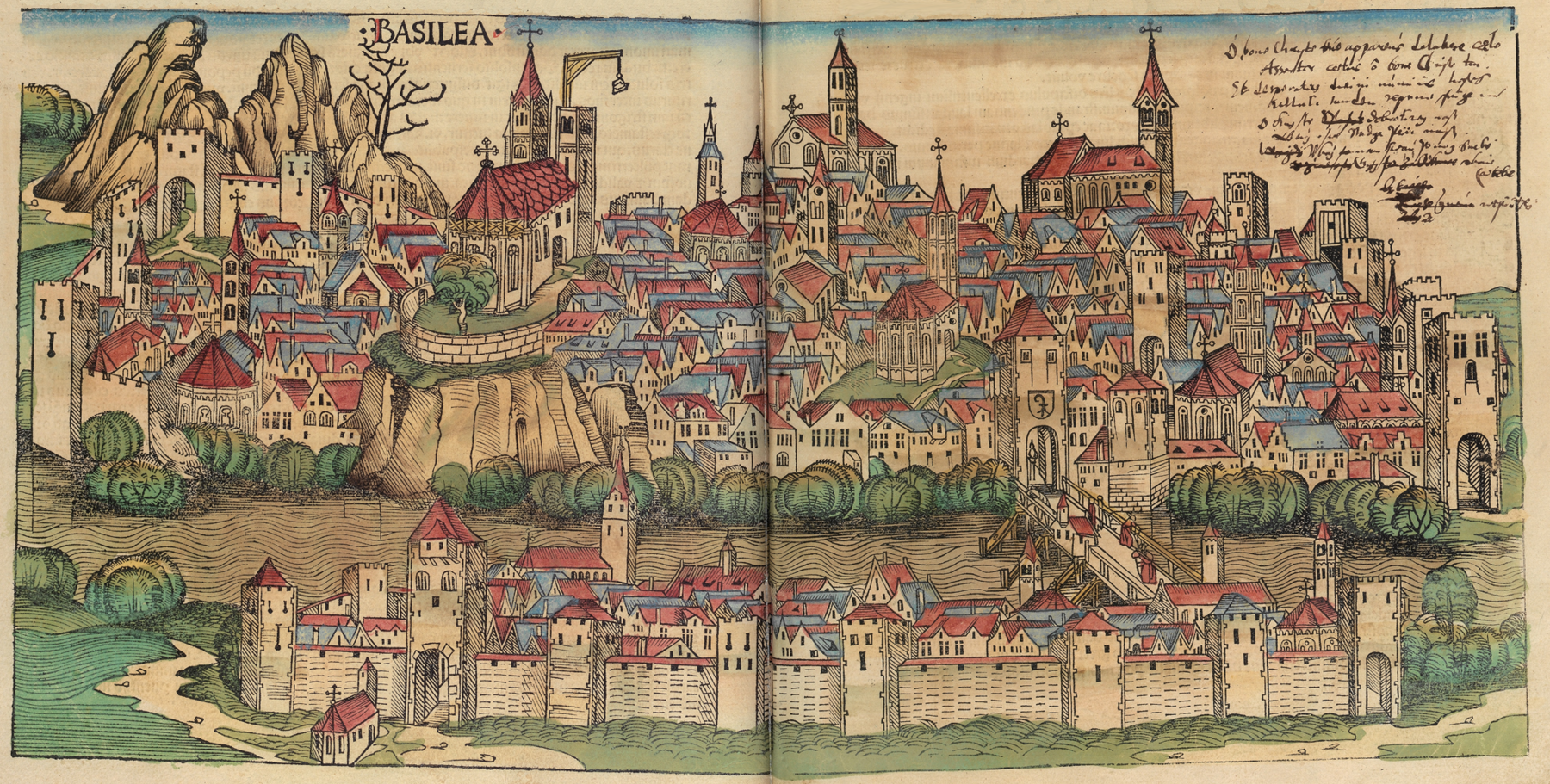
Basilea: Holzschnitt von Michael Wolgemut u. a. in der Weltchronik von Hartmann Schedel, Nürnberg 1493, fol. 243v–244r (© Wikimedia Commons).
[1] For example, So lanc so meer as So lang si mir (in I-TRbc 90, fol. 344v) or Een vraulic wesen as Ein frölich wesenn (in the songbook of Johannes Heer, CH-SGs Ms. 462, fol. 28v–30r).
[2] Binchois’ Dueil angoisseux becomes De langwesus in I-TRbc 88, fol. 204v, De langwesus; of the frottola line “Tente a l’ora, ruzinente, ch’io vo’ cantar” only “Dentelore” remains in the manuscript CH-Bu F X 1–4 (fol. 97), written by the Augsburg scribe Johann Wüst; a quodlibet from the Sagan partbooks (No. 118) quotes the songs Rabaßkadol and Panny, pany, baby (“Woman, woman, old woman”).
[4] These are RISM numbers 1512/1, 1513/2, [1513]/3, [1513]/3 (published in Mainz in 1517), and 1519]/5 (a woodcut reprint of a lost songbook originally published around 1510 in Augsburg, printed 1514/1515, see Schwindt 2008).
[5] On all three manuscripts, see Strohm 1993, 492–503.
[8] According to Strohm 1993, 519, and Strohm 2001, 23, the manuscript was originally in the possession of the choir school of St. Jakob, Innsbruck, whose members were employed for musical service at court. See also » G. Nicolaus Krombsdorfer.
[10] I-TRbc 89, fol. 388v–389r; I-Fn, B.R. 229, fol. 174v–175r; » Guter seltzamer und kunstreicher teutscher Gesangk; Nürnberg 1544, Nr. 8: “Heyaho nun wie sie grollen dort auff dem Ritten die geschwollen” in the Secunda pars, T. 76–85; textual reference at the beginning, bars 1–13: “Woll wir aber heben an den Danhauser zu singen” (DTÖ 147/148, 63 and 69 f.).
[11] Bienenfeld 1904/1905, 96, note 2.
[12] CH-Zz, Ms. G 438 (written c. 1524); Pfisterer 2013.
[13] A-Wn Mus.Hs. 18810 (c. 1524) and D-Mu, 8°Cod. ms. 328–331 (before 1527), also known as the “Welser Songbook”.
[14] Also known as the “Herwart” or “Augsburg Songbook”.
[15] Birkendorf 1994, vol. 1, 98.
[16] Schwindt 2013, 126–130.
[17] D-W, Cod. Guelf. 78.Quodl.4 (Southern Germany c. 1505); D-Mbs Mus. ms. 4483 (Southern Germany c. 1515); A-Wn Cod. 4337 (Vienna, early 1520s); D-W Cod. Guelf. 292 Musica hdschr. (Constance?, c. 1525).
[18] CH-Bu F X 10 (1510); CH-Bu F X 5–9 (Fascicle I: c. 1510); CH-Bu F X 1–4 (Fascicle I: c. 1517/1518, Fascicle II: c. 1524); CH-Bu F VI 26 (first quarter of the sixteenth century); CH-SGs Ms. 462 (1510–1516, 1530), also known as the “Heer Songbook”.
[19] See above note 4.
[20] RISM 1534/17: » Der erst teil. Hundert vnd ainundzweintzig newe Lieder…, hrsg. von Johann Ott, Nürnberg 1534.
[21] Sterl 1971, 24. Grünwald/Gruenwolt is documented as Persefant (under-herald) in Regensburg from 1483–1487.
[22] Grosch 2013, 48–54.
[23] A-Wn Cod. 3027 (Passau c. 1492–1494), fol. 174v–177r: “Von yppliklichen dingen”. Score reproduction in Curschmann 1970, 22 f.
[24] Quodlibet No. XX quotes the couplet “Da schalt sie jhn ein trollen, ein truncken vnd ein vollen” from the middle of the third Hesselloher stanza (Secunda pars, bars 133–137, rhythm corresponds to the song model, diastematic contour slightly modified, see DTÖ 147/148, 132).
[25] A-Whh RR V (1489-1492): Wien, Haus-, Hof- und Staatsarchiv, Reichsregister vol. V (1489–1492), fol. 60r.
[26] “Die situationsbasierten Thematisierungsverfahren lassen die Liebe vor allem als kulturelles Handeln in konventionalisierten Umständen erscheinen” (The situation-based methods of thematisation present love primarily as cultural action in conventionalised circumstances): Hübner 2013, 107.
[27] The earliest available source for the polyphonic Elslein song is the Sagan partbooks (PL-Kj Berol. Mus.ms. 40098). There is indeed an earlier transmission from around 1455 in the form of a monophonic melody, but with a Latin text Gaudeamus pariter (CZ-Pnm Vysehrad 376, fol. 39v; digitised in the database Melodiarum hymnologicum Bohemiae: http://tinyurl.com/gaudeamuspariter). It is very likely – or at least possible – that this is a sacred contrafactum of the secular monophonic Elslein song, though this cannot yet be documented.
[28] The earliest sources for this popular song are a broadside print of the text by Albert Kunne (Memmingen, c. 1501, see http://tinyurl.com/Ich-stund-Kunne, metadata at http://tinyurl.com/Kunne-meta) uand a freely paraphrased adaptation of melodic elements under the text marker in the tenor “Ich stund an einem Morgen”, entered around 1499/1500 on fols. 221v–222r in the Berlin mensural codex D-B Mus. ms. 40021. Both suggest a widely known song melody, although no earlier written version is currently documented.
[29] D-B Ms. germ. oct. 280, fol. 48b–49b (Nr. 33): Ich sien den morgenssterren.
[30] Bayerisches Hauptstaatsarchiv München, Geheimes Hausarchiv, 601, XXVI, letter from Duke Philipp to his father Wilhelm V dated 13.10.1593.
[31] On the history of the term, see Grosch 2013, 23–33. See also » B. Minnesang und alte Meister on the terminological tradition of “tenores”, which was initially not associated with polyphony.
[32] Complete transcription of both songs and further remarks in Strohm 1993, 496–499.
[34] Strohm 1989; Leverett 1995; Höink 2012. The overview should also include the Missa Ducis Saxsoniae Sing ich nit wol composed by Nicolas Champion dit Liegeois, whose song basis is already recorded before the South German manuscript D-WGl Lutherhalle Ms. 403/1048 (c. 1535/1536) in Bernhard Rem’s partbook setting D-Mu, 8°Cod. ms. 328–331 (before 1527).
[35] D-Mbs Mus. ms. 3154, fol. 53v: Tannhauser Ihr seid mir lieb (3v), fol. 151r: Veni creator spiritus, and Thanhauser jr seit mir lieb. Heidrich 2005, 54 ff.
[36] Klüpfel; Karl (ed.): Urkunden zur Geschichte des Schwäbischen Bundes (1488–1533), vol. 1, Stuttgart 1846, 24.
[37] On authorship, see Leverett 1995; on the musical style in the context of Frederick III, see Schmalz 1987; on the title, see Strohm 1989.
[38] Schwindt 2006, 51–56.
[40] See Schwindt 2013, 127 and 133.
[41] Edited in Adler/Koller 1900, 269. Further details on this song and its text in Schwindt 1999, 58–62.
[42] Hübner 2013, 107.
Recommended citation:
Nicole Schwindt: “Songs in the Austrian Region, c. 1450-c.1520”, in: Musical Life of the Late Middle Ages in the Austrian Region <https://musical-life.net/en/essays/songs-austrian-region-c-1450-c-1520> (2026); slightly revised AI-assisted translation of the original German essay (2016).