Scattered Transmission
German polyphonic song in the second half of the fifteenth century typically had a scattered transmission,which telling about the status of the polyphonically notated song at the time. The older tradition of courtly solo song was conceived primarily in literary terms. It is preserved in large song collections, more often than not without notation. This practice could not be easily transferred to polyphonic song. Rather, songs written down in multiple voices in the German lands initially appear only as a kind of “footnote” to sacred music. In the “mixed quarto manuscripts” or “small folio manuscripts” typical of musical transmission in the German-speaking world up to the end of the fifteenth century, song material are appended to the dominant sacred repertoire. Sometimes songs even blend into sacred repertoire through contrafact, that is, the substitution of Latin texts for use in liturgy and private devotion. In any case, the German-language songs in these sources appear as a peripheral phenomenon. This is often evident codicologically, since many were added as later insertions in blank spaces in their host volumes. These sources do not reveal any deliberate attempt to compile representatives of a functional or generic category of song.
The thousands of pages of music in the Trent Codices » I-TRbc 90, » I-TRcap 93*, » I-TRbc 88, and » I-TRbc 89, copied between roughly 1455 and 1470, primarily by Johannes Wiser, a native of Munich who became succentor and rector of the cathedral school in Trent, are particularly informative in this issue. These codices contain just eight songs, eight Leisen (» B. Geistliches Lied), and eight Masses based on cantus firmi derived from songs.[6] A similar yield is found in another convolute manuscript, the choirbook of the Innsbruck schoolmaster Nikolaus Leopold (» D-Mbs Mus. ms. 3154), a little later than the sources produced in Trent.[7] This choirbook, to which many hands contributed, was copied between around 1466 and 1511. It can be assumed – though not with absolute certainty – that the manuscript of over 800 pages reflects the repertoire of various Habsburg-Tyrolean chapel ensembles in the vicinity of Augsburg and Innsbruck before it came into the possession of the schoolmaster.[8] Here, German songs are as marginal as in the Trent manuscripts: in the fascicle completed in 1476, a scribe entered a cluster of five song settings and one standalone song (cf. » Audio example ♫ Ich sachs einsmals; » Audio example ♫ Gespile, liebe gespile gút; » Audio example ♫ Es sassen höld in ainer Stuben; » Audio example ♫ So steh ich hie; » Audio example ♫ Tannhauser). Presumably in the late 1480s, three Masses were added, which seem to be based on song material. (On the song underlying the Missa O Österreich, see » F. Musiker aus anderen Ländern). Several motet-like settings are combined with song melodies; three further songs are notated in the margins. The scarcity of material aligns with evidence from other regions: the Strahov Codex from Prague (» CZ-Ps D.G. IV. 47; » F. Bohemian Sources) records three German songs. Two extensive musical collections from Leipzig dating from before and around 1500 – the Berlin Mensural Codex » D-B Mus. ms. 40021 and the Nikolaus Apel Codex (» D-LEu Ms. 1494) – also each contain only a handful of songs.
It is not easy to determine when the tide began to turn in the South German–Austrian region, transforming secular polyphonic songs into a distinct object of collection, as further manuscripts containing song elements from the 1480s and 1490s have survived only in fragmentary form. This group includes the Augsburg fragment (» D-As Cod. 4° Mus. 25, c. 1492/93), the isolated Trento fascicle (» I-TRc Ms. 1947-4, c. 1495 to before 1500), or – particularly interesting – the Linz fragment (» A-LIb Hs. 529, c. 1490) with its three songs and additional related fragments. None of these are conceived in partbook format. Given its provenance, the Linz fragment may well owe its existence to those periods when the Habsburg court was resident in Linz. The connections to the court are especially evident in the song Heya, heya nun wie sie grollen hervor (» Audio example ♫ Heya, heya and » Audio example ♫ Heya ho, nun wie si grollen). This four-line feud call, which may even go back to Oswald von Wolkenstein or at least relate to an episode from his life (c. 1442–43),[9] is transmitted in one of the Trent Codices (I-TRbc 89) from around 1465, in the Braccesi Chansonnier (» I-Fn B.R. 229), compiled in 1492 in Florence, where Heinrich Isaac resided, and in the Linz fragment. It is also quoted in a quodlibet from the collection of Wolfgang Schmeltzl.[10] The schoolmaster of the Scots’ Monastery (Schottenstift) in Vienna drew heavily on old material for his 1544 edition, reaching back to the early Maximilian period and stored in the Scots’ Monastery.[11] Thus, he also combined Heya heya with the Tannhäuser song from the Nikolaus Leopold Codex. This configuration of transmission suggests that, within closer or broader court circles, the unruly Brixen knight-peasant affair remained a subject of interest for many decades (» Music example Heya, heya, nun wie si grollen).
Notenbsp. Heya heya, nun wie si grollen
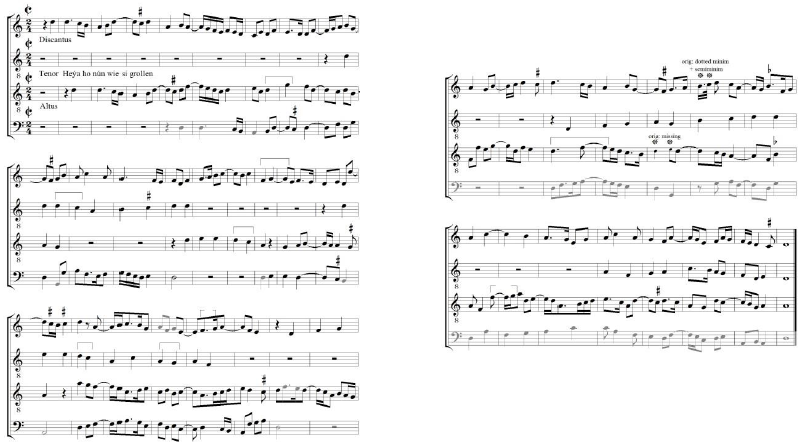
Rekonstruierte Transkription (Marc Lewon) des auf Oswald von Wolkenstein zurückgehenden Liedes nach Fragment Nr. 2 in » A-LIb Hs. 529. Die schattierten Noten, die im Linzer Fragment fehlen, sind ergänzt nach » I-TRbc 89, fol. 388v–389r.
[8] According to Strohm 1993, 519, and Strohm 2001, 23, the manuscript was originally in the possession of the choir school of St. Jakob, Innsbruck, whose members were employed for musical service at court. See also » G. Nicolaus Krombsdorfer.
[10] I-TRbc 89, fol. 388v–389r; I-Fn, B.R. 229, fol. 174v–175r; » Guter seltzamer und kunstreicher teutscher Gesangk; Nürnberg 1544, Nr. 8: “Heyaho nun wie sie grollen dort auff dem Ritten die geschwollen” in the Secunda pars, T. 76–85; textual reference at the beginning, bars 1–13: “Woll wir aber heben an den Danhauser zu singen” (DTÖ 147/148, 63 and 69 f.).
[11] Bienenfeld 1904/1905, 96, note 2.
[1] For example, So lanc so meer as So lang si mir (in I-TRbc 90, fol. 344v) or Een vraulic wesen as Ein frölich wesenn (in the songbook of Johannes Heer, CH-SGs Ms. 462, fol. 28v–30r).
[2] Binchois’ Dueil angoisseux becomes De langwesus in I-TRbc 88, fol. 204v, De langwesus; of the frottola line “Tente a l’ora, ruzinente, ch’io vo’ cantar” only “Dentelore” remains in the manuscript CH-Bu F X 1–4 (fol. 97), written by the Augsburg scribe Johann Wüst; a quodlibet from the Sagan partbooks (No. 118) quotes the songs Rabaßkadol and Panny, pany, baby (“Woman, woman, old woman”).
[4] These are RISM numbers 1512/1, 1513/2, [1513]/3, [1513]/3 (published in Mainz in 1517), and 1519]/5 (a woodcut reprint of a lost songbook originally published around 1510 in Augsburg, printed 1514/1515, see Schwindt 2008).
[5] On all three manuscripts, see Strohm 1993, 492–503.
[8] According to Strohm 1993, 519, and Strohm 2001, 23, the manuscript was originally in the possession of the choir school of St. Jakob, Innsbruck, whose members were employed for musical service at court. See also » G. Nicolaus Krombsdorfer.
[10] I-TRbc 89, fol. 388v–389r; I-Fn, B.R. 229, fol. 174v–175r; » Guter seltzamer und kunstreicher teutscher Gesangk; Nürnberg 1544, Nr. 8: “Heyaho nun wie sie grollen dort auff dem Ritten die geschwollen” in the Secunda pars, T. 76–85; textual reference at the beginning, bars 1–13: “Woll wir aber heben an den Danhauser zu singen” (DTÖ 147/148, 63 and 69 f.).
[11] Bienenfeld 1904/1905, 96, note 2.
[12] CH-Zz, Ms. G 438 (written c. 1524); Pfisterer 2013.
[13] A-Wn Mus.Hs. 18810 (c. 1524) and D-Mu, 8°Cod. ms. 328–331 (before 1527), also known as the “Welser Songbook”.
[14] Also known as the “Herwart” or “Augsburg Songbook”.
[15] Birkendorf 1994, vol. 1, 98.
[16] Schwindt 2013, 126–130.
[17] D-W, Cod. Guelf. 78.Quodl.4 (Southern Germany c. 1505); D-Mbs Mus. ms. 4483 (Southern Germany c. 1515); A-Wn Cod. 4337 (Vienna, early 1520s); D-W Cod. Guelf. 292 Musica hdschr. (Constance?, c. 1525).
[18] CH-Bu F X 10 (1510); CH-Bu F X 5–9 (Fascicle I: c. 1510); CH-Bu F X 1–4 (Fascicle I: c. 1517/1518, Fascicle II: c. 1524); CH-Bu F VI 26 (first quarter of the sixteenth century); CH-SGs Ms. 462 (1510–1516, 1530), also known as the “Heer Songbook”.
[19] See above note 4.
[20] RISM 1534/17: » Der erst teil. Hundert vnd ainundzweintzig newe Lieder…, hrsg. von Johann Ott, Nürnberg 1534.
[21] Sterl 1971, 24. Grünwald/Gruenwolt is documented as Persefant (under-herald) in Regensburg from 1483–1487.
[22] Grosch 2013, 48–54.
[23] A-Wn Cod. 3027 (Passau c. 1492–1494), fol. 174v–177r: “Von yppliklichen dingen”. Score reproduction in Curschmann 1970, 22 f.
[24] Quodlibet No. XX quotes the couplet “Da schalt sie jhn ein trollen, ein truncken vnd ein vollen” from the middle of the third Hesselloher stanza (Secunda pars, bars 133–137, rhythm corresponds to the song model, diastematic contour slightly modified, see DTÖ 147/148, 132).
[25] A-Whh RR V (1489-1492): Wien, Haus-, Hof- und Staatsarchiv, Reichsregister vol. V (1489–1492), fol. 60r.
[26] “Die situationsbasierten Thematisierungsverfahren lassen die Liebe vor allem als kulturelles Handeln in konventionalisierten Umständen erscheinen” (The situation-based methods of thematisation present love primarily as cultural action in conventionalised circumstances): Hübner 2013, 107.
[27] The earliest available source for the polyphonic Elslein song is the Sagan partbooks (PL-Kj Berol. Mus.ms. 40098). There is indeed an earlier transmission from around 1455 in the form of a monophonic melody, but with a Latin text Gaudeamus pariter (CZ-Pnm Vysehrad 376, fol. 39v; digitised in the database Melodiarum hymnologicum Bohemiae: http://tinyurl.com/gaudeamuspariter). It is very likely – or at least possible – that this is a sacred contrafactum of the secular monophonic Elslein song, though this cannot yet be documented.
[28] The earliest sources for this popular song are a broadside print of the text by Albert Kunne (Memmingen, c. 1501, see http://tinyurl.com/Ich-stund-Kunne, metadata at http://tinyurl.com/Kunne-meta) uand a freely paraphrased adaptation of melodic elements under the text marker in the tenor “Ich stund an einem Morgen”, entered around 1499/1500 on fols. 221v–222r in the Berlin mensural codex D-B Mus. ms. 40021. Both suggest a widely known song melody, although no earlier written version is currently documented.
[29] D-B Ms. germ. oct. 280, fol. 48b–49b (Nr. 33): Ich sien den morgenssterren.
[30] Bayerisches Hauptstaatsarchiv München, Geheimes Hausarchiv, 601, XXVI, letter from Duke Philipp to his father Wilhelm V dated 13.10.1593.
[31] On the history of the term, see Grosch 2013, 23–33. See also » B. Minnesang und alte Meister on the terminological tradition of “tenores”, which was initially not associated with polyphony.
[32] Complete transcription of both songs and further remarks in Strohm 1993, 496–499.
[34] Strohm 1989; Leverett 1995; Höink 2012. The overview should also include the Missa Ducis Saxsoniae Sing ich nit wol composed by Nicolas Champion dit Liegeois, whose song basis is already recorded before the South German manuscript D-WGl Lutherhalle Ms. 403/1048 (c. 1535/1536) in Bernhard Rem’s partbook setting D-Mu, 8°Cod. ms. 328–331 (before 1527).
[35] D-Mbs Mus. ms. 3154, fol. 53v: Tannhauser Ihr seid mir lieb (3v), fol. 151r: Veni creator spiritus, and Thanhauser jr seit mir lieb. Heidrich 2005, 54 ff.
[36] Klüpfel; Karl (ed.): Urkunden zur Geschichte des Schwäbischen Bundes (1488–1533), vol. 1, Stuttgart 1846, 24.
[37] On authorship, see Leverett 1995; on the musical style in the context of Frederick III, see Schmalz 1987; on the title, see Strohm 1989.
[38] Schwindt 2006, 51–56.
[40] See Schwindt 2013, 127 and 133.
[41] Edited in Adler/Koller 1900, 269. Further details on this song and its text in Schwindt 1999, 58–62.
[42] Hübner 2013, 107.
Recommended citation:
Nicole Schwindt: “Songs in the Austrian Region, c. 1450-c.1520”, in: Musical Life of the Late Middle Ages in the Austrian Region <https://musical-life.net/en/essays/songs-austrian-region-c-1450-c-1520> (2026); slightly revised AI-assisted translation of the original German essay (2016).