Sounds Accompanying Ceremonial Entries
The sequence described above, together with its various programme elements, was elaborated through a wide range of festive components in which music played a central role. Only a synoptic view of several entry events and their sources conveys an idea of the sonic diversity of these rituals, since descriptions of individual joyeuses entrée, if they mention musical activities at all, do so only in a few marginal remarks. For the most part, these are not very specific, though all the more markedly follow familiar topoi. This, in turn, makes it difficult to characterise and assess each individual joyeuse entrée.
Whether in the Low Countries or elsewhere, arrival spectacles are described in (late-) medieval chronicles primarily as noisy events. This stems from the medieval understanding that the recognition of the assumption of power and its public proclamation were not only announced through forceful sound, but also effectively enacted and confirmed by the ritual community through loud acoustic utterances.[8] The essential acoustic markers included the ringing of all ecclesiastical and civic bells, the acclamations and cries of jubilation of the population, cannon and artillery fire, welcoming speeches and oath‑taking ceremonies, as well as the playing of so‑called “loud instruments” — particularly trumpets, kettledrums, and drums (» H. Ch. The Selection of Instruments). In their accounts, the chroniclers repeatedly refer to the large number of silver trumpets involved (» Slide Trumpet, Instrument Museum).[9]
These sounded alongside singing and the playing of other instruments from prominent civic and ecclesiastical buildings, such as city gates, town halls, church towers, as well as other permanent and ephemeral architectural structures. Yet trumpeters and other musicians also predominantly sounded their “loud” instruments within the retinues of those participating in the festivities, that is, of the ruler, male or female, as well as of the guilds and confraternities involved. Bells and jingles rang in great numbers from the harnesses of the horses and from the garments of those making their entry.
Various accounts furthermore mention the urban clergy, who, festively adorned and bearing processional crosses, relics, holy water and candles, processed out singing to meet those making their entry and greeted them at the city gate (see Fig. The clergy welcomes the bishop of Cambrai), as well as the celebration of a festive Mass with the singing of the Te Deum.
Abb. Der Klerus begrüßt den Bischof von Cambrai / FIG. The clergy welcomes the bishop of Cambrai
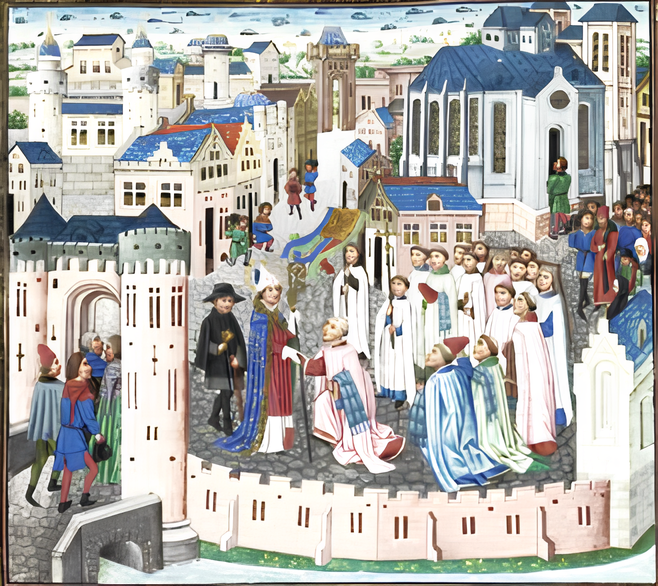
Miniatur aus den Chroniques de Hainaut, B-Br ms. 9243, fol. 85v, Brügge um 1450, https://uurl.kbr.be/1894866. Siehe auch Marti et al. 2008, Tafel 69.
/ Miniature from the Chroniques de Hainaut, B-Br ms. 9243, fol. 85v, Bruges, ca. 1450, https://uurl.kbr.be/1894866. See also Marti et al. 2008, pl. 69.
The Te Deum could be performed not only in the context of the liturgical Office, but also as a processional chant. Following the entry procession, further festivities ensued depending on the occasion. If the entry marked an accession, the ruler would often take their oaths at the altar of the principal church, thereby confirming the cities’ privileges and rights. Urban and ecclesiastical dignitaries, or alternatively the ruler and spouse, invited the celebrants to banquets and dancing in the residence or the town hall. Feasts, tournaments, and bonfires were held in public squares (» E. Ch. Royal Election and Bonfires). Such, in brief, are the festive elements and sonic characteristics as they can generally be identified in the Netherlandish and German‑speaking parts of the Empire during the late Middle Ages and extending well into the Early Modern period.[10]
In the cities of the Low Countries, an individual culture of ceremonial entries developed during the late Middle Ages, with specific characteristics that differed from those in German‑ and Italian‑speaking territories, more closely resembling practices in the French‑ and English‑speaking world. Streets, buildings, and squares were adorned with precious textiles and paintings and were staged through extravagant illuminations, light displays, and fireworks. Theatrical performances were presented. Responsibility for planning, financing, and realisation lay with the civic authorities (most usually in consultation with the court), together with the various guilds and confraternities, above all the >rederijkerskamers<, working collectively with painters’ guilds and merchants of the different “nations”, all of whom appeared in the entry spectacles. As, for example, the municipal accounts for the entry of Archduke Charles from the years 1514 and 1515 demonstrate, planning for the joyeuses entrées began long before the actual date of the festivities and required extensive preparations.[11]
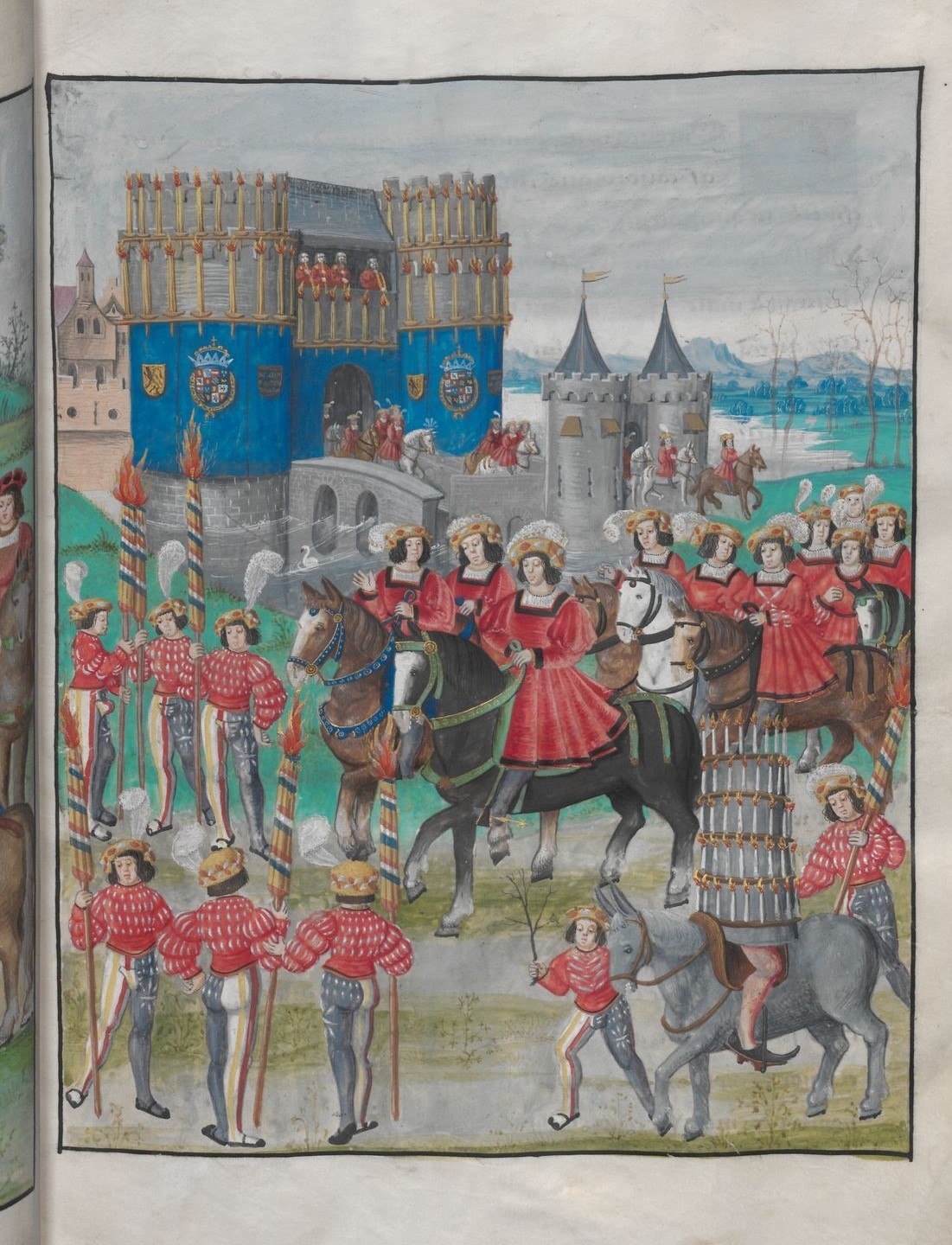
Particularly the tableaux vivants (“living pictures”; see FIG. Tableau vivant), also referred to as “silent images”, were characteristic of the festive culture of the Low Countries, as also that of England and France. These consisted of theatrical boxes or stages positioned along the official processional route on platforms, wagons, or ships, on which biblical, mythological, historical, and allegorical scenes, coats of arms, or emblems were presented by living performers, who remained silent and motionless. The scenes depicted were often explained by banners with mottos, inscriptions, or by designated speakers.[12] ITheir mode of presentation continues to raise various questions to this day, not least whether they were in fact always truly silent and motionless. Music (not only within the pictorial subjects), symbolic gestures, and moving automata evidently played a significant role.[13] The problem lies in the fact that the chroniclers who inform us about the tableaux say little to nothing about their sonic realisation. This is also true of Molinet, already mentioned above, who notes the tableaux but provides no information whatsoever about the musical festive elements of the joyeuses entrées following Maximilian’s coronation as king. In his festival account, Solemnelle entrée, Remy du Puys likewise offers only extremely sporadic information on musical and sonic activities relating to Archduke Charles’s entry into Bruges in 1515.[14] Rather, he concentrates on a detailed description of the triumphal arches and the individual subjects of the tableaux, which lined the entry route in great numbers and presented the prince with various stages of the city’s history up to the present, as well as idealised forms of courtly conduct and governance. By contrast, if one considers the woodcuts and paintings in the manuscript and printed festival accounts, trumpeters can be seen on the majority of the representative structures. On the city gate, for example, an alta ensemble consisting of one trumpeter and three shawm players greets the archduke as he enters (see FIG. An Alta capella welcomes Archduke Charles at the Kruispoort in Bruges, 1515).
Abb. Ein Alta-Ensemble begrüßt Erzherzog Karl an der Kruispoort in Brügge, 1515 / An Alta capella welcomes Archduke Charles at the Kruispoort in Bruges, 1515
Individual subjects within the tableaux further suggest that musicians and singers were involved in the staging. One example is a tableau depicting a courtly company dancing a branle—probably an automaton—or another showing Orpheus seated in a garden, playing either his harp (see FIG. Tableau vivant) or a lira da braccio (» Lira da braccio, Instrument Museum; » H. Ch. The Selection of Instruments).[15] It is likely, however, that music also accompanied those tableaux that did not present a music‑specific theme. Thus Anthonis de Roovere reports that, on the occasion of the bridal entry of Margaret of York in Bruges in 1468, a wide variety of musicians were to be heard on all the structures. More specifically, however, he mentions only an organist who accompanied the depiction of Alexander and Cleopatra with his playing “in masterly fashion”.[16] That the staging of the tableaux was accompanied by a wide range of musical instruments—mostly “soft” ones—as well as by singing is shown by various accounts. The chroniclers also make clear that singers from different religious communities—boys as well as adults—not only took part in the tableaux vivants but also sang down from towers and other urban architectural structures.[17]
Although most of the more detailed descriptions of entries and their visual documentation focus on the triumphal arches and tableaux vivants, it can scarcely be assumed that theatrical forms of performance within entrées were limited to these alone. Rather, it is likely that moralities and sacred plays (mystères) in which music played a role were performed frequently. Music was also heard during the festive Mass in the local principal or residence church, as well as on further occasions connected with the respective festive event (banquets, dancing, and tournaments). It may be assumed that settings of Masses, motets, and other genres were composed expressly for such occasions and performed accordingly (» D. Music for Emperor Charles V (1530)). For none of the entries in the Low Countries mentioned here, however, can this be conclusively demonstrated. For a long time it has nevertheless been assumed that the two motets by Benedictus de Opitiis contained in the book Unio pro co[n]servatio[n]e rei publice / Lofzangen ter ere van Keizer Maximiliaan en zij kleinzoon Karel den Vijfden, printed by Jan de Gheet, were performed on the occasion of Archduke Charles’s entry into Antwerp in 1515. Final certainty on this point, however, is lacking (» D. Ch. Printed Polyphonic Praises of the Ruler and the Virgin Mary).[18] Only from the 1540s onwards can specific compositions for entries in the Low Countries be identified: the motet Venite populi terrae by Jean Courtois for Charles V’s entry into Cambrai in 1540, and two motets on the text Quis te victorem dicat by Thomas Crecquillon and Jacobus Clemens non Papa for the entrée of Philip II into Lille in 1549.[19] A few further examples from Italian contexts are known for the fifteenth and sixteenth centuries.[20]
[9] Puys 1515 (BnF, RES FOL‑OC‑1659, https://gallica.bnf.fr/ark:/12148/bpt6k1521561n/), without pagination; Dits die Excellente Chronijcke, 1531, C.xxxvi.v, without pagination; Strohm 1985, 76, 80.
[10] On the soundscape of Burgundian entries under the Valois dukes: Strohm 1985, 79–85; Hurlbut 1990, 179–187; 1999. On the late medieval Empire: Bojcov 1997, 99; Rudolph 2005; Kelber 2017 and 2018, 167–201.
[11] Anglo 1973, 18–34.
[12] Strohm 1985, 80-81; Eichberger 1988, 46; Hurlbut 1990, inter alia 188–203.
[13] Eichberger does not count representations that incorporated symbolic gestures among the tableaux in the strict sense. Eichberger 1988, 43. See also Tammen 2019, 350.
[14] Puys’s festival account appeared in both manuscript form (A‑Wn Cod. 2591, https://digital.onb.ac.at/RepViewer/viewer.faces?doc=DTL_6449837&order=1&view=SINGLE) and printed form (BnF, RES FOL‑OC‑1659, https://gallica.bnf.fr/ark:/12148/bpt6k1521561n/). See also the edition by Anglo 1973. In addition to this account, a poem by Jan de Scheereres on the “triumph” of the archduke was published. The musical descriptions are of little specificity; see Mareel 2005.
[15] See Tammen 2019, 345–349 and the two copies of Puys’s festival account from 1515.
[16] Dits die Excellente Chronijcke, 1531, C.xxxvi.v, without pagination.
[17] Strohm 1985, 81-82; Hurlbut 1990, 185-186.; Ramakers 2005, 177.
[19] Vendrix – Fiala 2015, 36.
[20] Vendrix – Fiala 2015, 42–49 (appendices).
[1] Other terms include: “blijde intrede” or “blijde inkomst”, “adventus”, “introitus”, “ingressus”, or “einreyttung”. See Rudolph 2005, 318.
2] On this, see in detail, among others, Eichberger 1988, 47–54, 57f.; 2005; Cauchies 1994; Tammen 2008; 2011 and 2019.
[3] Shortly afterwards, on 21 July 1486, Maximilian carried out a further ceremonial entry into Brussels together with Frederick III and his son Philip. On the series of entries see, among others, Gachard 1876, vol. 1, 109–111, as well as the following note.
[4] See chap. CXLVIII in Molinet’s Chroniques, Buchon 1828, vol. 3, 93–99.
[5] Drabek 1964, 49.
[6] Chroniclers refer above all to urban entries.
[7] For this model, see representatively Hurlbut 1990, 36–37; Kipling 1998, 176–181; Schenk 2003, 238–242; Rudolph 2005, 319.
[9] Puys 1515 (BnF, RES FOL‑OC‑1659, https://gallica.bnf.fr/ark:/12148/bpt6k1521561n/), without pagination; Dits die Excellente Chronijcke, 1531, C.xxxvi.v, without pagination; Strohm 1985, 76, 80.
[10] On the soundscape of Burgundian entries under the Valois dukes: Strohm 1985, 79–85; Hurlbut 1990, 179–187; 1999. On the late medieval Empire: Bojcov 1997, 99; Rudolph 2005; Kelber 2017 and 2018, 167–201.
[11] Anglo 1973, 18–34.
[12] Strohm 1985, 80-81; Eichberger 1988, 46; Hurlbut 1990, inter alia 188–203.
[13] Eichberger does not count representations that incorporated symbolic gestures among the tableaux in the strict sense. Eichberger 1988, 43. See also Tammen 2019, 350.
[14] Puys’s festival account appeared in both manuscript form (A‑Wn Cod. 2591, https://digital.onb.ac.at/RepViewer/viewer.faces?doc=DTL_6449837&order=1&view=SINGLE) and printed form (BnF, RES FOL‑OC‑1659, https://gallica.bnf.fr/ark:/12148/bpt6k1521561n/). See also the edition by Anglo 1973. In addition to this account, a poem by Jan de Scheereres on the “triumph” of the archduke was published. The musical descriptions are of little specificity; see Mareel 2005.
[15] See Tammen 2019, 345–349 and the two copies of Puys’s festival account from 1515.
[16] Dits die Excellente Chronijcke, 1531, C.xxxvi.v, without pagination.
[17] Strohm 1985, 81-82; Hurlbut 1990, 185-186.; Ramakers 2005, 177.
[19] Vendrix – Fiala 2015, 36.
[20] Vendrix – Fiala 2015, 42–49 (appendices).
Recommended citation:
Margret Scharrer: “Joyeuses entrées in the Low Countries”, in: Musical Life of the Late Middle Ages in the Austrian Region <https://musical-life.net/essays/joyeuses-entrees-den-niederen-landen> (2023).