The Tradition of the Joyeuses Entrées (Ceremonial Entries)
Joyeuses entrées[1] are generally understood as the inaugural entries carried out by a ruler in the territories under their control following their assumption of power or elevation of rank.These were rituals that took place after declarations of legal majority and the associated accessions to rule, after royal and imperial coronations, the assumption of governorships, or marriages. Among the outstanding late‑medieval entry festivities in the Low Countries, which were part of the Holy Roman Empire, were the reception of the bride Joanna I of Castile, consort of Philip the Fair, in Brussels in 1496, and the entry of Archduke Charles, the future King of the Romans and Holy Roman Emperor, on the occasion of his coming of age in Bruges in 1515 (see Fig. Archduke Charles before Bruges, 1515; » D. Ch. Printed Polyphonic Praises). These were remarkable because they were among the first to be documented on a large scale in visual form. Like Joanna and Charles, Maximilian I and his children Philip and Margaret had also been welcomed by their Netherlandish subjects with magnificent joyeuses entrées (D. Music for a Royal Entry, » I. Kap. The arrival of Bianca Maria Sforza).2]
Abb. Erzherzog Karl vor Brügge, 1515 / Fig. Archduke Charles in Bruges, 1515
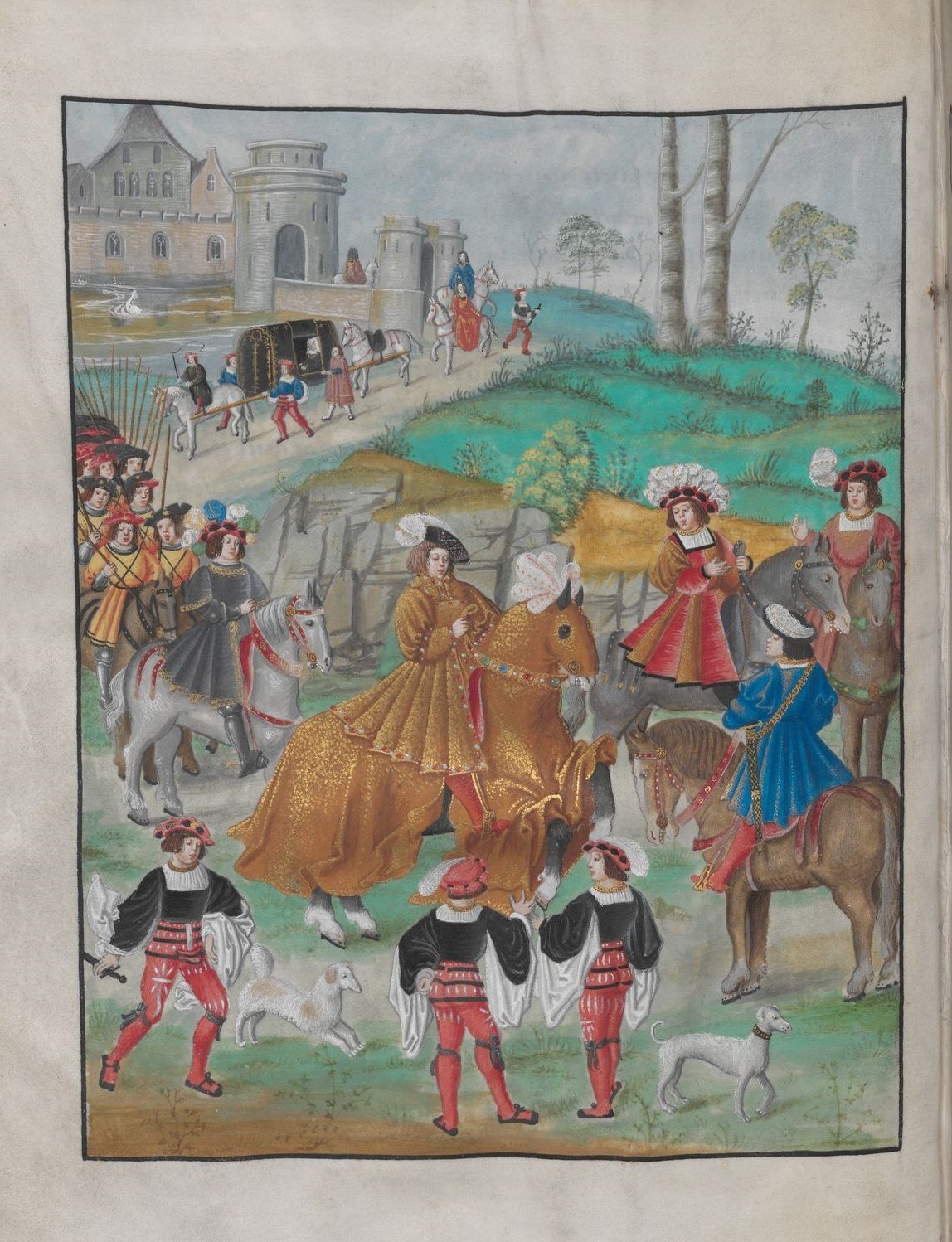
Erzherzog Karl, Sohn Philipps des Schönen, bei seiner Joyeuse entrée in Brügge, 1515. Remy du Puys: Solemnelle entrée faicte sur l’advenement de Charles Archidux d’Autriche en Bruges 1515, © A-Wn, Österreichische Nationalbibliothek, Cod. 2591, fol. 7v. https://digital.onb.ac.at/RepViewer/viewer.faces?doc=DTL_6449837&order=1… /
Archduke Charles, son of Philip the Handsome, at his Joyeuse entrée in Bruges, 1515. Remy du Puys: Solemnelle entrée faicte sur l’advenement de Charles Archidux d’Autriche en Bruges 1515, © A-Wn, Österreichische Nationalbibliothek, Cod. 2591, fol. 7v. https://digital.onb.ac.at/RepViewer/viewer.faces?doc=DTL_6449837&order=1…
Most of the Habsburg rulers, both male and female, experienced this ritual several times during their lifetimes and reigns. Thus, in Maximilian’s case, an entire series of joyeuses entrées can be identified following key stages of his life: his marriage to Mary of Burgundy (1477), his assumption of guardianship for his son Philip after the death of his wife Mary (1482) and his coronations as King of the Romans (1486) and Holy Roman Emperor (1508).
The Burgundian chronicler Jean Molinet describes Maximilian’s series of entries in the Low Countries following his coronation as King of the Romans in Aachen in 1486, journeys which he undertook partly in the company of his father Frederick III and his son Philip (» D. Ch. Emperor Friedrich III and Archduke Maximilian 1485/86: Reunion – Royal Election – Journey to the Netherlands). He reports that particular efforts were devoted to the preparations, since for the towns it represented a novelty “to receive a king as lord”. In Brussels, which Maximilian entered for the first time alone on 10 July, the population welcomed him with an extensive festive programme.[3] Between forty and fifty biblical stories and moralities” were to be seen there, ephemeral festival constructions in the form of triumphal arches were erected at all entrances to the market square, and houses, streets, and squares were adorned with precious cloths and tapestries. Molinet places particular emphasis on the illuminations, which not only during the entry itself but also throughout the following six or seven nights bathed Brussels’ market square in light as bright as day. The various festive pleasures, he explains, increased many times over during the several days of celebration.[4]
Alongside the special form of inaugural entries, however, there also existed a wide variety of other types of processional entry rituals, which are not normally referred to as joyeuses entrées. These include, for example, all manner of reception rituals in everyday political life, such as those that were routine owing to the rulers’ constant travels, as well as prominent receptions on the occasion of military triumphs, meetings of rulers or diets of the Empire, and other political and diplomatic gatherings. All of these possess a long tradition, whose origins can be traced back to antiquity. Ancient, mythological, and biblical concepts all contributed equally to the idea of the joyeuse entrée and decisively shaped both the understanding and the course of these rituals.
However, inaugural entries were not performed solely by secular rulers, male or female. Popes, bishops, abbots, and envoys (both secular and ecclesiastical) were also honoured with special arrival rituals following their installation in office. Regardless of the rank of the respective dignitaries, these entrées—including those of high‑ranking secular rulers—likewise took place in castles and monasteries.[5] JThese spaces of entry, however, have been far less extensively researched than urban ones.[6] The present contribution therefore focuses on inaugural entries by members of the Habsburg dynasty in Netherlandish cities, not least because both the term and the specific form of the festive joyeuse entrée were particularly familiar in these parts of the Empire.
Even if the forms of festive staging of entry rituals varied greatly depending on region and tradition, they generally followed a recurring pattern, which underwent minor or more substantial variations according to regional and occasional circumstances. This pattern was structured as follows: a preparatory phase prior to crossing the territorial boundary; the approach of the retinue of the sovereign, male or female, towards the city; the ceremonial reception and welcome by urban dignitaries as well as the various ecclesiastical representatives (occursus); in the case of inaugural entries after the assumption of rule, ceremonies of homage and the presentation of the keys of the city; passage through the city gate (ingressus); procession of the ruling entourage through festively decorated streets (processio) along a predetermined route, past key political and ecclesiastical landmarks of the city to the princely palace or another representative building accommodating the court and retinue; attendance at Mass in the principal or residence church (offertorium); and finally arrival at and entry into accommodation appropriate to rank.[7]
[1] Other terms include: “blijde intrede” or “blijde inkomst”, “adventus”, “introitus”, “ingressus”, or “einreyttung”. See Rudolph 2005, 318.
2] On this, see in detail, among others, Eichberger 1988, 47–54, 57f.; 2005; Cauchies 1994; Tammen 2008; 2011 and 2019.
[3] Shortly afterwards, on 21 July 1486, Maximilian carried out a further ceremonial entry into Brussels together with Frederick III and his son Philip. On the series of entries see, among others, Gachard 1876, vol. 1, 109–111, as well as the following note.
[4] See chap. CXLVIII in Molinet’s Chroniques, Buchon 1828, vol. 3, 93–99.
[5] Drabek 1964, 49.
[6] Chroniclers refer above all to urban entries.
[7] For this model, see representatively Hurlbut 1990, 36–37; Kipling 1998, 176–181; Schenk 2003, 238–242; Rudolph 2005, 319.
[1] Other terms include: “blijde intrede” or “blijde inkomst”, “adventus”, “introitus”, “ingressus”, or “einreyttung”. See Rudolph 2005, 318.
2] On this, see in detail, among others, Eichberger 1988, 47–54, 57f.; 2005; Cauchies 1994; Tammen 2008; 2011 and 2019.
[3] Shortly afterwards, on 21 July 1486, Maximilian carried out a further ceremonial entry into Brussels together with Frederick III and his son Philip. On the series of entries see, among others, Gachard 1876, vol. 1, 109–111, as well as the following note.
[4] See chap. CXLVIII in Molinet’s Chroniques, Buchon 1828, vol. 3, 93–99.
[5] Drabek 1964, 49.
[6] Chroniclers refer above all to urban entries.
[7] For this model, see representatively Hurlbut 1990, 36–37; Kipling 1998, 176–181; Schenk 2003, 238–242; Rudolph 2005, 319.
[9] Puys 1515 (BnF, RES FOL‑OC‑1659, https://gallica.bnf.fr/ark:/12148/bpt6k1521561n/), without pagination; Dits die Excellente Chronijcke, 1531, C.xxxvi.v, without pagination; Strohm 1985, 76, 80.
[10] On the soundscape of Burgundian entries under the Valois dukes: Strohm 1985, 79–85; Hurlbut 1990, 179–187; 1999. On the late medieval Empire: Bojcov 1997, 99; Rudolph 2005; Kelber 2017 and 2018, 167–201.
[11] Anglo 1973, 18–34.
[12] Strohm 1985, 80-81; Eichberger 1988, 46; Hurlbut 1990, inter alia 188–203.
[13] Eichberger does not count representations that incorporated symbolic gestures among the tableaux in the strict sense. Eichberger 1988, 43. See also Tammen 2019, 350.
[14] Puys’s festival account appeared in both manuscript form (A‑Wn Cod. 2591, https://digital.onb.ac.at/RepViewer/viewer.faces?doc=DTL_6449837&order=1&view=SINGLE) and printed form (BnF, RES FOL‑OC‑1659, https://gallica.bnf.fr/ark:/12148/bpt6k1521561n/). See also the edition by Anglo 1973. In addition to this account, a poem by Jan de Scheereres on the “triumph” of the archduke was published. The musical descriptions are of little specificity; see Mareel 2005.
[15] See Tammen 2019, 345–349 and the two copies of Puys’s festival account from 1515.
[16] Dits die Excellente Chronijcke, 1531, C.xxxvi.v, without pagination.
[17] Strohm 1985, 81-82; Hurlbut 1990, 185-186.; Ramakers 2005, 177.
[19] Vendrix – Fiala 2015, 36.
[20] Vendrix – Fiala 2015, 42–49 (appendices).
Recommended citation:
Margret Scharrer: “Joyeuses entrées in the Low Countries”, in: Musical Life of the Late Middle Ages in the Austrian Region <https://musical-life.net/essays/joyeuses-entrees-den-niederen-landen> (2023).