Organs and Organ Music in the Region of Austria
Development and Dissemination
The sources for late-medieval Austrian organs are sparse. Any survey of organs, organists, organ playing, and organ music in the region must therefore draw on the wider Central European context. Apart from regional studies — particularly on the history of organ building — musicology has so far barely developed an approach focused specifically on the Habsburg territory. [1] Recent years have brought new source finds — some within the region of Austria — and fresh research approaches. Together these have substantially altered our picture of the early history of organ music, and of keyboard music as a whole. The epochal transformations in organ building and organ music between the thirteenth and the mid-sixteenth century have, however, been recognized for many centuries. Michael Praetorius could therefore rightly claim in 1619 that no art of the past had “risen as high as the art of the organ.”[2] Alongside the church organs — to which a positive organ set up in the choir could normally also belong (E. Music in the Church Service; Fig. Maria am Gestade) — keyboard music owed its rise in the fifteenth century above all to the small organs, the portative and the regal. Within a humanistic culture of private music-making, these occupied a central position beside the stringed keyboard instruments. As quiet instruments, these small organs belonged to a different conception of art, and they probably did much to stimulate and accelerate the rapprochement between the traditional, orally transmitted keyboard music and artful composition.[3] Smaller organs were of course also used in church, and for sacred music performed in other contexts as well (Fig. Angel Zwickenberg portative organ). In the region of Austria, as elsewhere, the impulses for spreading and developing keyboard music probably came at first above all from the monasteries.[4] Only later did the nobility and the court follow, together with the towns, though to a lesser extent than in the German southwest.[5]
Aspects of Organ Building
In instrument building, technical innovations and improved craft techniques of the fourteenth and fifteenth centuries made ever larger organs with expanded tonal potential possible.[6] In his Spiegel der Orgelmacher und Organisten of 1511, Arnolt Schlick drew a preliminary summary of these developments. The older Blockwerk, in which all the pipes sounded together, was gradually broken up, though often not fully, for example where an undifferentiated “Hintersatz” remained. This produced instruments that could have differentiated sound registrations in the modern sense.
Besides the main division (Hauptwerk), fifteenth-century organs often already had a Rückpositiv, and more rarely a further division played from a third manual. From around 1400, keys in the modern sense existed, replacing the stiff, sluggish older sliders. In the fifteenth century the pedal occasionally gained independence, although for a long time it continued to be built as a downward extension of the manual compass.[7] The wind supply, too, was placed on new technical foundations. This came through better protection of the bellows, well-sealed windchests, and a shift from spring-chests to registrable slider-chests. Finally, over the course of the fifteenth century, meantone temperament became established, making possible an adequate rendering of newer vocal compositions. The impression made by the new stops, which imitated wind instruments, is attested by a traveling eyewitness of the time. In 1517/18 he heard the new organ of St Jakob’s church in Innsbruck and marveled at its “perfettissime voci” (perfect voices).[8]
Organs in the Austrian region
No original instruments built before the sixteenth century survive in Austria.[9] Even so, contemporary depictions allow a partial picture of a number of instruments: a few church organs (» A-Sn N.23C3, » A-Wn Cod. 1855, » A-Wn Cod. 1987[10]) and several portatives and positives (the oldest, from around 1390/1400, in the Schnalstal and at Stams)[11]). The oldest instrument still in existence today, by Jörg Ebert in the Innsbruck court church, was built in 1555–1561. The earliest surviving smaller organs (positives, regals) date only from around 1580/90.[12]
Even the most conservative instruments in either group preserve no more than remnants of the late-medieval organ.
Organs of the fifteenth and early sixteenth centuries usually did not survive long, even in their own day. Most were demolished by the eighteenth century at the latest.[13] There are two reasons for this. First came a phase of turbulent technical progress in the fifteenth century, during which older instruments were replaced relatively quickly. This happened even when they had not fallen victim to fire or been rendered unusable by technical defects. After a spike in organ building during the era of Emperor Maximilian I, a phase of relative calm set in, for economic reasons.[14]
A further wave of new construction after 1550 then ensured that organs from before 1550 largely disappeared in the Austrian territories.
The oldest documentary records of the purchase and repair of church organs come from the Prague area (St. Vitus Cathedral 1255, Königsaal 1292 and Politz 1294). In Bohemia, however, this early diffusion was temporarily halted by the Hussites, who in 1427 also devastated the organ of Altenburg Abbey.[15] Only around 1500 did the country regain its status as a leading centre for the art of organ building.”[16] In the Austrian territories, organs are attested as early as the thirteenth century at Salzburg Cathedral and at St Florian. In the fourteenth century the organ spread through cathedral, collegiate and parish churches. The documented series of references to organs[17] begins with Admont Abbey (1327/98) and runs through St Stephen’s in Vienna (1334, 1336, c. 1400), Feldkirch (1335), Wilhering (1354/55), St Lambrecht (1366), St Peter’s in Salzburg (1368), and the town parish church of Steyr (1398)[18] to Salzburg Cathedral (1399). Geographically it thus spans a wide area, from west to east and from north to south.
The Salzburg cathedral organ (“magnum organum”) of 1399 stood on the west gallery. According to the sources, it was 38 feet wide and had 2,024 pipes. Of these, the smaller pipes were 18 feet long, while the twenty larger ones were 24½ feet long and 2½ feet wide. The wind supply was provided by 28 bellows.[19] Another rare testimony to the constructional details of organ building at that time is a contract of 1497. Signed with the Budweis organ builder Michael Khall, it concerned the new organ at St Wolfgang am See, with thirteen separate stops.[20]
In the fifteenth century, then, the organ galleries datable to specific years and the documented organ constructions increase markedly: Rein (1406), Radstadt (1418), Salzburg Nonnberg (1420/1433/1485), Altenburg (1427/1437), St Georgen am Längsee (1433), Klosterneuburg (c. 1437–1441), Millstatt (1429), St Peter’s in Salzburg (1481/1505), Michaelbeuern (1449), Vorau (1453/1492), the Franciscan church in Salzburg (1465), St Lambrecht (1466/1505), St Florian (c. 1468), St Jakob in Innsbruck (1468/1491/1513), Lambach (1469), Steyr (1478/1544; Fig. Organ Building in Steyr, 1478), Stams (1481–84/1506), Seckau (c. 1484/1500/1524), Baumgartenberg (1484), Traun (1485), Cattaro (1488), Sterzing (1490), Maria Saal (1496), Gmunden (1497), St Wolfgang (1497), Schwaz (1504), St Stephen’s in Vienna (1507/1544), Zwettl (1513), Mondsee (1514), Kremsmünster (1515/1518), Meran (1516), the Vienna Schottenstift (1517), Freistadt (1518/1537), and Brixen (1531). In many churches there were several organs at once, for instance at St Lambrecht (1366), Neustift near Brixen (before 1467), St Florian (1475), Vorau (second half of the fifteenth century), Bozen (1484–1486; E. Bozen), and Mariazell (c. 1500).
Abb. Orgelbau Steyr 1478 /Fig. Organ building in Steyr, 1478
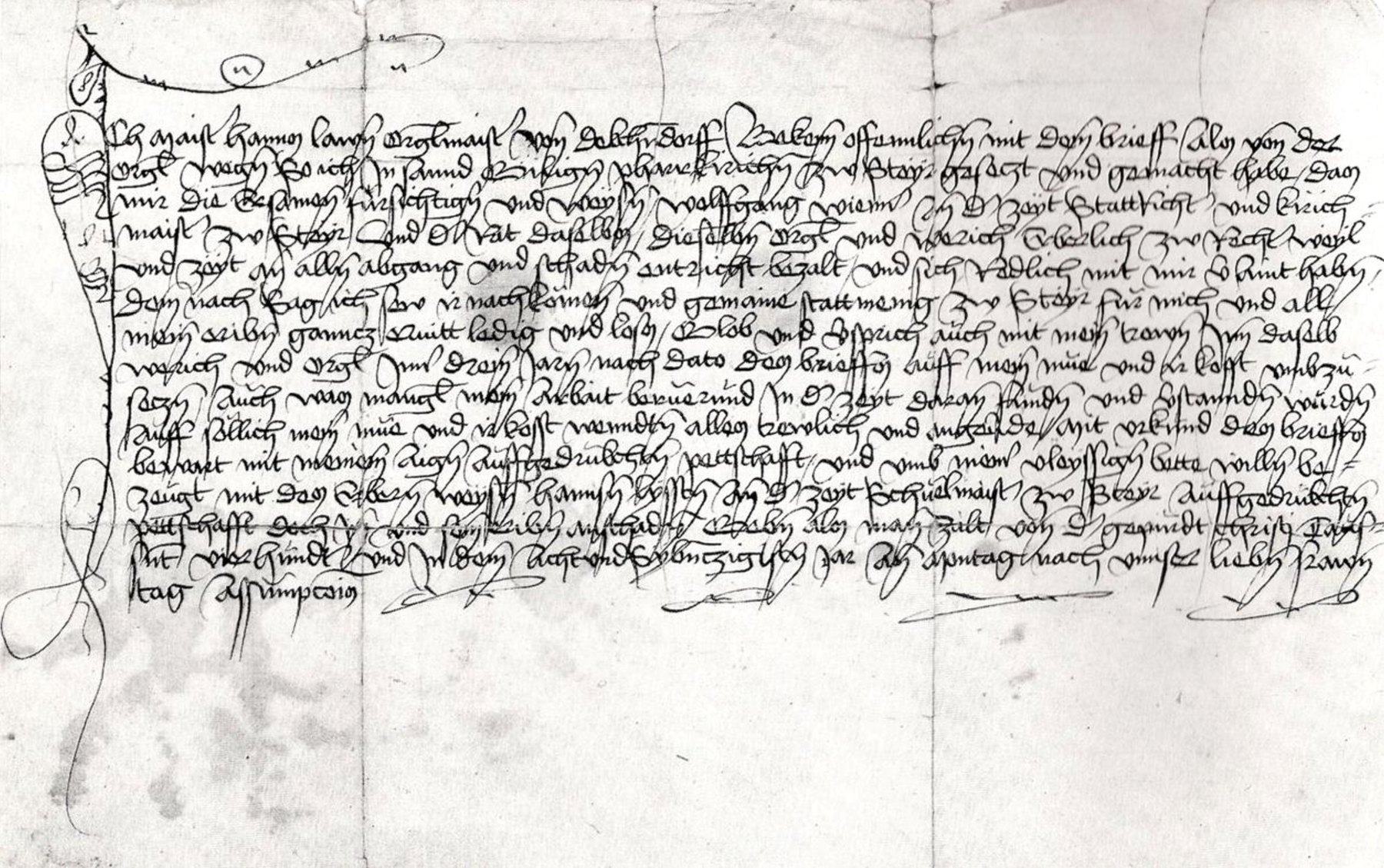
Han(ne)s Law(e)n, Orgelmeister aus Deggendorf, bestätigt die Bezahlung der neuen Orgel in der Stadtpfarrkirche zu Steyr durch den Stadtrichter und Kirchenmeister Wolfgang Wienner (1478 VIII 19) (Fiala 2013, 141, Abb. 27; Bildzitat). /
Han(ne)s Lawen, organ master from Deggendorf, confirms payment for the new organ of the town parish church of Steyr through the town judge and church warden Wolfgang Wienner (1478 VIII 19) (Fiala 2013, 141, Abb. 27; image citation).
Organ Builders
The oldest organ builder known by name in Austrian territory is Jörg Behaim. He worked at St Stephen’s Cathedral in Vienna between 1391 and 1412 (or 1430) and appears to have been active over a large territory. Other organ builders of supraregional importance in the fifteenth and early sixteenth centuries were Burkhard Tischlinger (Dienstlinger), Peter Gareis, Jakob Kunigswerth (Kunigsschwerdt), Hans Larer (Lar), Bertold Mörly, Wolfgang Reichenauer, Johannes Reicher, Wolfgang and Hans Rudorf (Ruedorfer), and Balthasar Streng.[21] Prominent organ builders from elsewhere included Heinrich Traxdorff (Traßdorfer) of Mainz and Christian Taler (Faber) of Wasserburg am Inn. These two builders supplied organs for the Abbey of St Peter in Salzburg in 1444 and 1505, respectively. Michael Khall of Budweis was commissioned in 1497 to build an organ for St Wolfgang. Another foreigner was the famous Jan Behaim of Dubrau near Prachatice (Bohemia), active in Innsbruck between 1498 and 1513.
Organists
Numerous organists identifiable by name from the fourteenth century onward complete the picture of the era.[22] In social status as in musical ability, the spectrum was broad.[23] At one end stood the usual cleric or educated layman, who normally played several instruments and also had to maintain the instrument himself. At the other extreme, in individual cases, stood highly qualified, specialized organists in municipal or courtly service. A few of these, such as Conrad Paumann or Paul Hofhaimer, won European renown already in their lifetimes. They placed their widely admired art in the service of a prince’s self-representation. Organ playing was a craft-based art, transmitted by practice and akin to that of the minstrels; it was pursued above all by clerics, teachers, and scribes. For chapel service, “artful organists” were preferred: men who also worked as singers or, rarely, as composers.[24] Through them the organists’ profession grew into the “paradigmatic mediator between orality and literacy.”[25] The written testimonies to the art of the organ thus also reflect the appropriation of late-medieval intellectual culture.[26] None of the organists known by name before Hofhaimer left an individual profile. Even so, in mid-fifteenth-century Vienna we find a “schoolmaster Chunradus der Weispacher,” in whose estate a portative and a positive were found.[27] And with Wolfgang Chranekker, a further organist active in the Austrian region can now be identified. He wrote down the final part of the St Emmeram Codex (D-Mbs Clm 14274). In his work he may have built some kind of bridge between the artful vocal polyphony of the day and organ playing (C. Organists and Copyists).[28]
With Paul Hofhaimer, around 1500 the “monarcha organistarum” appears, a player for whose virtuosity no epithet, no praise was too lofty.[29] Apart from his appearances a soloist, he was given fellow organists to assist him in the court chapel: Benedict Senflinger, Gregor Accot, Hans Sattler, Jakob Kellergraf, and Jörg Bamheck.l[30] Hofhaimer’s significance as a teacher is attested by his many, sometimes prominent, pupils, a number of whom worked in southwestern Germany. Of these, probably only Hans Buchner stood briefly in Habsburg court service; his Fundamentum preserves Hofhaimer’s teaching. Wolfgang Grefinger, by contrast, did not serve the court. He appears in the Vienna university registers in 1509, frequented the city’s humanist circles, and served as cathedral organist at St Stephen’s. His Passau pupil Schachinger we find in Schwaz, Tyrol, from 1506 to 1508. Hofhaimer’s later Salzburg colleagues Gregor Peschin and Caspar Glanner, too, probably studied under him.[31]
Paul Hofhaimer
Paul Hofhaimer came from a family of organists in Radstadt and was trained into a thoroughly accomplished organ expert at the court of Frederick III. Active at the Innsbruck court from about 1487, he was engaged in 1490 by Maximilian I as “chief organist” (obrigster Organist). In this capacity Hofhaimer had to accompany the emperor on all his important journeys, which quickly spread his fame internationally. As a soloist endowed with privileges, he formed part of Maximilian’s self-fashioning as a ruler. Depictions of him on a chariot in the Triumphal Procession and on a woodcut by Hans Weiditz attest to this (Fig. Emperor Maximilian’s Chapel; Fig. Triumphal Procession, Regal).[32] Emperor Maximilian also tried his own hand at playing the organ, thereby joining a long line of Habsburg rulers at the keyboard.[33]
In 1515 Hofhaimer was knighted. After Maximilian’s death he moved to Salzburg as cathedral organist. There, too, he served primarily as chamber organist to his sovereign, Cardinal Matthäus Lang. His colleagues Nicolaus Lescalier and, from 1527, the Bohemian-born Gregor Peschin had to take on the ordinary services in the cathedral. Hofhaimer himself could be admired at the cathedral organ only in the cardinal’s presence and on the highest feast days.[34]
Use and Abuse of the Organ
The “organ-building boom” demonstrable for the region of Austria as well in the fifteenth century should not obscure one fact. The scope, value, and functions of organ playing within the church remained partly disputed, and by no means uniformly regulated, right up to the Reformation era.[35] Its place as an ecclesiastical instrument in its own right, documented as early as the thirteenth century at Admont Abbey, long remained the exception.[36] As a rule, organ playing during the liturgy required special authorization, even where it was welcomed. However, continual complaints about abuses show that the instrument had prevailed by around 1500. By then it was used in the solemn liturgy of all the larger churches of the German-speaking lands. The nomination of a patron saint in the figure of St Cecilia contributed to promoting its use in church.[37]
At the start of the fifteenth century, the use of the organ was still restricted to the highest feast days. Within a few decades it evidently expanded to all Sundays and feast days. It established itself in a close relation to the human voice, as a factor that abbreviated the singing or replaced it in phases in a technique of alternation (“alternatim” practice).[38] The extent and quality of its use depended on the rank of the feast, and sometimes on that of the celebrant. This could at times even influence the choice of tempi and stops.[39] There were no uniform rules for liturgical participation. Precise stipulations of the duties were only rarely set down, as in Hans Buchner’s contract of employment at the cathedral of Constance in 1512.[40])
Even so, the performance of the Mass Ordinary was usually divided entirely between singers and organist. The organ was also used regularly in certain parts of the Proper (Introit, Gradual, Communion), during the offertory, and for hymns, psalms, the Magnificat, and the Te Deum. It opened and closed the liturgy and accompanied processions. Only in Advent and Lent did it fall silent, except on the feasts of Candlemas and the Annunciation.
Complaints about improper use in worship run like a recurring thread through the history of organ playing, well into the sixteenth century. However, the frequent repetition and renewal of official prohibitions evidently had little effect.[41] Among the most denounced abuses were two: the playing of music deemed too secular — chiefly dances — and playing that became intrusive because it was too frequent and too long. A visitation of Garsten monastery in 1419 complained of the latter.[42] Because organs could not convey text as did the human voice, a suspicion persisted that the meaning and message of the word were also lost.
Little is known about organ playing in secular contexts, though it is well documented iconographically. The repertoire is likely to have consisted mainly of intabulations of vocal pieces and of dances. Landini, Paumann, and Du Fay all had themselves portrayed with the portative. Yet the portative, like the positive and the regal, counted as a primarily courtly or domestic instrument.
[1] This is exemplified by the standard work of Apel 1967, whose geographical arrangement is fixed on the German-speaking area and accordingly subsumes all Austrian representatives of keyboard music under the rubric “South German.”
[2] Praetorius 1619, 85.
[3] Edler 1997, 12.
[4] Salmen 1978, 22.
[5] Klotz 1986, 7–123; Edler 1997, 22. Organ building and the appointment of organists are well documented, e.g. in Bozen (E. Bozen).
[7] Klotz 1986, 68 f.
[8] Klotz 1986, 60.
[9] Of the great Seckau organ of the late fifteenth century, only the case survives; Federhofer 1951, 25.
[10] Bowles 1987, 183.
[11] Oberhuber 1978, 147 f.
[12] Forer 1973, 60, 172 und 196.
[13] One might mention here, among others, the organ at Seckau Abbey, demolished only in 1905; Flotzinger 1980, 23.
[14] Stenzl/Hintermaier/Walterskirchen 2005, 305.
[15] Quoika 1953, 16.
[16] Quoika 1953, 11.
[17] Compiled after Flotzinger/Gruber 1995, 89 f.; Quoika 1953; Eberstaller 1955; Forer 1973, 17–35, and Frieberger 1984, 26–29.
[18] Fiala 2013, 136 f.
[19] Eberstaller 1955, 4.
[20] Frieberger 1984, 27 f.
[21] Eberstaller 1955, 11–15. See also » E. Bozen.
[22] Flotzinger/Gruber 1995, 90.
[23] Salmen 1978, 12–26.
[24] Salmen 1978, 15–16.
[25] Meyer 2001, 78.
[26] Meyer 2001, 78.
[27] Quoika 1953, 14.
[29] Salmen 1978, 23.
[31] Flotzinger/Gruber 1995, 198.
[32] Moser 1929, 26 f.; Dammann 1974, 252, 259, 274 ff.; Michel/Sternath 2012, 247 f.
[34] Stenzl/Hintermaier/Walterskirchen 2005, 91, 94.
[35] Pacik 1978, 120–143.
[36] Quoika 1953, 18.
[37] Körndle 2003, 24–30.
[38] Mielke 1993, Bd. 1, 29–67.
[39] Körndle 2001, 225–256.
[40] Schuler 2000, 1191.
[41] Körndle 2001, 228–240; Mielke 1993, vol. 1, 42–55.
[42] Frieberger 1984, 26.
Aringer 2007 | Besseler 1973 | Crane 1965 | Göllner 2003 | Hofhaimer 2009 | Klugseder 2012 | Witkowska-Zaremba 2001
Suggested citation:
Klaus Aringer: „Organs and Organ Music in the Region of Austria“, slightly revised translation of the original German essay (2016), in Musikleben des Spätmittelalters in der Region Österreich musical-life.net/essays/orgeln-und-orgelmusik-der-region-oesterreich (2016).