The Polyphonic Church Year as a Cultural Project of Maximilian I
In the context of Maximilian I’s cultural policy (» I. Ch. Court Music and Representation), his transfer of regency in the Netherlands to his son Philip (1494) and the renewed focus on affairs within the Holy Roman Empire sent clear signals regarding musical representation. Between 1496 and 1498, the court chapel(s) distributed between Augsburg and Innsbruck (» I. The court chapel of Maximilian I.) were restructured following the Burgundian model.[1] Henricus Isaac was appointed to the newly created position of “componist” (» I. Ch. „I […] will use all my art for his Majesty’s chapel“). Georg Slatkonia, the future (first resident) Bishop of Vienna, was named as chapel master. Finally, the dispersed musical forces were consolidated in Vienna. All these actions embodied the strong representational ambitions of the future emperor. The function of the chapel thus becomes evident, both as the performing body for services and liturgical celebrations, and as an acoustic flagship. It therefore received special care in the promotion of its singers and their vocal qualities. In the long term, this reveals a new dimension in the creation of a cultural identity and a previously unknown politics of memory within the Habsburg family.
The most significant musical expression of the new attitude was the liturgical compositions of Henricus Isaac, which made it possible to experience the church year not only in monophony but also in polyphony. Against this background, the composition of a series of eleven introits for six voices, extraordinary for the time, becomes understandable. These works, preserved exclusively in the Munich Choir Book » D-Mbs Mus.ms. 31, provide music for the high feasts of the church year (Christmas Day, the Octave Day of Christmas, Epiphany, the Purification of Mary, Marian feasts in Advent, Easter Sunday, Ascension Day, Pentecost Sunday, Trinity Sunday, Corpus Christi), as well as providing an introit for general Marian feasts.
How solemnly the church feasts could be shaped with these few polyphonic settings is shown, for example, by Isaac’s six-part introit Resurrexi for Easter Sunday (» Fig. Introitus Resurrexi). In this opening and entrance chant for the Mass, Isaac was apparently less concerned with expressing the joy of Christ’s resurrection than with reflecting the dignity of the feast in a setting that appears archaic. This impression is created on the one hand by the hypophrygian mode of the chant melody, which conveys a rather “sorrowful” mood due to its characteristic semitone step, and on the other hand by the frequently occurring parallel fourths. (» Audio example ♫ Resurrexi) Isaac chooses a different kind of festive representation in his four-part introit for the feast day of St Mary Magdalene, through combination with a litany (» I. SL Isaac‘s Introit).
Abb. Introitus Resurrexi
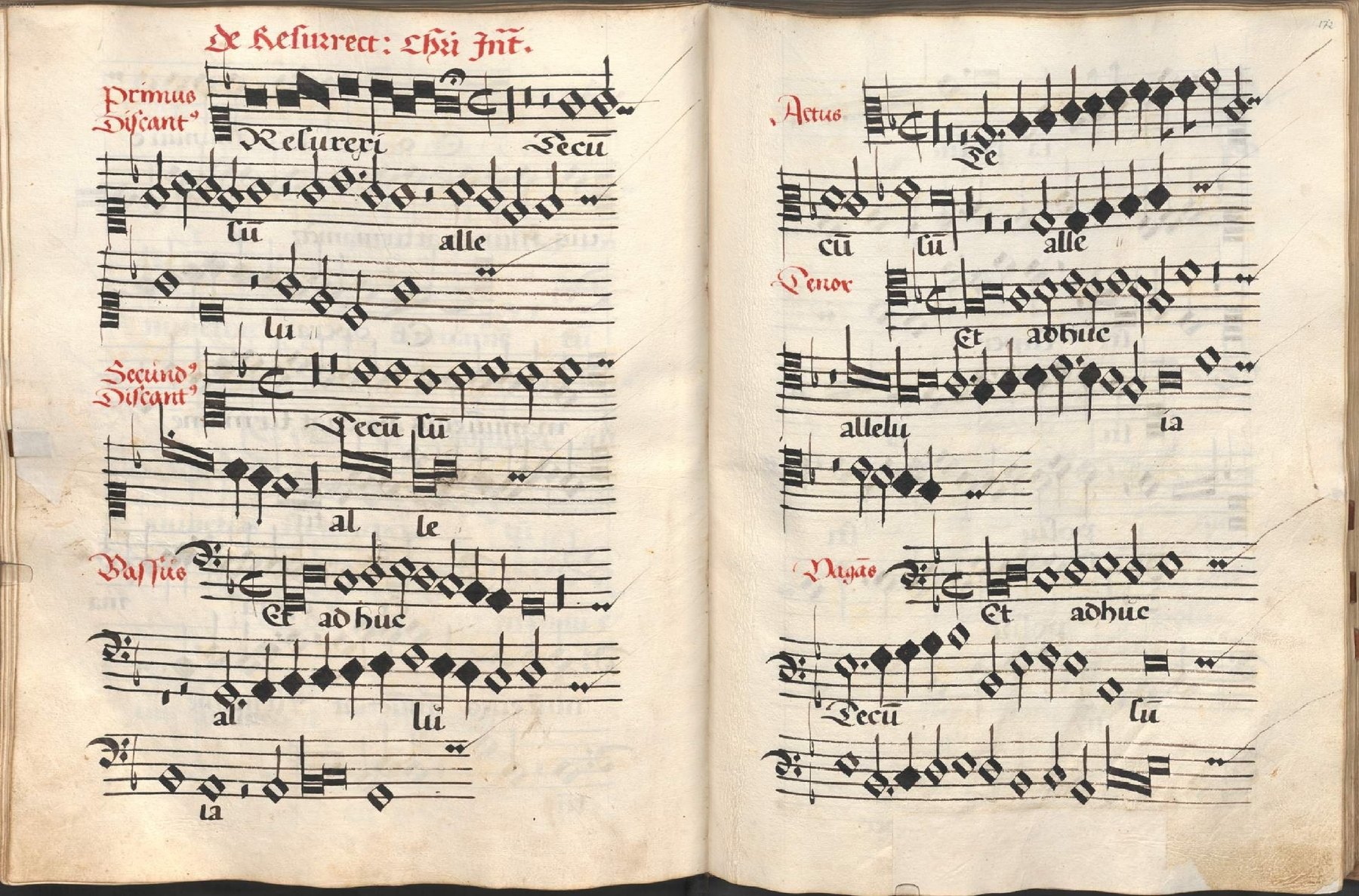
Heinrich Isaacs sechsstimmiger Introitus Resurrexi für den Ostersonntag im Münchner Chorbuch » D-Mbs Mus.ms. 31, fol. 171v–172r. (Mit Genehmigung der Bayerischen Staatsbibliothek.)
Resurrexi, et adhuc tecum sum, alleluia.
Posuisti super me manum tuam, alleluia.
Mirabilis facta est scientia tua, alleluia.
Ps. Domine, probasti me, et cognovisti me;
tu cognovisti sessionem meam, et resurrectionem meam.
Gloria patri…
(Ich bin auferstanden, und bin noch bei dir, alleluia. Du hast deine Hand auf mich gelegt, alleluia. Deine Weisheit ist ein Wunderwerk, alleluia. Ps. Herr, du hast mich geprüft und erkannt. Du kanntest mein Einschlafen und mein Aufwachen. Ehre sei dem Vater…)
[1] A discussion of Isaac’s chapel personnel can now be found in Gasch 2015, see especially 363–370.
[1] A discussion of Isaac’s chapel personnel can now be found in Gasch 2015, see especially 363–370.
[3] On the idea of monumentalising the liturgical year through polyphonic settings of the Propers, see Strohm 2011.
[4] For a general overview of Isaac’s Masses, see Staehelin 1977.
[5] For a digital facsimile of Isaac’s Missa paschalis in » D-Ju Ms. 36, fol. 141v–155r, see: http://nbn-resolving.de/urn:nbn:de:urmel-1bb48d27-d632-4bb7-b381-36e0bae379018-00004515-2851.
[8] On ruler praise in the fifteenth century, see » D. Albrecht II. und Friedrich III.
[9] For a reconstruction and German translation of the complete motet text, see Panagl 2004, 54. For a digital facsimile of the motet in » CH-Bu Ms. F IX 55, fol. 4v–7r: http://www.e-manuscripta.ch/bau/content/pageview/311300.
[10] See Haggh 2007 for general background, and Körndle 2007 for the specific context in Constance. Evidence of instrumental accompaniment is found in a Tegernsee chronicl (D-Mbs Clm 1586, fol. 429v–430r).
[11] For a digital facsimile of the motet Virgo prudentissima in » CH-SGs Cod. Sang. 464 see: http://www.e-codices.unifr.ch/en/csg/0464/5v/0.
[12] The earlier view that both works were intended for 15 August 1507 (Dunning 1970, 41) is questionable, as the Diet had already concluded by that time. See also Rothenberg 2011.
[13] Körndle 2007, 96–101.
[14] Although the painting was not commissioned by Maximilian but by the German Rosary Brotherhood at the Church of San Bartolomeo in Venice, its composition contains numerous elements reflecting Maximilian’s ideals of self-representation. See Rothenberg 2011, 78 ff.
[15] See Wiesflecker 1971–1986, vol. 4, 1–27.
Recommended Citation:
Stefan Gasch: „Henricus Isaac in the Service of Maximilian’s Ecclesiastical and State Ceremonies“, in: Musical Life of the Late Middle Ages in the Austrian Region <https://musical-life.net/en/essays/henricus-isaac-service-maximilians-ecclesiastical-and-state-ceremonies> (2025); slightly revised AI-assisted translation of the original German essay (2016).