Henricus Isaac in the Service of Maximilian’s Ecclesiastical and State Ceremonies
The Liturgical Year (Church Year)
Life in the Middle Ages and the Early Modern period was shaped by religion and religious beliefs in a way hardly imaginable today. In Christianity, the liturgical year (church year) consists of the two festive cycles of Christmas and Easter, which trace the central events in the life of Jesus (birth, death, and resurrection). This structured daily life like no other constant. The high feasts of the church year were each extended by several weeks of fasting and preparation (Advent and Quadragesima) and, in the case of the post-Easter period, by the inclusion of further feasts such as the Ascension of Christ (on the fortieth day after Easter) and the celebration of the sending of the Holy Spirit (Pentecost, on the fiftieth day after Easter), before the period of the free Sundays in the church year began, the number of which depended on the date of Easter. In addition, there were other “official” church celebrations such as feasts of Mary or saints, whose significance could vary depending on the diocese, as well as “individual” feast and memorial days (anniversary foundations for deceased family members or particular saints), for the liturgical-musical arrangement of which large sums of money were spent.
This strict, annually recurring sequence was determined ceremonially and musically by a prescribed liturgy and the music associated with it. This music initially consisted of an extraordinarily rich repertoire of monophonic chant melodies, commonly referred to as “Gregorian chant”. Only on special occasions was the monophony expanded into polyphony – in order to highlight the exceptional character of the respective feast (» E. Ch. Church plainsong and “music”).
The Polyphonic Church Year as a Cultural Project of Maximilian I
In the context of Maximilian I’s cultural policy (» I. Ch. Court Music and Representation), his transfer of regency in the Netherlands to his son Philip (1494) and the renewed focus on affairs within the Holy Roman Empire sent clear signals regarding musical representation. Between 1496 and 1498, the court chapel(s) distributed between Augsburg and Innsbruck (» I. The court chapel of Maximilian I.) were restructured following the Burgundian model.[1] Henricus Isaac was appointed to the newly created position of “componist” (» I. Ch. „I […] will use all my art for his Majesty’s chapel“). Georg Slatkonia, the future (first resident) Bishop of Vienna, was named as chapel master. Finally, the dispersed musical forces were consolidated in Vienna. All these actions embodied the strong representational ambitions of the future emperor. The function of the chapel thus becomes evident, both as the performing body for services and liturgical celebrations, and as an acoustic flagship. It therefore received special care in the promotion of its singers and their vocal qualities. In the long term, this reveals a new dimension in the creation of a cultural identity and a previously unknown politics of memory within the Habsburg family.
The most significant musical expression of the new attitude was the liturgical compositions of Henricus Isaac, which made it possible to experience the church year not only in monophony but also in polyphony. Against this background, the composition of a series of eleven introits for six voices, extraordinary for the time, becomes understandable. These works, preserved exclusively in the Munich Choir Book » D-Mbs Mus.ms. 31, provide music for the high feasts of the church year (Christmas Day, the Octave Day of Christmas, Epiphany, the Purification of Mary, Marian feasts in Advent, Easter Sunday, Ascension Day, Pentecost Sunday, Trinity Sunday, Corpus Christi), as well as providing an introit for general Marian feasts.
How solemnly the church feasts could be shaped with these few polyphonic settings is shown, for example, by Isaac’s six-part introit Resurrexi for Easter Sunday (» Fig. Introitus Resurrexi). In this opening and entrance chant for the Mass, Isaac was apparently less concerned with expressing the joy of Christ’s resurrection than with reflecting the dignity of the feast in a setting that appears archaic. This impression is created on the one hand by the hypophrygian mode of the chant melody, which conveys a rather “sorrowful” mood due to its characteristic semitone step, and on the other hand by the frequently occurring parallel fourths. (» Audio example ♫ Resurrexi) Isaac chooses a different kind of festive representation in his four-part introit for the feast day of St Mary Magdalene, through combination with a litany (» I. SL Isaac‘s Introit).
Abb. Introitus Resurrexi
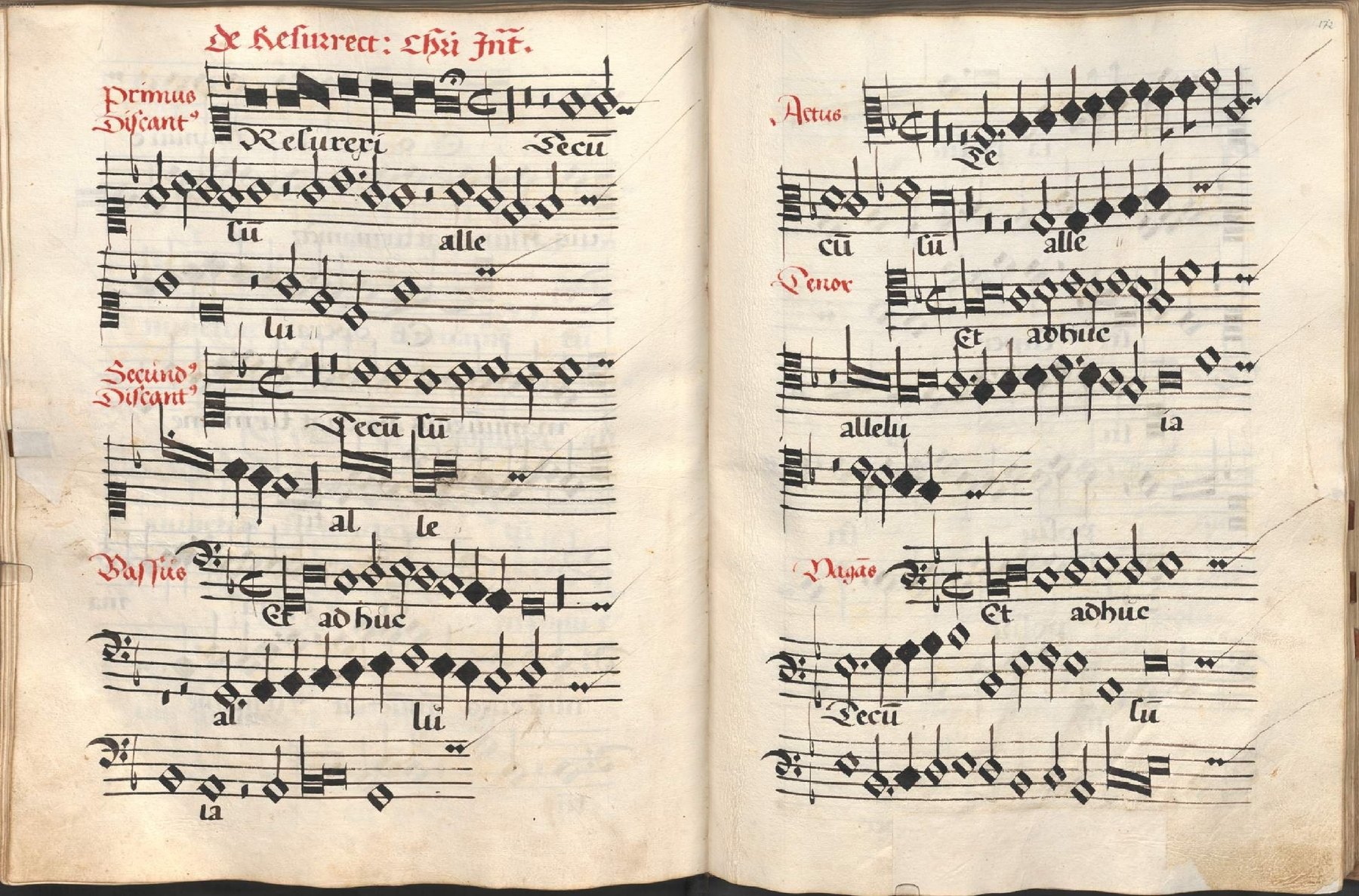
Heinrich Isaacs sechsstimmiger Introitus Resurrexi für den Ostersonntag im Münchner Chorbuch » D-Mbs Mus.ms. 31, fol. 171v–172r. (Mit Genehmigung der Bayerischen Staatsbibliothek.)
Resurrexi, et adhuc tecum sum, alleluia.
Posuisti super me manum tuam, alleluia.
Mirabilis facta est scientia tua, alleluia.
Ps. Domine, probasti me, et cognovisti me;
tu cognovisti sessionem meam, et resurrectionem meam.
Gloria patri…(Ich bin auferstanden, und bin noch bei dir, alleluia. Du hast deine Hand auf mich gelegt, alleluia. Deine Weisheit ist ein Wunderwerk, alleluia. Ps. Herr, du hast mich geprüft und erkannt. Du kanntest mein Einschlafen und mein Aufwachen. Ehre sei dem Vater…)
Isaac as a Key Figure: Chant-Based Cycles of Propers and Ordinaries
Among the projects through which Maximilian spread the ideology of the imperial house,[2] are Isaac’s cycles of Propers. Though the work was never fully completed, it was intended in its entirety to form a polyphonic Graduale (a book containing the variable, day-specific chants of the Mass) for all occasions and feasts of the church year at the imperial court (» G. Henricus Isaac; » I. Isaac’s Amazonas).[3] The settings, published more than thirty years after Isaac’s death in three volumes under the title Coralis Constantinus in Nuremberg, include Isaac’s compositions of the Introit, Alleluia or Tract, Sequence, and Communion.
Isaac’s twenty-one chant-based ordinaries – cyclical mass settings based on the chant melodies of the individual ordinary chants – also belong to Maximilian’s new approach to ceremonial sonic representation. In several respects, they are extraordinary for the period around 1500: with multiple settings for three to six voices, they not only cover the various festive occasions of the church year (high feasts, feasts of apostles, martyrs, confessors, virgins, Marian feasts, etc.), but in their conception as chant-based ordinary cycles, they also represent the monumentalisation of a genre that had previously led a niche existence.[4] Although individual Mass settings based on the chant melodies appropriate to each section of the Mass had been known since the early fifteenth century, Isaac brought this previously little-regarded form of Ordinary setting to an unprecedented flourishing through his systematic approach to the musical staging of the imperial household’s daily worship, both in terms of genre history and through the incorporation of the latest compositional trends. The musical genre of the Mass thus acquired a representative function for the Habsburgs.
Some characteristics of this type of ordinary mass setting can be illustrated by Isaac’s sonorous six-part Missa paschalis (» D-Ju Ms. 36, fol. 141v–155r).[5] As in nearly all liturgical music of the time, the chant forms the guiding thread around which the polyphonic composition is woven. In this case, it is the first chant-based Mass, used in the liturgy only on Easter Sunday and the Sundays following Easter (until Pentecost) (» Fig. Graduale Pataviense, Kyrie für Ostern). Isaac conceived this composition – as always when setting monophonic Ordinary melodies – as an alternatim Mass, a performance practice in which sections of sung polyphony alternate either with monophonic chant or with improvised organ versets (» Audio example ♫ Kyrie Missa paschalis).[6] The performance with organ improvisations, in which the imperial organist Paul Hofhaimer (» C. Ch. Paul Hofhaimer), a widely renowned improviser, participated, is well documented at the imperial court, for example in the designation of Masses “ad organum” in the Viennese manuscript » A-Wn Mus. Hs. 18745). The music demonstrates an extremely flexible interplay between monophonic chant and polyphony on both vocal and instrumental levels, as well as a close interweaving of vocal and instrumental resources in the liturgical music performed at the court of Maximilian I.
Abb. Graduale Pataviense, Kyrie für Ostern
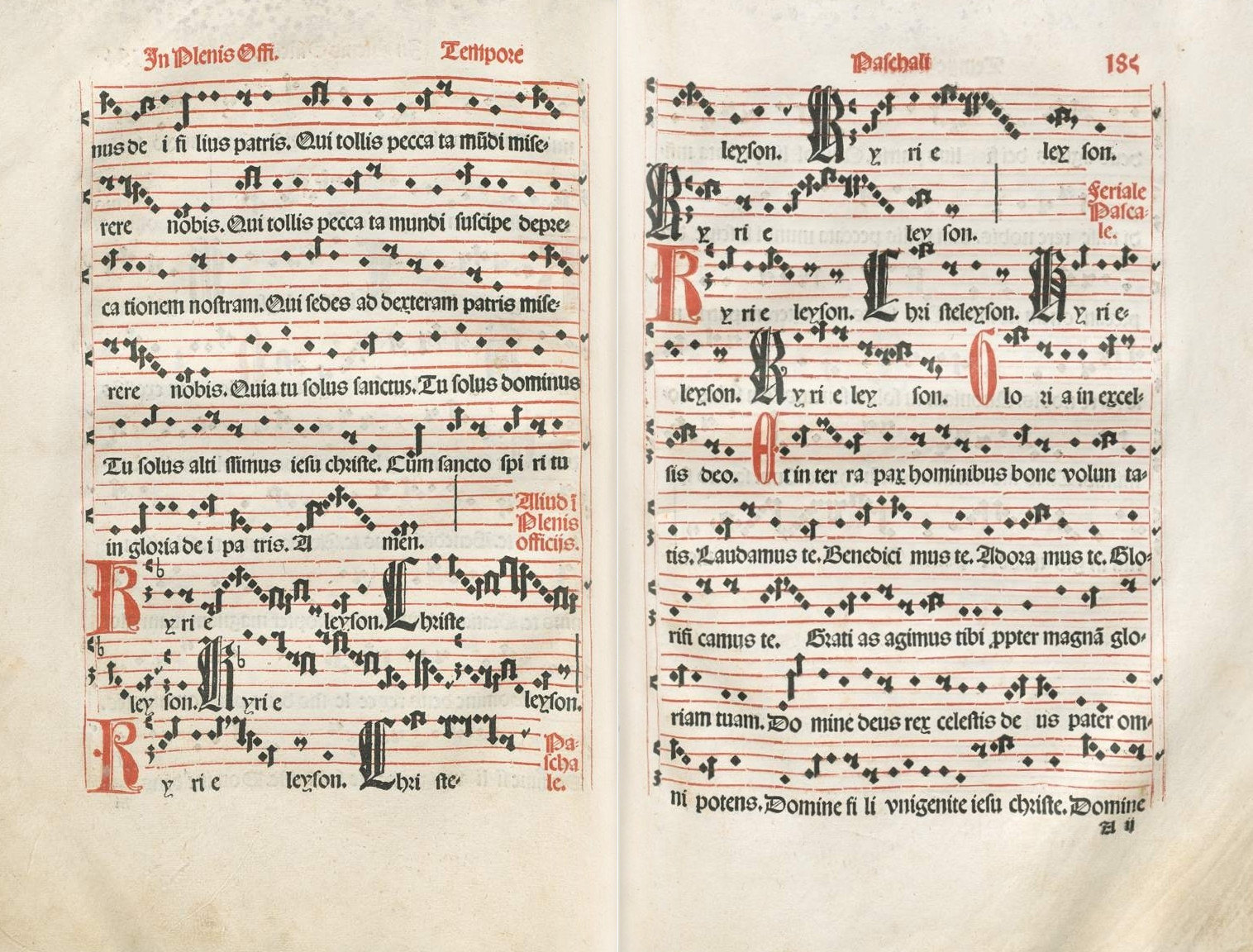
Kyrie für den Ostersonntag und die Sonntage nach Ostern (bis Pfingsten) im » Graduale Pataviense (Wien: Johannes Winterburger 1511), fol. 184v–185r. (Mit Genehmigung der Bayerischen Staatsbibliothek.)
Composed Praise of the Ruler: Isaac’s Motet Optime divino … pastor
The court chapel naturally played no less a representative role in diplomatic contexts and official ceremonies on the occasion of weddings, deaths, or imperial diets than it did in worship services. Isaac’s two-part motet Optime divino … pastor (» Hörbsp. ♫ Optime pastor). belongs to such a context. The composition, which research had suggested was created for the reception of the papal nuncio Lorenzo Campeggi in Innsbruck (1514) but which more recently has been shown to have been commissioned to celebrate the papal election of Leo X in 1513,[7] is – uniquely in Isaac’s motet output – conceived with two cantus firmus melodies (Da pacem, Domine; Sacerdos et pontifex), which sound simultaneously in both sections. Together with a text written in elevated humanist Latin, the monophonic chant melodies serve as expressive layers for the close interweaving of the spheres of secular (Emperor) and spiritual power (Pope), united in the shared plea for peace (referring to the defence against the Turks). Both protagonists are only indirectly named in the text (e.g. “medicus” or “leo” = Medici Pope Leo X; “aquila” = Emperor Maximilian I). This increased the piece’s appeal for reuse, as realised in its role as the opening motet in the » Liber selectarum cantionum of 1520 (» Fig. Liber selectarum cantionum). Moreover, such implicit homage – which places offices rather than individuals at the centre of attention – reflects a changed attitude towards the genre of works in praise of a ruler compared to those from the fifteenth century.[8] By using two cantus firmi and developing the polyphonic setting from a finely woven two-part texture, Isaac consciously places himself within the long musical tradition of politically motivated panegyric and lends the music an archaic-sounding effect. On the other hand, this type of sound contrasts with the fully voiced, pompous final sections typical of more recent times. Thus, the composer – who was known to have worked for both the Habsburgs and the Medici – achieves in this motet a symbiosis between traditional praise of the ruler and contemporary compositional technique.
Abb. Liber selectarum cantionum
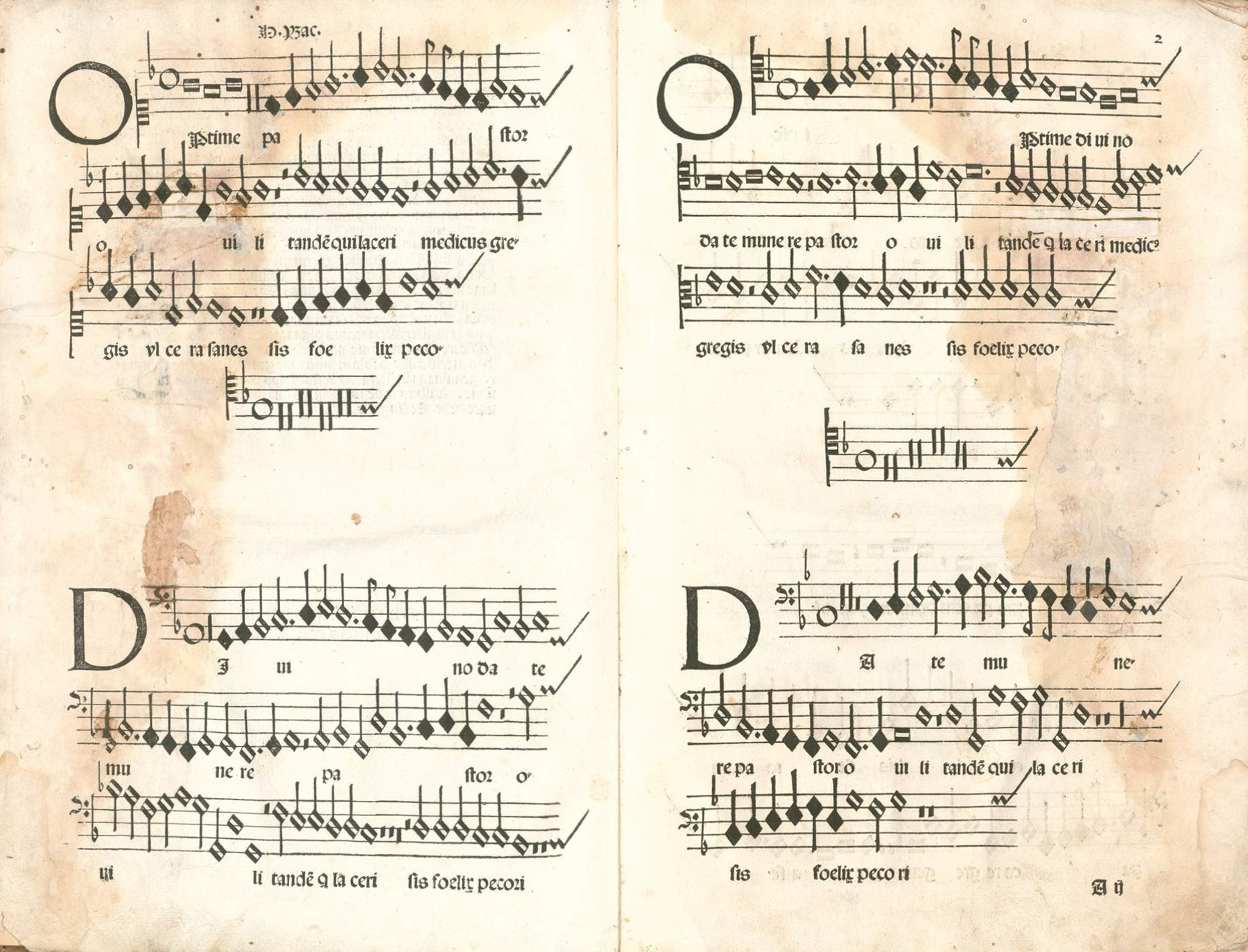
Die Eröffnungsmotette Optime pastor im » Liber selectarum cantionum (Augsburg: Grimm & Wirsung 1520), fol. 1v – 2r.
(Mit Genehmigung der Bayerischen Staatsbibliothek.)
Music for the Imperial Diet of Constance, 1507
In contrast to Isaac’s motet Optime pastor, an example of a comparatively private setting honouring a cleric (cf. Ch. Composed Praise of the Ruler: Isaac’s Motet Optime divino … pastor), there were logistical “mega-events” such as imperial diets, where the emperor, prince-electors, and other high-ranking secular and ecclesiastical dignitaries entered a bishop’s or imperial city with pomp and entourage (» D. Royal Entry) to negotiate future political strategies over a period of weeks, months, or even years. The trumpeters who accompanied them provided an indispensable sonic signal upon the arrival of each participant. Musicians temporarily employed by participants of the diet from among the local Stadtpfeifer (town pipers), as well as court chapels travelling in various sizes, also contributed to the soundscape that accompanied the elements of such grand events.
The imperial diet was usually opened with a mass of the Holy Spirit, to seek God’s blessing for the decisions to be made. In this, the emperor’s singers played a central role. It is very likely that at the Imperial Diet of Constance in 1507, where Maximilian I’s imperial coronation in Rome, the reform of the empire and other matters were once again to be negotiated (» D. Ch. Zum Repertoire der Handschrift A-Wn Mus.Hs. 15495), Maximilian’s chapel sang Isaac’s motet Sancti Spiritus assit nobis gratia (Secunda pars: Imperii proceres) (» Fig. Maximilian I. im Dom zu Konstanz).[9] With the opening quotation from the Pentecost sequence, the first part of the motet calls upon the Holy Spirit for support and commends Maximilian – in repeated chordal phrases – to the almighty God. The second part of the motet, by contrast, lists the various participants of the diet, who are called to unity and obedience towards Maximilian, for example, in the passage “Pro Maximiliano psallite” (“Sing for Maximilian”). Both sections use the same auditory and musical devices, and are characterised less by imitative counterpoint than by repeated notes and chordal declamation in homorhythmic passages, creating a majestic and festive sound that honoured the future emperor and suited the solemnity of the occasion.
Abb. Maximilian I. im Dom zu Konstanz
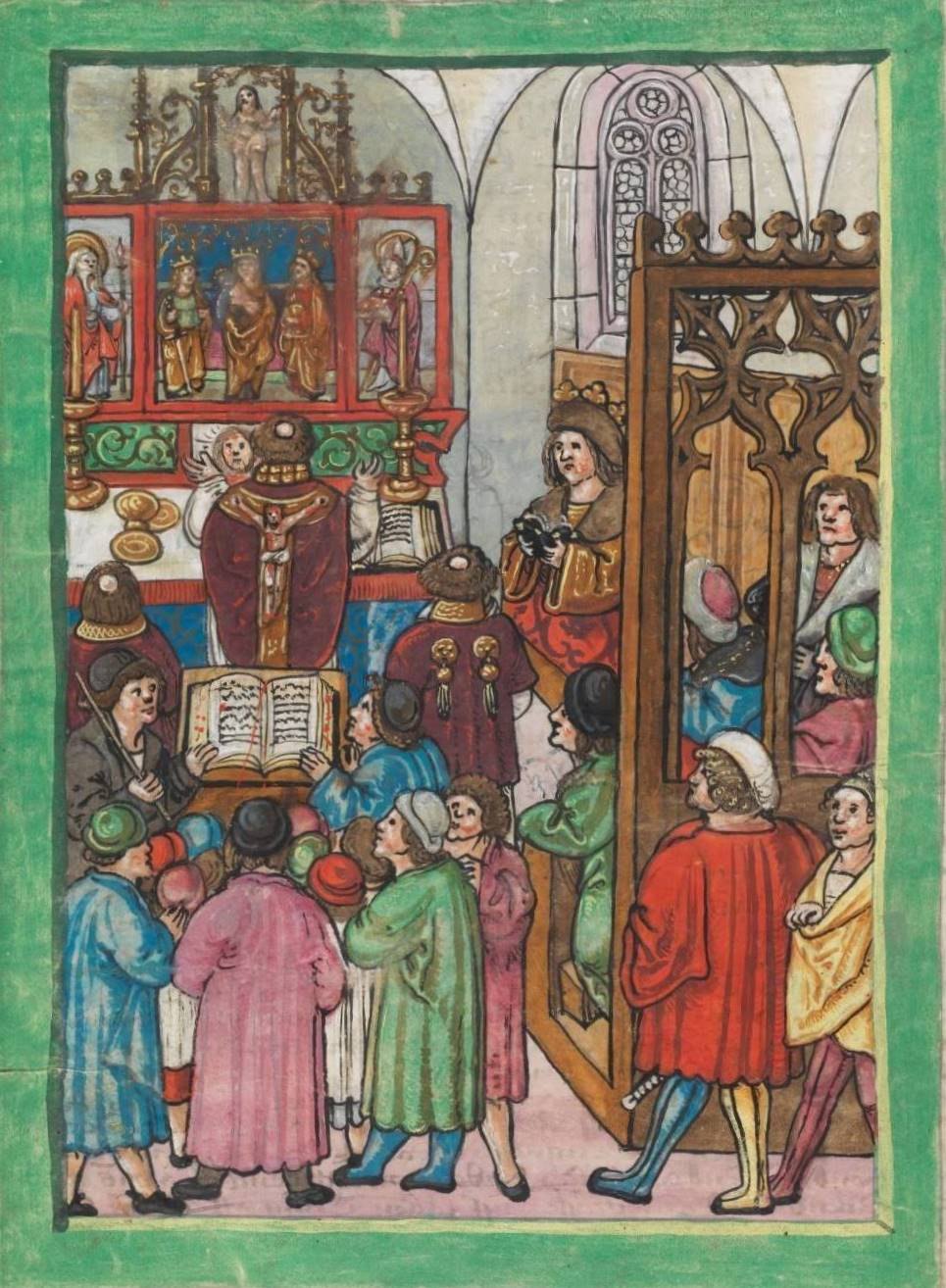
Kaiser Maximilian I. die Messe hörend im Dom zu Konstanz, im Vordergrund die Hofkapelle. Der Künstler stellt das Chorbuch in die Mitte und verteilt die 13 Musiker im Halbkreis darum. Diebold Schilling, Luzerner Chronik (1513), fol. 233v (S. 472). Abb. mit Genehmigung der Korporation Luzern. /Emperor Maximilian I. in Constance cathedral, listening to a Mass service, with the court chapel in the foregrund. The miniaturist places the choirbook in a central position and arranges the 13 musicians in a semicircle around it. The musical source is the pivotal item in the performance described here. Diebold Schilling, Luzerner Chronik (1513), fol. 233v (p. 472). Reproduction with permission of the corporation of Lucerne.
Another event at this imperial diet that required appropriate commemoration was the funeral ritual for Maximilian’s son Philip, who had died unexpectedly the previous year. As was customary in such cases, the event was marked with a Requiem Mass and a Lady Mass. It is documented that the Lady Mass was accompanied by trombones and the organ, the latter played by the imperial court organist Paul Hofhaimer.[10] The close musical connections between Isaac’s extraordinarily splendid motet Virgo prudentissima (6v) (» Audio example ♫ Virgo prudentissima) and his Mass of the same name suggest that this was the motet composed in Constance. (The note “Isaac CONSTANTIÆ POSVIT” appears beside this piece in » CH-SGs Cod. Sang. 464[11], fol. 5v). Furthermore, the magnificently conceived Mass Virgo prudentissima should also be seen in the context of this special occasion.[12] In the Mass, the Marian antiphon Virgo prudentissima, used as a cantus firmus, and the actual Ordinary Mass text interact musically in the closest way,[13] while in the motet, the special relationship between the Virgin Mary and King Maximilian I is also emphasised through the text. This “relationship” was often staged by the emperor himself and was also reflected iconographically, for example in the Feast of the Rosary painted by Albrecht Dürer in 1506 (» Fig. Albrecht Dürer, Das Rosenkranzfest). In this painting, not only is the coronation of Mary depicted, but also the simultaneous coronation of Maximilian by the Queen of Heaven, through whom the king receives his legitimacy.[14] The author of the richly imagistic, humanist-classicising Marian text of the motet – which quotes the antiphon only at the beginning of the main text and alludes to Virgil – was the imperial court chapel master Georg Slatkonia, who in 1513 was appointed the first Bishop of Vienna by Pope Leo X. Slatkonia was also responsible for the text of Optime divino … pastor (cf. Ch. Composed Praise of the Ruler: Isaac’s Motet Optime divino … pastor; McDonald, The chapel of Maximilian). In the text of Virgo prudentissima, Maximilian is addressed as emperor with the words “pro sacro imperio, pro Caesare Maximiliano,” even before his official proclamation as emperor by Cardinal Matthäus Lang (Trent, 1508).[15]
Liturgy, ruler panegyric, politics, representation, and the demonstration of power – are thus closely linked to the Imperial Diet of Constance. With their monumentalisation of sound, overwhelming spatial effects, and the stylisation of the Habsburg emperor, they impressively demonstrate Isaac’s compositional skill as well as his sensitivity to Maximilian’s representational needs. They also help explain why Isaac’s music lost none of its appeal even decades after his death. (» I. Ch. „Hic maxime Ecclesiasticum ornavit cantum“).
[1] A discussion of Isaac’s chapel personnel can now be found in Gasch 2015, see especially 363–370.
[3] On the idea of monumentalising the liturgical year through polyphonic settings of the Propers, see Strohm 2011.
[4] For a general overview of Isaac’s Masses, see Staehelin 1977.
[5] For a digital facsimile of Isaac’s Missa paschalis in » D-Ju Ms. 36, fol. 141v–155r, see: http://nbn-resolving.de/urn:nbn:de:urmel-1bb48d27-d632-4bb7-b381-36e0bae379018-00004515-2851.
[8] On ruler praise in the fifteenth century, see » D. Albrecht II. und Friedrich III.
[9] For a reconstruction and German translation of the complete motet text, see Panagl 2004, 54. For a digital facsimile of the motet in » CH-Bu Ms. F IX 55, fol. 4v–7r: http://www.e-manuscripta.ch/bau/content/pageview/311300.
[10] See Haggh 2007 for general background, and Körndle 2007 for the specific context in Constance. Evidence of instrumental accompaniment is found in a Tegernsee chronicl (D-Mbs Clm 1586, fol. 429v–430r).
[11] For a digital facsimile of the motet Virgo prudentissima in » CH-SGs Cod. Sang. 464 see: http://www.e-codices.unifr.ch/en/csg/0464/5v/0.
[12] The earlier view that both works were intended for 15 August 1507 (Dunning 1970, 41) is questionable, as the Diet had already concluded by that time. See also Rothenberg 2011.
[13] Körndle 2007, 96–101.
[14] Although the painting was not commissioned by Maximilian but by the German Rosary Brotherhood at the Church of San Bartolomeo in Venice, its composition contains numerous elements reflecting Maximilian’s ideals of self-representation. See Rothenberg 2011, 78 ff.
[15] See Wiesflecker 1971–1986, vol. 4, 1–27.
Recommended Citation:
Stefan Gasch: “Henricus Isaac in the Service of Maximilian’s Ecclesiastical and State Ceremonies”, in: Musical Life of the Late Middle Ages in the Austrian Region <https://musical-life.net/en/essays/henricus-isaac-service-maximilians-ecclesiastical-and-state-ceremonies> (2025); slightly revised AI-assisted translation of the original German essay (2016).