Composed Praise of the Ruler: Isaac’s Motet Optime divino … pastor
The court chapel naturally played no less a representative role in diplomatic contexts and official ceremonies on the occasion of weddings, deaths, or imperial diets than it did in worship services. Isaac’s two-part motet Optime divino … pastor (» Hörbsp. ♫ Optime pastor). belongs to such a context. The composition, which research had suggested was created for the reception of the papal nuncio Lorenzo Campeggi in Innsbruck (1514) but which more recently has been shown to have been commissioned to celebrate the papal election of Leo X in 1513,[7] is – uniquely in Isaac’s motet output – conceived with two cantus firmus melodies (Da pacem, Domine; Sacerdos et pontifex), which sound simultaneously in both sections. Together with a text written in elevated humanist Latin, the monophonic chant melodies serve as expressive layers for the close interweaving of the spheres of secular (Emperor) and spiritual power (Pope), united in the shared plea for peace (referring to the defence against the Turks). Both protagonists are only indirectly named in the text (e.g. “medicus” or “leo” = Medici Pope Leo X; “aquila” = Emperor Maximilian I). This increased the piece’s appeal for reuse, as realised in its role as the opening motet in the » Liber selectarum cantionum of 1520 (» Fig. Liber selectarum cantionum). Moreover, such implicit homage – which places offices rather than individuals at the centre of attention – reflects a changed attitude towards the genre of works in praise of a ruler compared to those from the fifteenth century.[8] By using two cantus firmi and developing the polyphonic setting from a finely woven two-part texture, Isaac consciously places himself within the long musical tradition of politically motivated panegyric and lends the music an archaic-sounding effect. On the other hand, this type of sound contrasts with the fully voiced, pompous final sections typical of more recent times. Thus, the composer – who was known to have worked for both the Habsburgs and the Medici – achieves in this motet a symbiosis between traditional praise of the ruler and contemporary compositional technique.
Abb. Liber selectarum cantionum
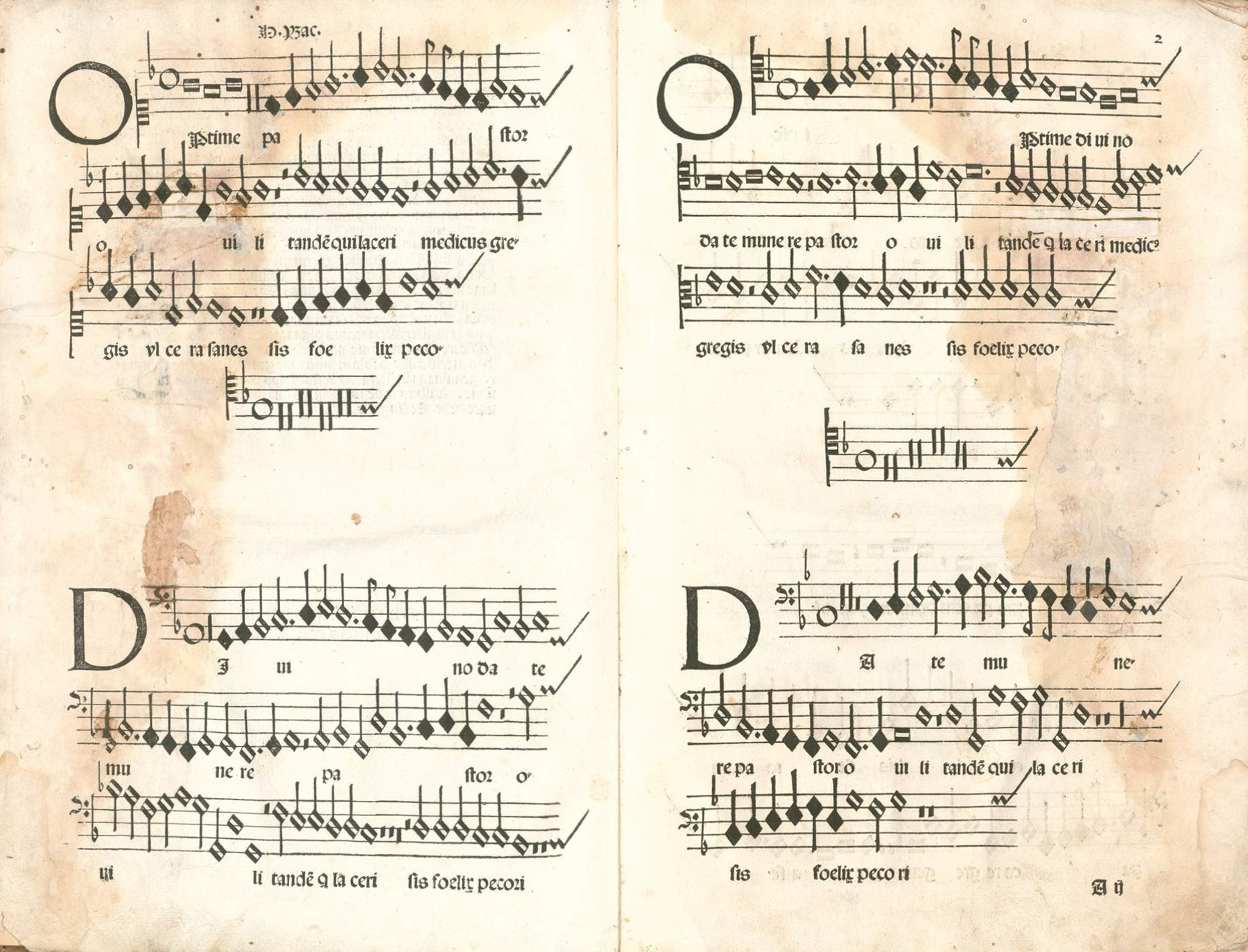
Die Eröffnungsmotette Optime pastor im » Liber selectarum cantionum (Augsburg: Grimm & Wirsung 1520), fol. 1v – 2r.
(Mit Genehmigung der Bayerischen Staatsbibliothek.)
[7] Pietschmann 2010; date of 1513 according to McDonald, The chapel of Maximilian I., 2019.
[8] On ruler praise in the fifteenth century, see » D. Albrecht II. und Friedrich III.
[1] A discussion of Isaac’s chapel personnel can now be found in Gasch 2015, see especially 363–370.
[3] On the idea of monumentalising the liturgical year through polyphonic settings of the Propers, see Strohm 2011.
[4] For a general overview of Isaac’s Masses, see Staehelin 1977.
[5] For a digital facsimile of Isaac’s Missa paschalis in » D-Ju Ms. 36, fol. 141v–155r, see: http://nbn-resolving.de/urn:nbn:de:urmel-1bb48d27-d632-4bb7-b381-36e0bae379018-00004515-2851.
[8] On ruler praise in the fifteenth century, see » D. Albrecht II. und Friedrich III.
[9] For a reconstruction and German translation of the complete motet text, see Panagl 2004, 54. For a digital facsimile of the motet in » CH-Bu Ms. F IX 55, fol. 4v–7r: http://www.e-manuscripta.ch/bau/content/pageview/311300.
[10] See Haggh 2007 for general background, and Körndle 2007 for the specific context in Constance. Evidence of instrumental accompaniment is found in a Tegernsee chronicl (D-Mbs Clm 1586, fol. 429v–430r).
[11] For a digital facsimile of the motet Virgo prudentissima in » CH-SGs Cod. Sang. 464 see: http://www.e-codices.unifr.ch/en/csg/0464/5v/0.
[12] The earlier view that both works were intended for 15 August 1507 (Dunning 1970, 41) is questionable, as the Diet had already concluded by that time. See also Rothenberg 2011.
[13] Körndle 2007, 96–101.
[14] Although the painting was not commissioned by Maximilian but by the German Rosary Brotherhood at the Church of San Bartolomeo in Venice, its composition contains numerous elements reflecting Maximilian’s ideals of self-representation. See Rothenberg 2011, 78 ff.
[15] See Wiesflecker 1971–1986, vol. 4, 1–27.
Recommended Citation:
Stefan Gasch: „Henricus Isaac in the Service of Maximilian’s Ecclesiastical and State Ceremonies“, in: Musical Life of the Late Middle Ages in the Austrian Region <https://musical-life.net/en/essays/henricus-isaac-service-maximilians-ecclesiastical-and-state-ceremonies> (2025); slightly revised AI-assisted translation of the original German essay (2016).