Isaac as a Key Figure: Chant-Based Cycles of Propers and Ordinaries
Among the projects through which Maximilian spread the ideology of the imperial house,[2] are Isaac’s cycles of Propers. Though the work was never fully completed, it was intended in its entirety to form a polyphonic Graduale (a book containing the variable, day-specific chants of the Mass) for all occasions and feasts of the church year at the imperial court (» G. Henricus Isaac; » I. Isaac’s Amazonas).[3] The settings, published more than thirty years after Isaac’s death in three volumes under the title Coralis Constantinus in Nuremberg, include Isaac’s compositions of the Introit, Alleluia or Tract, Sequence, and Communion.
Isaac’s twenty-one chant-based ordinaries – cyclical mass settings based on the chant melodies of the individual ordinary chants – also belong to Maximilian’s new approach to ceremonial sonic representation. In several respects, they are extraordinary for the period around 1500: with multiple settings for three to six voices, they not only cover the various festive occasions of the church year (high feasts, feasts of apostles, martyrs, confessors, virgins, Marian feasts, etc.), but in their conception as chant-based ordinary cycles, they also represent the monumentalisation of a genre that had previously led a niche existence.[4] Although individual Mass settings based on the chant melodies appropriate to each section of the Mass had been known since the early fifteenth century, Isaac brought this previously little-regarded form of Ordinary setting to an unprecedented flourishing through his systematic approach to the musical staging of the imperial household’s daily worship, both in terms of genre history and through the incorporation of the latest compositional trends. The musical genre of the Mass thus acquired a representative function for the Habsburgs.
Some characteristics of this type of ordinary mass setting can be illustrated by Isaac’s sonorous six-part Missa paschalis (» D-Ju Ms. 36, fol. 141v–155r).[5] As in nearly all liturgical music of the time, the chant forms the guiding thread around which the polyphonic composition is woven. In this case, it is the first chant-based Mass, used in the liturgy only on Easter Sunday and the Sundays following Easter (until Pentecost) (» Fig. Graduale Pataviense, Kyrie für Ostern). Isaac conceived this composition – as always when setting monophonic Ordinary melodies – as an alternatim Mass, a performance practice in which sections of sung polyphony alternate either with monophonic chant or with improvised organ versets (» Audio example ♫ Kyrie Missa paschalis).[6] The performance with organ improvisations, in which the imperial organist Paul Hofhaimer (» C. Ch. Paul Hofhaimer), a widely renowned improviser, participated, is well documented at the imperial court, for example in the designation of Masses “ad organum” in the Viennese manuscript » A-Wn Mus. Hs. 18745). The music demonstrates an extremely flexible interplay between monophonic chant and polyphony on both vocal and instrumental levels, as well as a close interweaving of vocal and instrumental resources in the liturgical music performed at the court of Maximilian I.
Abb. Graduale Pataviense, Kyrie für Ostern
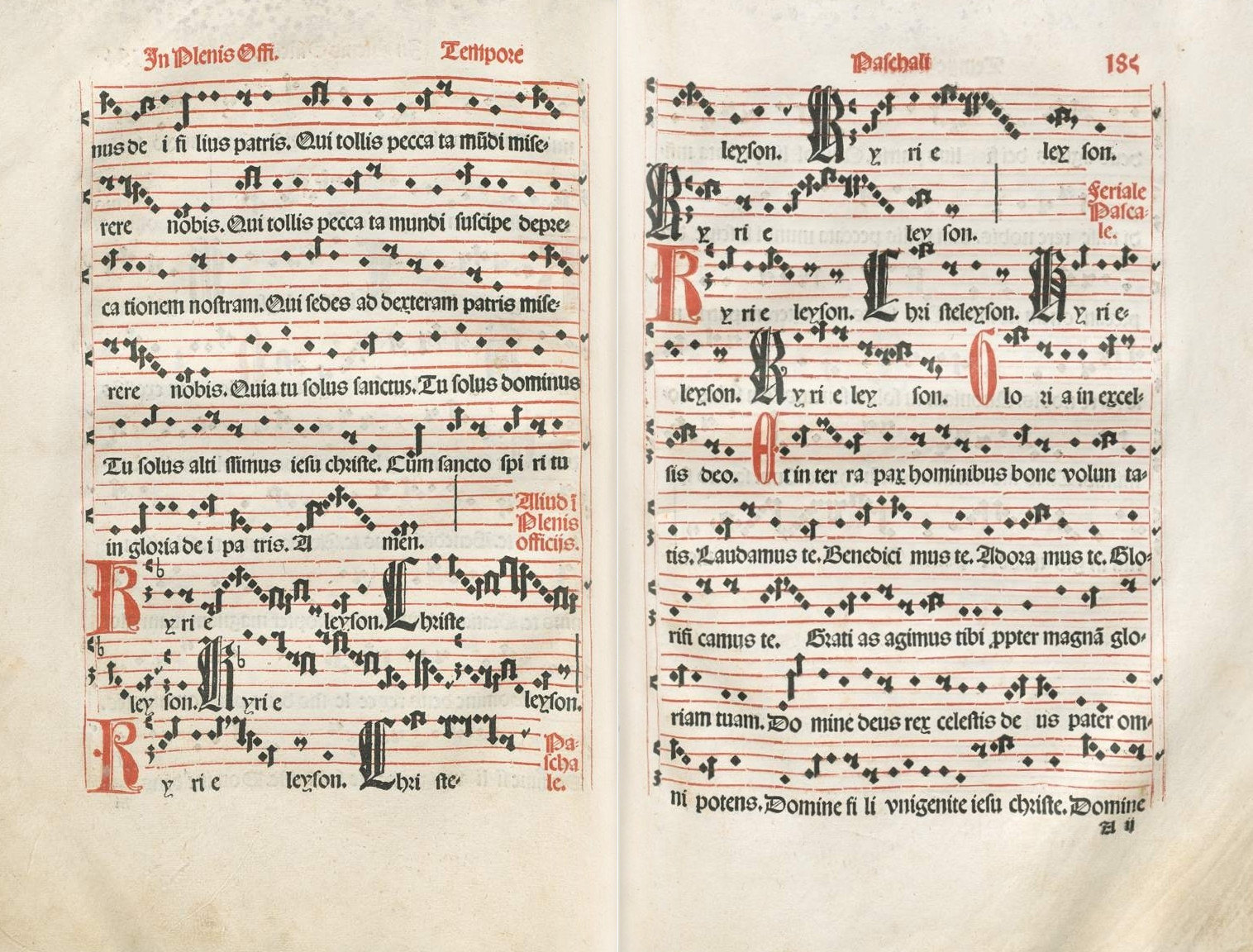
Kyrie für den Ostersonntag und die Sonntage nach Ostern (bis Pfingsten) im » Graduale Pataviense (Wien: Johannes Winterburger 1511), fol. 184v–185r. (Mit Genehmigung der Bayerischen Staatsbibliothek.)
[3] On the idea of monumentalising the liturgical year through polyphonic settings of the Propers, see Strohm 2011.
[4] For a general overview of Isaac’s Masses, see Staehelin 1977.
[5] For a digital facsimile of Isaac’s Missa paschalis in » D-Ju Ms. 36, fol. 141v–155r, see: http://nbn-resolving.de/urn:nbn:de:urmel-1bb48d27-d632-4bb7-b381-36e0bae379018-00004515-2851.
[1] A discussion of Isaac’s chapel personnel can now be found in Gasch 2015, see especially 363–370.
[3] On the idea of monumentalising the liturgical year through polyphonic settings of the Propers, see Strohm 2011.
[4] For a general overview of Isaac’s Masses, see Staehelin 1977.
[5] For a digital facsimile of Isaac’s Missa paschalis in » D-Ju Ms. 36, fol. 141v–155r, see: http://nbn-resolving.de/urn:nbn:de:urmel-1bb48d27-d632-4bb7-b381-36e0bae379018-00004515-2851.
[8] On ruler praise in the fifteenth century, see » D. Albrecht II. und Friedrich III.
[9] For a reconstruction and German translation of the complete motet text, see Panagl 2004, 54. For a digital facsimile of the motet in » CH-Bu Ms. F IX 55, fol. 4v–7r: http://www.e-manuscripta.ch/bau/content/pageview/311300.
[10] See Haggh 2007 for general background, and Körndle 2007 for the specific context in Constance. Evidence of instrumental accompaniment is found in a Tegernsee chronicl (D-Mbs Clm 1586, fol. 429v–430r).
[11] For a digital facsimile of the motet Virgo prudentissima in » CH-SGs Cod. Sang. 464 see: http://www.e-codices.unifr.ch/en/csg/0464/5v/0.
[12] The earlier view that both works were intended for 15 August 1507 (Dunning 1970, 41) is questionable, as the Diet had already concluded by that time. See also Rothenberg 2011.
[13] Körndle 2007, 96–101.
[14] Although the painting was not commissioned by Maximilian but by the German Rosary Brotherhood at the Church of San Bartolomeo in Venice, its composition contains numerous elements reflecting Maximilian’s ideals of self-representation. See Rothenberg 2011, 78 ff.
[15] See Wiesflecker 1971–1986, vol. 4, 1–27.
Recommended Citation:
Stefan Gasch: „Henricus Isaac in the Service of Maximilian’s Ecclesiastical and State Ceremonies“, in: Musical Life of the Late Middle Ages in the Austrian Region <https://musical-life.net/en/essays/henricus-isaac-service-maximilians-ecclesiastical-and-state-ceremonies> (2025); slightly revised AI-assisted translation of the original German essay (2016).