Printed Sources of the Missa Salve diva parens
Polyphonic music was transmitted both in manuscript and print. Polyphony was often printed in so-called “partbooks”, small booklets in landscape format, with each book containing only one voice of a polyphonic composition. In practice, these partbooks were kept together as a complete set. If one or more partbooks have been lost, it can happen that any compositions transmitted uniquely in those partbooks survives today only as a fragment, in this case, missing one or more voice parts. The format of partbooks is less suited to the performance practice of chapels at large institutions, and more appropriate for music-making in smaller settings, whether in private contexts or in smaller ensembles performing within the framework of foundations.
The Venetian printer Ottaviano Petrucci systematically published a total of fifty-three music books from the year 1501 onwards, some in multiple editions.[8] These were printed in small format on paper. Petrucci printed both secular repertoire and motets, but most frequently settings of the Mass.
In the year 1503, Petrucci printed Missa Salve diva parens as the last of five Masses by Obrecht in the single-author collection Misse Obreht, that is, “Masses of Obrecht” (» Fig. Misse Obreht, Discantus; » Fig. Misse Obreht, Tenor; » Fig. Misse Obreht, Bassus).[9] This collection was only the second printed collection of Mass settings by a single composer, and Petrucci’s fifth musical edition overall. As in the pioneering edition » Misse Josquin of 1502 and in later single-author Mass collections, Petrucci arranged the voices in separate partbooks.[10]
Abb. Misse Obreht, Discantus
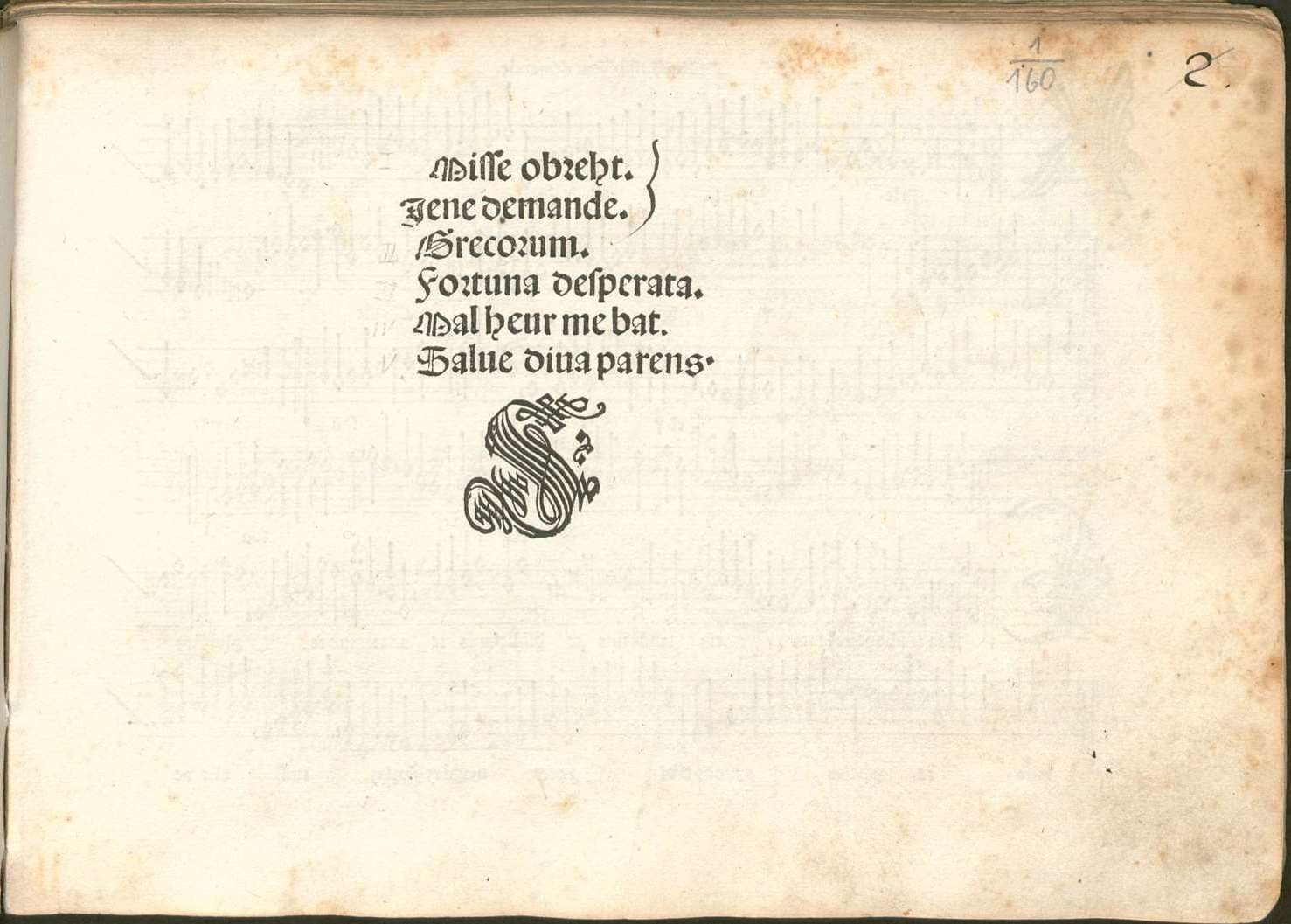
Titelseite des Discantus-Stimmbuchs des Drucks » Misse Obreht Venedig: Ottaviano Petrucci 1503; Exemplar D-Mbs 4° Mus.pr. 160/1) mit der Angabe aller in diesem Stimmbuchsatz enthaltenen Messen. Mit Genehmigung der Bayerischen Staatsbibliothek.
In printed editions, paratexts[11] became even more important than before. Beside detailed title pages indicating the contents of the book, as we see, for example, in » Fig. Misse Obreht, Discantus, printed music books might contain a printed preface with dedication, though these were rare in Petrucci’s editions, and absent entirely from the Misse Obreht. Printed books often contained colophons that indicate the printer, place of printing, year of publication, and extent of the edition. Such technical information might allow users to verify the completeness of their copy, since the printed sheets were often sold in separate gatherings and only bound later (» Fig. Misse Obreht, Bassus).
Abb. Misse Obreht, Bassus
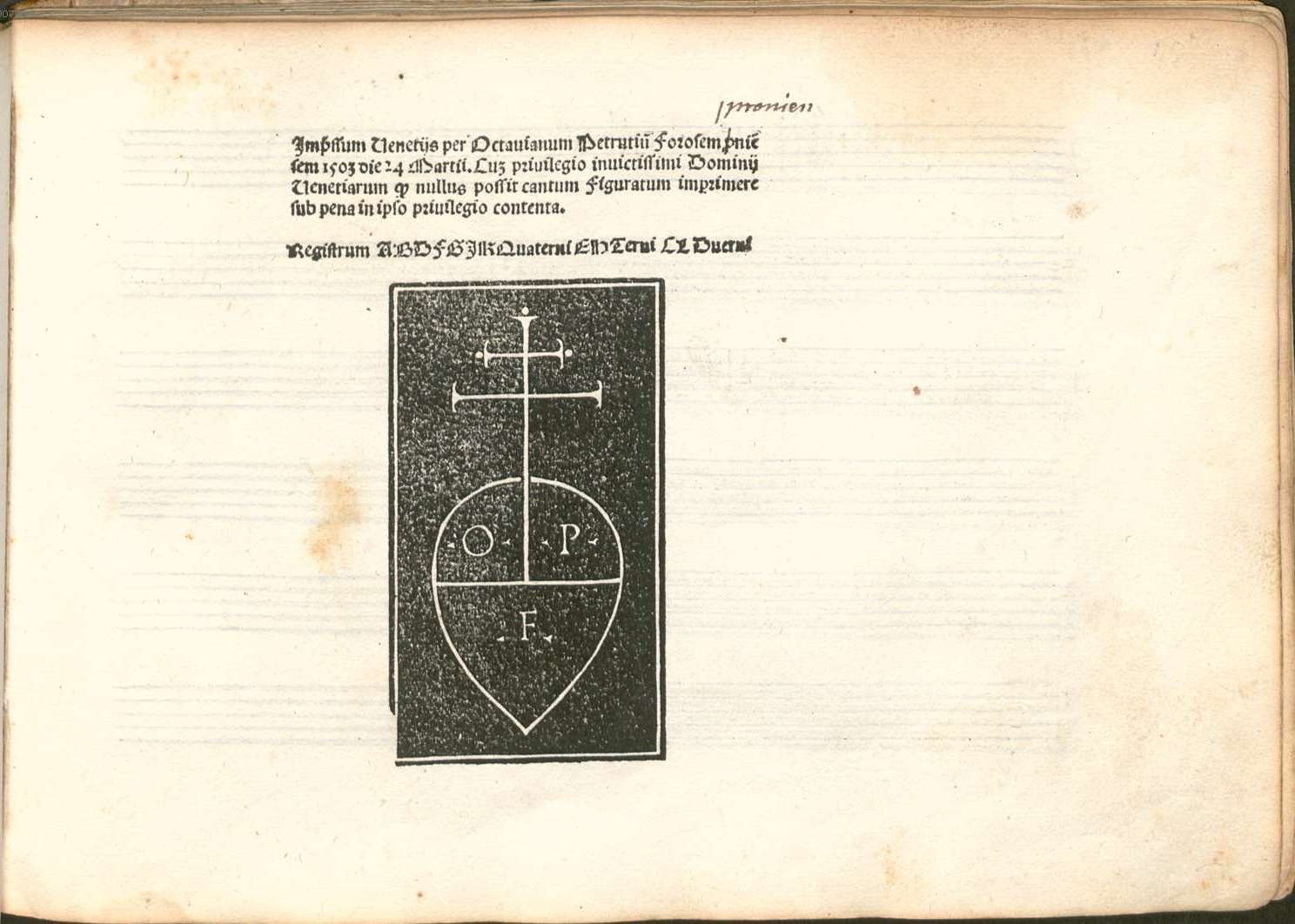
Kolophon im Bassus-Stimmbuch des Drucks » Misse Obreht, Venedig: Ottaviano Petrucci 1503; Exemplar » D-Mbs 4° Mus.pr. 160/1) Ein Benutzer hat das lateinische Kürzel zu „[Forosem]pronien“ (deutsch: „aus Fossombrone“, Petruccis Geburtsort) aufgelöst.
(Mit Genehmigung der Bayerischen Staatsbibliothek.)
The print run for Petrucci’s editions was probably no more than 300 copies.[12] Today, just seven copies of Petrucci’s » Misse Obreht are known to survive. All three copies held in Austrian and South German libraries were bound together with other Petrucci collections of Masses. One such collector’s volume is a thick volume containing at least 393 individual Mass settings (» A-Wn SA.77.C.13/1–3; » Fig. Misse Obreht, Tenor).[13] Such extensive volumes might have been owned by bibliophiles (who may not have sung from them at all), patrons of music (such as the Fuggers in Augsburg: » E. Musik für die Fugger) professional musicians or institutions. One could imagine them being used, for instance, in a large Mass foundation that involved the regular performance of figural music by a relatively small group of singers (» D. SL Waldauf-Stiftung). Individual music books by Petrucci were certainly also purchased by private individuals who, not affiliated with an institution, pursued the singing and playing of polyphonic music out of personal interest, and were proficient in mensural notation. Such owners might have been nobles, clerics, wealthy citizens (merchants, doctors, lawyers), professors, teachers, or (well-off) students.[14]
Abb. Misse Obreht, Tenor
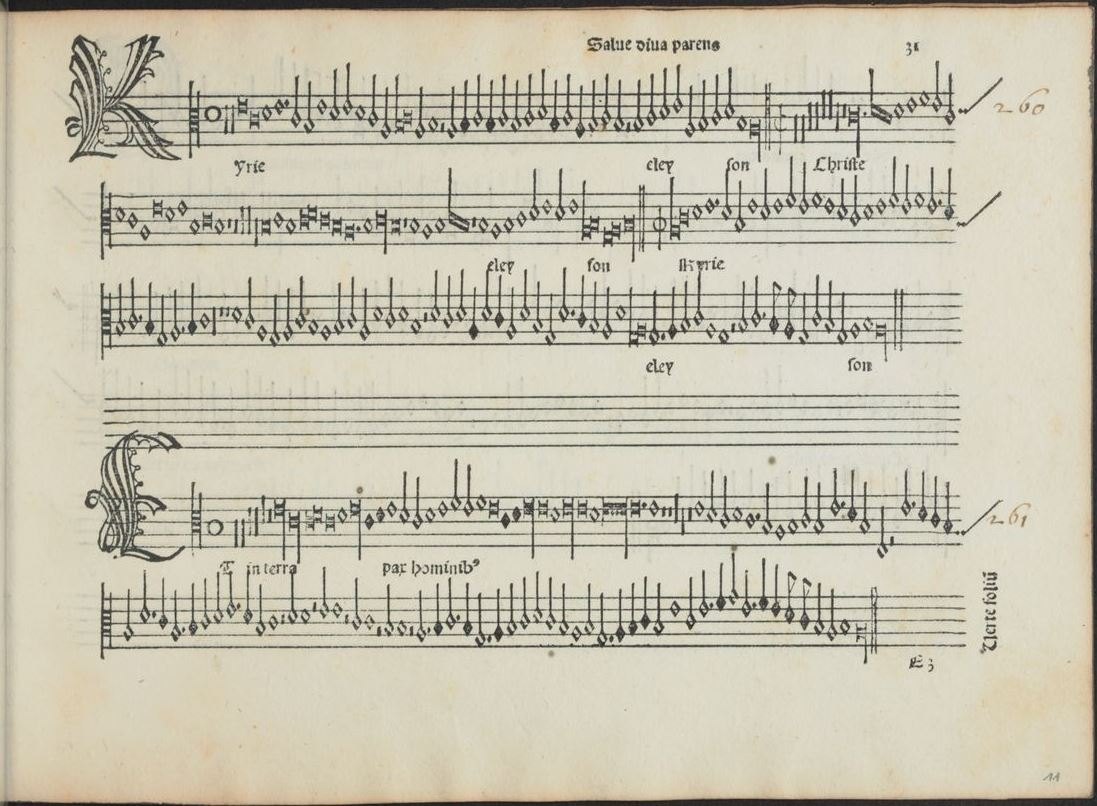
Beginn von Jacob Obrechts Missa Salve diva parens im Tenor-Stimmbuch des Drucks Misse Obreht (» Venedig: Ottaviano Petrucci 1503; Exemplar » A-Wn SA.77.C.13/1–3, S. 31). Am rechten Seitenrand befinden sich die handschriftlichen Nummern „260“ und „261“: Der zeitgenössische Besitzer nummerierte sämtliche Messsätze des Bandes, in dem der Druck Misse Obreht mit 13 weiteren Petrucci-Messdrucken zusammengebunden war, einzeln durch.
(Mit Genehmigung der Österreichischen Nationalbibliothek.)
Soon after Petrucci’s first publication, music was also printed in the German-speaking world.[15] As early as 1507, a collection of four Masses by Jacob Obrecht was printed at Basel by Gregor Mewes (» Concentus harmonici[16]); very shortly thereafter, settings of odes (» I. Odengesang), songs, and later also motets were printed in Augsburg. Some of these books are closely connected with the musical repertoire of the court chapel of Maximilian I (» D. Ch. On the Musical Sources of Maximilian’s Court Chapel; » B. Ch. Liederdrucke).
[8] Successful editions appeared in anything up to four editions, often within just a few years. See Boorman 2006, esp. 411–413.
[9] See Lodes 2001.
[10] In Petrucci’s printed collections of secular songs (canti), motets, and also frottola, the choir book format was retained for a long time.
[11] For a general discussion, see Genette 1989; Schwindt 2008.
[12] Boorman 2006, 360–366.
[13] The original purpose of use is unfortunately not verifiable for any of these three copies:
The copy held by the Austrian National Library (» A-Wn SA.77.C.13/1–3; Bassus partbook missing; digitised version: http://data.onb.ac.at/rec/AC09200708) was bound together with a total of thirteen other Petrucci Mass collections (one of which is now lost). All Mass settings in the Vienna collection are individually numbered (up to No. 339). Furthermore, the numbering continues in two other Petrucci editions (up to No. 393), which are now in Venice but were apparently once bound with the volume held in Vienna. This may suggest that the Petrucci editions now preserved in Vienna possibly only entered the Austrian National Library in the nineteenth century (see Boorman 2006, 349, 351, 493).
Another copy of the Misse Obreht is now held at the Franciscan Monastery in Güssing, Burgenland (no shelfmark; only the Tenor partbook survives). This too is bound with eight other Petrucci Mass prints. The monastery in Güssing was founded only in 1641, so this is a later acquisition or donation, probably from Carinthia or Hungary (see Federhofer 1963).
The third surviving copy in the southern German-speaking region, now in the Bavarian State Library in Munich (» D-Mbs 4° Mus.pr. 160/1; digitsed version: http://stimmbuecher.digitale-sammlungen.de/view?id=bsb00072010) probably originates from Passau. It is bound with two other Petrucci editions, including a motet collection (Motetti C, 1504) (cf. Boorman 2006, 348 f., 685). Some handwritten annotations indicate that this copy was used by musically knowledgeable individuals. For example, printing errors are corrected by hand, and an additional handwritten “Fuga” (= canon) is added at the end of the Altus partbook).
[14] For the general readership of Petrucci’s editions, see Boorman 2006, 336–349.
[15] See the essays in Lodes 2010.
[16] See Lodes 2001 and Lodes 2002.
[1] Hudson 1990, XI–XXXIV.
[2] See Lodes 2008.
[3] A generally accessible introduction is provided by Lindmayr-Brandl 2014b; concise introductions to mensural notation (Lindmayr-Brandl 2014c), tablature scripts (Aringer 2014) and dance notation (Malkiewicz 2014) can also be found in Lindmayr-Brandl 2014a.
[4] For further details, see Lodes 2009.
[5] After Frederick’s death in 1493, Maximilian took over Frederick’s chapel. Reinhard Strohm, who was the first to compile an inventory of these fragments, places them more in the context of the Innsbruck court music, as Maximilian had taken over administration there in 1490 (Strohm 1984; Strohm 1993, 523). The fragments were digitised by Robert Klugseder as part of the research project Musikalische Quellen (9.–15. Jahrhundert) in der Österreichischen Nationalbibliothek (Musical Sources (9th–15th Century) at the Austrian National Library) and can be viewed at http://www.cantusplanus.at/de-at/austriaca/Linz529/index.htm.
[6] Some new identifications, reconstructions, and editions of individual pieces from the Linz Fragments by Marc Lewon can be found on his blog “Musikleben – Supplement”.
[7] A visualisation of the relationship between the surviving fragment and the original manuscript page has been created by Marc Lewon using the example of J’ay pris amours. See “Musikleben – Supplement”.
[8] Successful editions appeared in anything up to four editions, often within just a few years. See Boorman 2006, esp. 411–413.
[9] See Lodes 2001.
[10] In Petrucci’s printed collections of secular songs (canti), motets, and also frottola, the choir book format was retained for a long time.
[11] For a general discussion, see Genette 1989; Schwindt 2008.
[12] Boorman 2006, 360–366.
[13] The original purpose of use is unfortunately not verifiable for any of these three copies:
The copy held by the Austrian National Library (» A-Wn SA.77.C.13/1–3; Bassus partbook missing; digitised version: http://data.onb.ac.at/rec/AC09200708) was bound together with a total of thirteen other Petrucci Mass collections (one of which is now lost). All Mass settings in the Vienna collection are individually numbered (up to No. 339). Furthermore, the numbering continues in two other Petrucci editions (up to No. 393), which are now in Venice but were apparently once bound with the volume held in Vienna. This may suggest that the Petrucci editions now preserved in Vienna possibly only entered the Austrian National Library in the nineteenth century (see Boorman 2006, 349, 351, 493).
Another copy of the Misse Obreht is now held at the Franciscan Monastery in Güssing, Burgenland (no shelfmark; only the Tenor partbook survives). This too is bound with eight other Petrucci Mass prints. The monastery in Güssing was founded only in 1641, so this is a later acquisition or donation, probably from Carinthia or Hungary (see Federhofer 1963).
The third surviving copy in the southern German-speaking region, now in the Bavarian State Library in Munich (» D-Mbs 4° Mus.pr. 160/1; digitsed version: http://stimmbuecher.digitale-sammlungen.de/view?id=bsb00072010) probably originates from Passau. It is bound with two other Petrucci editions, including a motet collection (Motetti C, 1504) (cf. Boorman 2006, 348 f., 685). Some handwritten annotations indicate that this copy was used by musically knowledgeable individuals. For example, printing errors are corrected by hand, and an additional handwritten “Fuga” (= canon) is added at the end of the Altus partbook).
[14] For the general readership of Petrucci’s editions, see Boorman 2006, 336–349.
[15] See the essays in Lodes 2010.
[16] See Lodes 2001 and Lodes 2002.
[17] As this two-voice section is missing in three important sources, Barton Hudson suggests that it may have been added to the mass later, perhaps not even by Obrecht (Hudson 1990, XXf.).
[18] Similar collections also exist for three voices (“Tricinia”). In Formschneider’s Tricinia collection (Nuremberg 1538), the three-voice Pleni sunt from Obrecht’s Missa Salve diva parens appears among a colourful mix of 100 pieces from various genres.
[19] Jas 1999, 165; see also Verhaar 2014.
Recommended Citation:
Birgit Lodes: “The Media of Polyphonic Vocal Music around 1500. A Case Study: Jacob Obrecht’s Missa Salve diva parens”, in: Musical Life of the Late Middle Ages in the Austrian region, <https://musical-life.net/en/essays/media-polyphonic-vocal-music-around-1500-case-study-jacob-obrechts-missa-salve-diva-parens> (2025); slightly revised AI-assisted translation of the original German essay (2017).