A Gift for the Newly Crowned Emperor: The Alamire Choirbook A-Wn Mus.Hs. 15495
The magnificent choirbook A-Wn Mus.Hs. 15495 belongs to a group of more than sixty surviving choirbooks and sets of partbooks that are known in current scholarship as the ‘Burgundian-Habsburg music manuscripts.[11] These manuscripts were produced in a highly professional scriptorium located near the Burgundian-Habsburg courts of Archduke Philip the Handsome, Archduchess Margaret of Austria, and Archduke Charles (later Emperor Charles V) in Brussels and Mechelen. Created between approximately 1495 and 1534 – initially on parchment, the highest-quality material – these music manuscripts are often richly illuminated and served, among other purposes, as valuable gifts within Habsburg circles. The deluxe manuscript A-Wn Mus.Hs. 15495 is the first choirbook from this scriptorium to be produced under the direction of the professional copyist, singer, and diplomat Petrus Alamire.
Abb. Kyrie Salve diva parens
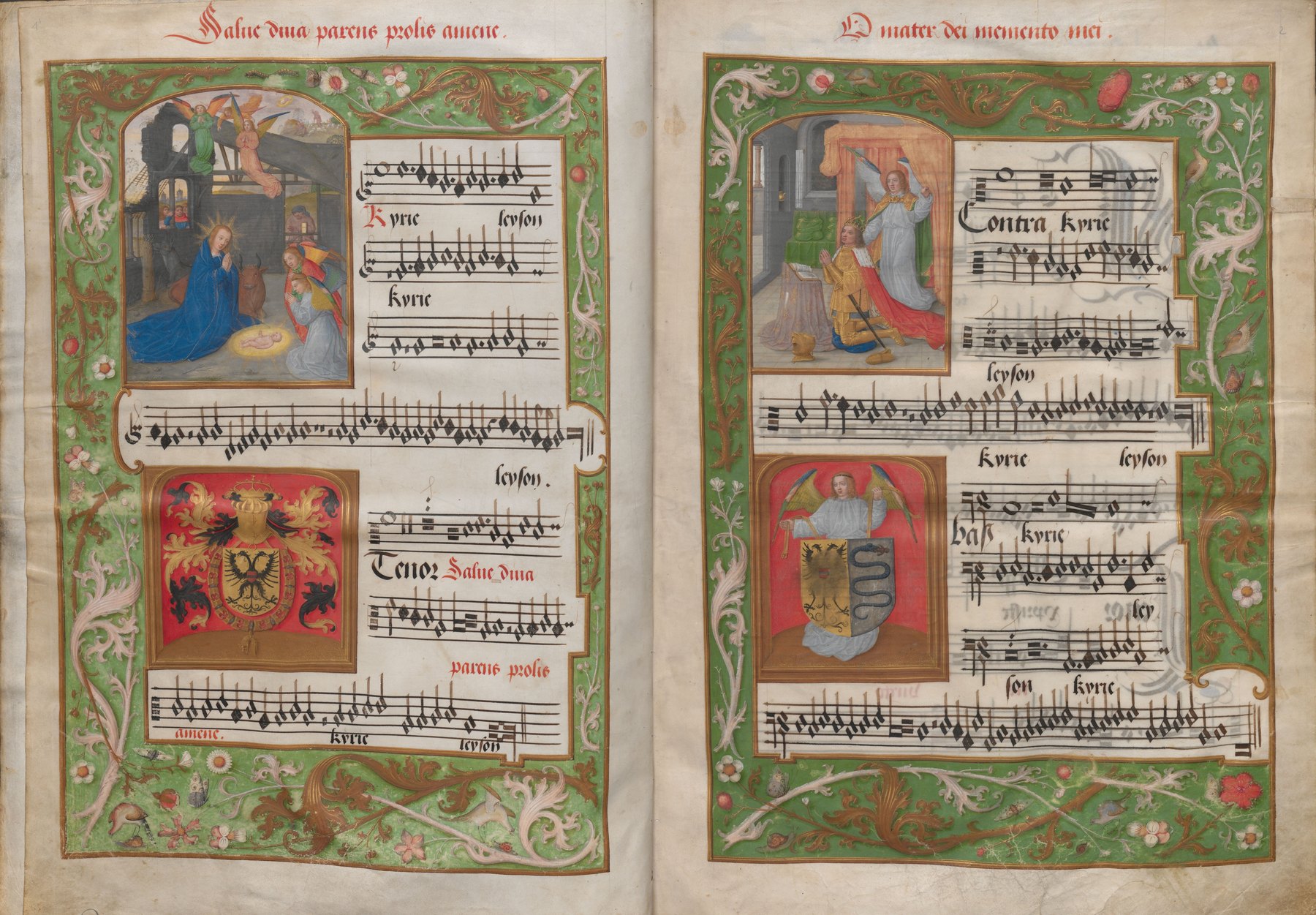
Eröffnende Doppelseite des Prachtchorbuchs » A-Wn Mus.Hs. 15495, fol. 1v–2r, mit dem Kyrie aus Jacob Obrechts Missa Salve diva parens (» D. Obrechts Missa Salve diva parens).
» Abb. Kyrie Salve diva parens shows the richly illuminated opening pages of the choir book, which comprises a total of 105 folios (210 pages). The miniatures depict the following: (top left) the Nativity scene (Christmas); (top right) Emperor Maximilian in prayer, with his guardian angel behind him; (bottom left) the coat of arms of Emperor Maximilian; (bottom right) the marital coat of arms of Maximilian and his wife Bianca Maria Sforza. Based on the heraldry, the manuscript can be dated to between spring 1508 (Maximilian’s proclamation as emperor elect) and December 1510 (the death of his wife). See » D. Obrecht’s Missa Salve diva parens.[12]
The musical notation – typical for the time – is written voice by voice in separate reading fields, not in score format. Top left: Discantus, the highest voice; bottom left: Tenor (note the text “Salve diva parens” instead of “Kyrie eleison”); top right: Altus (here labelled as ‘Contra’[tenor altus]), bottom right: Bassus. This layout is called ‘choirbook format’. A large ensemble (choir) could perform the different parts from this single book (» Abb. Kaiser Maximilians Kapelle). Iconographical representations show that it was also possible for instruments to double individual vocal lines (» Abb. Triumphzug Kantorei).
[11] See, among others, Kellman 1999; Bouckaert/Schreurs 2003; Saunders 2010; Burn 2015.
[12] Lodes 2009, 248.