Shawm
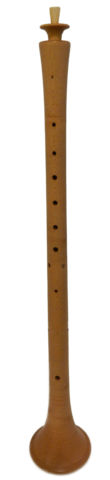
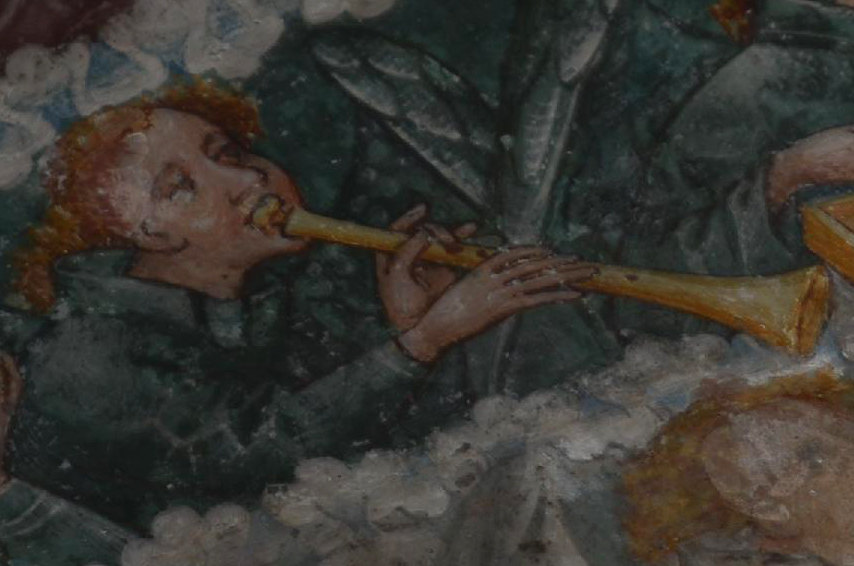
St. Andreas zu Thörl/Kärnten, Meister Thomas von Villach, um 1475.
© Carmen und Heinz Gaggl.

The shawm is a conically bored double-reed instrument that was played in European art music from the Middle Ages through the early Baroque period, and which has been used in art and traditional music throughout the world from antiquity to the present day.
Just like the buisine, the shawm was apparently (re-)introduced into Western Europe around the time of the crusades. With regard to its shape and size, only iconographic evidence survives from the Middle Ages, as no fully preserved shawms dating from before the 16th century are known. Early depictions show short instruments in which the distance between the lowest finger hole and the bell is considerably shorter than the distance between the lowest finger hole and the reed. In the 13th and 14th centuries, this instrument was often depicted together with buisines, bagpipes, pipe and tabor, small kettledrums and other percussion instruments. In the majority of folk traditions, the short shawm form is still used today, often in combination with the same accompanying instruments.
Toward the end of the 14th century, there was a major transformation in the composition of wind ensembles: bagpipes, percussion, and buisines were used less frequently with shawms; the slide trumpet was invented; and the shawm itself underwent fundamental changes. The instrument became longer, with the bell in particular being enlarged so that the distance between the lowest finger hole and the bell became greater than that between the lowest finger hole and the reed. With this long bell, pure volume and quick response—characteristics of most traditional shawms—were sacrificed in favour of the ability to produce chromatic notes, as well as a greater range and a wider dynamic spectrum. All of these changes are consistent with the desire to play “as singers sing”—in the manner of composed polyphony. From the tentative beginnings of this development in the late 14th century onward, the history of the “loud” wind ensemble of the 15th century is characterized by an increasing number of players learning this style, until by the end of the century individual wind players counted among the leading composers (including Bartolomeo Tromboncino and Nicolo Pifaro), while the sons of wind instrumentalists belonged to the absolute elite of polyphonists (Jacob Obrecht).
The “long” shawm was played from the end of the 14th century until the end of the 17th century, making it one of the longest-lived instruments in the history of Western music, as well as one of the most important European woodwind instruments of the 15th century—if the sheer number of depictions and written references is representative of its use. In several languages, the word “pipe” (“piffaro” in Italian, “pipe” in English, etc.) in fact referred to the shawm, although in principle it could have been applied to any wind instrument. The music theorist Johannes Tinctoris wrote in the 1480s that the shawm was a “perfect” instrument because “all music” could be played on it. It was the first instrument to be regularly played as a “family,” that is, with two or more instruments of the same type and in different sizes simultaneously, thereby setting in motion a development that would lead to the Renaissance consort and, later, the orchestra.
The shawm on “Geschichtsfenster”: https://www.youtube.com/watch?v=mrAq5WLU91I&t=3803s