Manuscript Sources of the Missa Salve diva parens
Grand choir books such as » A-Wn Mus.Hs. 15495 (» D. Ch. Ein Geschenk für den frischgebackenen Kaiser: Das Alamire-Chorbuch A-Wn Mus.Hs. 15495) were often written on precious parchment and served as a gift for a ruler. Whether such luxury sources were actually used for music-making remains a matter of debate. It is more likely that the repertoire was copied into other manuscripts for singing, what we might call “practical manuscripts”. These too, if intended for an institution such as a court chapel, might be arranged on the page as choir books, that is, with all voices distributed across a double-page spread. However, practical manuscripts were generally more modest in design: for example, they feature calligraphic rather than illuminated initials, paper instead of parchment, and a style of text and notation that were simpler in design, and thus quicker to write.
Obrecht’s Missa Salve diva parens was specially adapted for inclusion in the lavish codex A-Wn Mus.Hs. 15495, copied more than twenty years after the mass was written. For instance, at the end of the Sanctus, ten rhythmically intricate mensurations were simply omitted. During the copying process, voice leading was altered and seemingly old-fashioned under-third cadences or fauxbourdon passages were removed; the erasures are still visible in the manuscript.[4]
The so-called “Linz Fragments” (» A-LIb Hs. 529; » Fig. Missa Salve diva parens, Linz Fragments) are remnants of a completely different type of manuscript: they were not produced for representational purposes, but functioned as practical manuscripts or archives of repertoire. Individual pages even suggest that they were used for instrumental performances (» Fig. Ein tagweiss). The manuscript was created around 1490–1492, in the broader context of the court chapel of Emperor Frederick III, who spent his final years residing in Linz.[5] Among the works transmitted in the fragments are two Masses by Obrecht, Heinrich Isaac’s motet Argentum et aurum (» Audio example ♫ Argentum et aurum), as well as anonymous settings of the Ordinary and Proper, hymns, Magnificat settings, cantiones, German songs, and French chansons.[6] The Missa Salve diva parens was certainly once fully notated in this manuscript, but today only a short section of the Mass survives.[7]
Abb. Missa Salve diva parens, Linzer Fragmente / Fig. Missa Salve diva parens, Linz Fragments
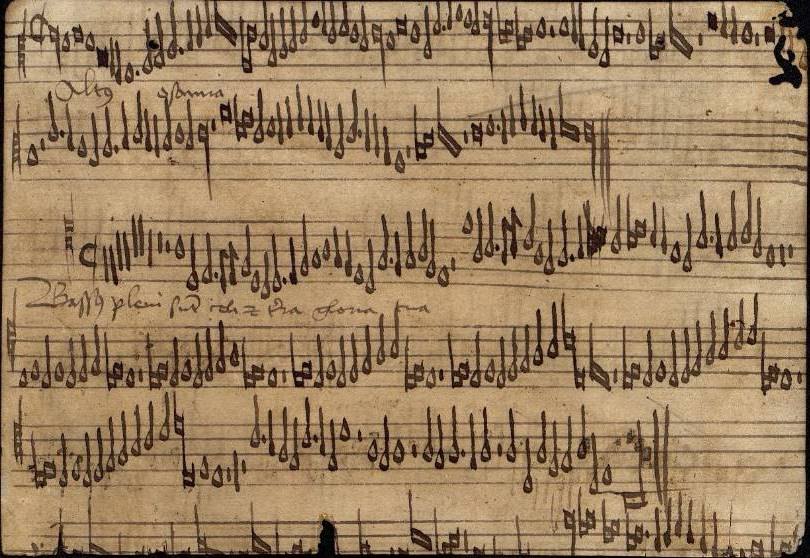
On this page of the Linz Fragments, the Altus voice (first “Osanna”) from the Missa Salve diva parens is visible at the top, and below it (in the C4 clef) the Bassus voice (“Pleni sunt” and first “Osanna”). Three staves are cut off at the top (beginning of the “Pleni sunt” in the Altus); at the very bottom, part of the stave is missing. The Discantus and Tenor voices of these sections of the Mass would have been notated on the facing left-hand page.
Such fragments transmitting (late) medieval music exist today because bookbinders sometimes reused discarded parchment or paper as binding material for other books. Even after the compositions themselves were no longer of interest, the material on which they were written remained valuable. In this process of “secondary use”, the leaves were often trimmed, as we see here, and frequently suffered further damage through binding, gluing, removal, and so on.
[4] For further details, see Lodes 2009.
[5] After Frederick’s death in 1493, Maximilian took over Frederick’s chapel. Reinhard Strohm, who was the first to compile an inventory of these fragments, places them more in the context of the Innsbruck court music, as Maximilian had taken over administration there in 1490 (Strohm 1984; Strohm 1993, 523). The fragments were digitised by Robert Klugseder as part of the research project Musikalische Quellen (9.–15. Jahrhundert) in der Österreichischen Nationalbibliothek (Musical Sources (9th–15th Century) at the Austrian National Library) and can be viewed at http://www.cantusplanus.at/de-at/austriaca/Linz529/index.htm.
[6] Some new identifications, reconstructions, and editions of individual pieces from the Linz Fragments by Marc Lewon can be found on his blog “Musikleben – Supplement”.
[7] A visualisation of the relationship between the surviving fragment and the original manuscript page has been created by Marc Lewon using the example of J’ay pris amours. See “Musikleben – Supplement”.
[1] Hudson 1990, XI–XXXIV.
[2] See Lodes 2008.
[3] A generally accessible introduction is provided by Lindmayr-Brandl 2014b; concise introductions to mensural notation (Lindmayr-Brandl 2014c), tablature scripts (Aringer 2014) and dance notation (Malkiewicz 2014) can also be found in Lindmayr-Brandl 2014a.
[4] For further details, see Lodes 2009.
[5] After Frederick’s death in 1493, Maximilian took over Frederick’s chapel. Reinhard Strohm, who was the first to compile an inventory of these fragments, places them more in the context of the Innsbruck court music, as Maximilian had taken over administration there in 1490 (Strohm 1984; Strohm 1993, 523). The fragments were digitised by Robert Klugseder as part of the research project Musikalische Quellen (9.–15. Jahrhundert) in der Österreichischen Nationalbibliothek (Musical Sources (9th–15th Century) at the Austrian National Library) and can be viewed at http://www.cantusplanus.at/de-at/austriaca/Linz529/index.htm.
[6] Some new identifications, reconstructions, and editions of individual pieces from the Linz Fragments by Marc Lewon can be found on his blog “Musikleben – Supplement”.
[7] A visualisation of the relationship between the surviving fragment and the original manuscript page has been created by Marc Lewon using the example of J’ay pris amours. See “Musikleben – Supplement”.
[8] Successful editions appeared in anything up to four editions, often within just a few years. See Boorman 2006, esp. 411–413.
[9] See Lodes 2001.
[10] In Petrucci’s printed collections of secular songs (canti), motets, and also frottola, the choir book format was retained for a long time.
[11] For a general discussion, see Genette 1989; Schwindt 2008.
[12] Boorman 2006, 360–366.
[13] The original purpose of use is unfortunately not verifiable for any of these three copies:
The copy held by the Austrian National Library (» A-Wn SA.77.C.13/1–3; Bassus partbook missing; digitised version: http://data.onb.ac.at/rec/AC09200708) was bound together with a total of thirteen other Petrucci Mass collections (one of which is now lost). All Mass settings in the Vienna collection are individually numbered (up to No. 339). Furthermore, the numbering continues in two other Petrucci editions (up to No. 393), which are now in Venice but were apparently once bound with the volume held in Vienna. This may suggest that the Petrucci editions now preserved in Vienna possibly only entered the Austrian National Library in the nineteenth century (see Boorman 2006, 349, 351, 493).
Another copy of the Misse Obreht is now held at the Franciscan Monastery in Güssing, Burgenland (no shelfmark; only the Tenor partbook survives). This too is bound with eight other Petrucci Mass prints. The monastery in Güssing was founded only in 1641, so this is a later acquisition or donation, probably from Carinthia or Hungary (see Federhofer 1963).
The third surviving copy in the southern German-speaking region, now in the Bavarian State Library in Munich (» D-Mbs 4° Mus.pr. 160/1; digitsed version: http://stimmbuecher.digitale-sammlungen.de/view?id=bsb00072010) probably originates from Passau. It is bound with two other Petrucci editions, including a motet collection (Motetti C, 1504) (cf. Boorman 2006, 348 f., 685). Some handwritten annotations indicate that this copy was used by musically knowledgeable individuals. For example, printing errors are corrected by hand, and an additional handwritten “Fuga” (= canon) is added at the end of the Altus partbook).
[14] For the general readership of Petrucci’s editions, see Boorman 2006, 336–349.
[15] See the essays in Lodes 2010.
[16] See Lodes 2001 and Lodes 2002.
[17] As this two-voice section is missing in three important sources, Barton Hudson suggests that it may have been added to the mass later, perhaps not even by Obrecht (Hudson 1990, XXf.).
[18] Similar collections also exist for three voices (“Tricinia”). In Formschneider’s Tricinia collection (Nuremberg 1538), the three-voice Pleni sunt from Obrecht’s Missa Salve diva parens appears among a colourful mix of 100 pieces from various genres.
[19] Jas 1999, 165; see also Verhaar 2014.
Recommended Citation:
Birgit Lodes: “The Media of Polyphonic Vocal Music around 1500. A Case Study: Jacob Obrecht’s Missa Salve diva parens”, in: Musical Life of the Late Middle Ages in the Austrian region, <https://musical-life.net/en/essays/media-polyphonic-vocal-music-around-1500-case-study-jacob-obrechts-missa-salve-diva-parens> (2025); slightly revised AI-assisted translation of the original German essay (2017).