Busine

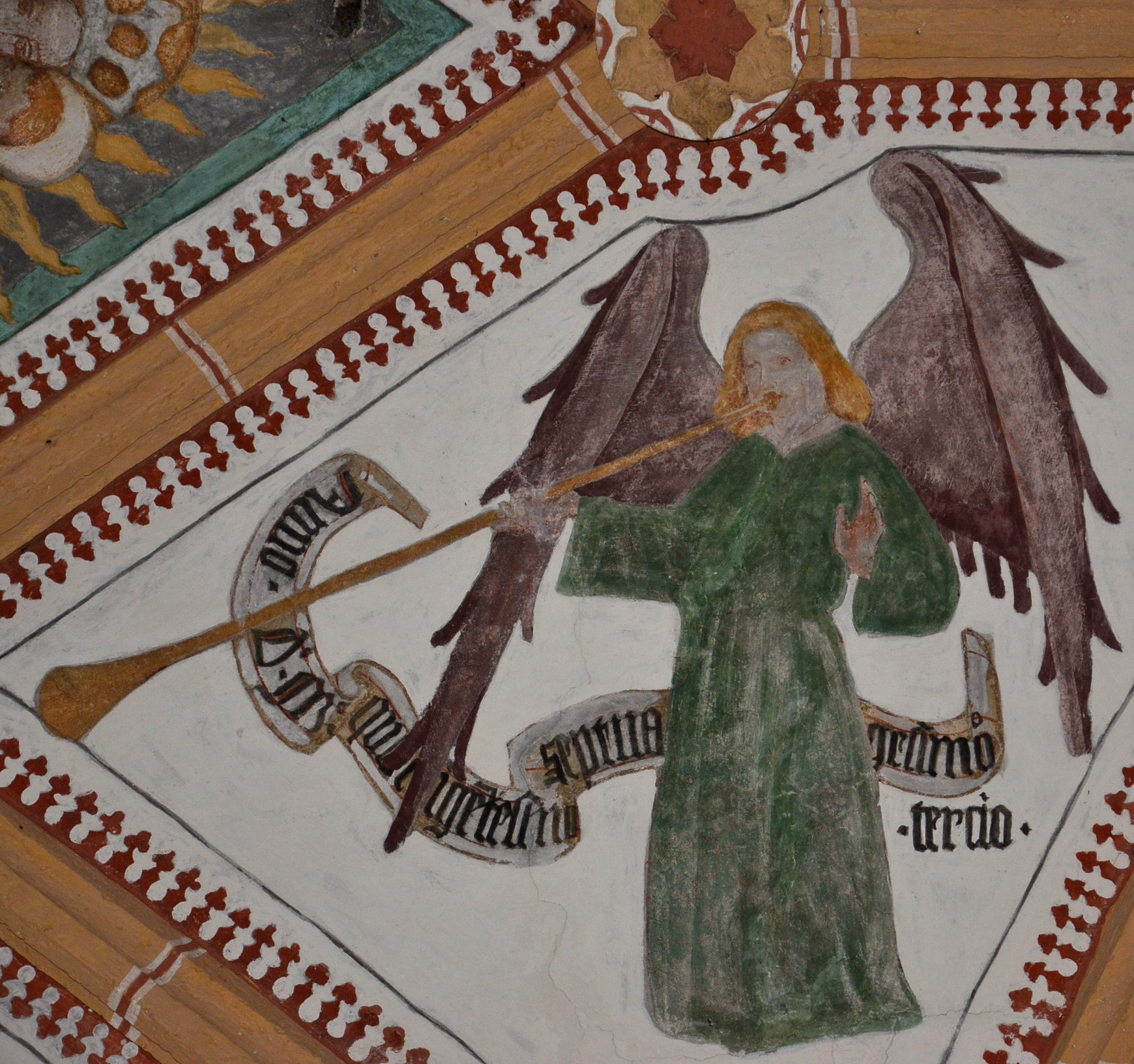
Unserer lieben Frau Himmelfahrt zu Haimburg/Kärnten, unbekannter Meister, 1473.
© Carmen und Heinz Gaggl.

The buisine (or busine) was the first type of trumpet to reappear in medieval Western Europe, probably in the twelfth century, as an import from the Near East. It is a simple, long, straight trumpet with a narrow, conical bell that flares only slightly. Instruments of this type can still be found in a number of folk-music traditions of the Middle East.
The buisine is the instrument most frequently depicted in representations of angel musicians. Its musical capabilities are extremely limited, since it can produce only the notes of the harmonic series; accordingly, it was used variously for fanfares, signals, and rhythmic drone accompaniment. It is rather unlikely that the clarino register was also employed, since 15th-century compositions that imitate trumpets—such as Guillaume Dufay’s Gloria ad modum tubae—make use only of the second or of the third through sixth partials.
Early representations frequently show the instrument in pairs. Later, it is depicted in a variety of ensemble configurations, most commonly in combination with shawms. Buisines were also employed as signalling instruments at sea, enabling communication between ships.
The only surviving instrument of this type—and one that is itself preserved only fragmentarily—is now housed in the Museum of London. It displays a remarkably sophisticated level of metalworking craftsmanship: it was made from extremely thin, hammered brass and probably dates from the first half of the 14th century.