Organs in the Austrian region
No original instruments built before the sixteenth century survive in Austria.[9] Even so, contemporary depictions allow a partial picture of a number of instruments: a few church organs (» A-Sn N.23C3, » A-Wn Cod. 1855, » A-Wn Cod. 1987[10]) and several portatives and positives (the oldest, from around 1390/1400, in the Schnalstal and at Stams)[11]). The oldest instrument still in existence today, by Jörg Ebert in the Innsbruck court church, was built in 1555–1561. The earliest surviving smaller organs (positives, regals) date only from around 1580/90.[12]
Even the most conservative instruments in either group preserve no more than remnants of the late-medieval organ.
Organs of the fifteenth and early sixteenth centuries usually did not survive long, even in their own day. Most were demolished by the eighteenth century at the latest.[13] There are two reasons for this. First came a phase of turbulent technical progress in the fifteenth century, during which older instruments were replaced relatively quickly. This happened even when they had not fallen victim to fire or been rendered unusable by technical defects. After a spike in organ building during the era of Emperor Maximilian I, a phase of relative calm set in, for economic reasons.[14]
A further wave of new construction after 1550 then ensured that organs from before 1550 largely disappeared in the Austrian territories.
The oldest documentary records of the purchase and repair of church organs come from the Prague area (St. Vitus Cathedral 1255, Königsaal 1292 and Politz 1294). In Bohemia, however, this early diffusion was temporarily halted by the Hussites, who in 1427 also devastated the organ of Altenburg Abbey.[15] Only around 1500 did the country regain its status as a leading centre for the art of organ building.”[16] In the Austrian territories, organs are attested as early as the thirteenth century at Salzburg Cathedral and at St Florian. In the fourteenth century the organ spread through cathedral, collegiate and parish churches. The documented series of references to organs[17] begins with Admont Abbey (1327/98) and runs through St Stephen’s in Vienna (1334, 1336, c. 1400), Feldkirch (1335), Wilhering (1354/55), St Lambrecht (1366), St Peter’s in Salzburg (1368), and the town parish church of Steyr (1398)[18] to Salzburg Cathedral (1399). Geographically it thus spans a wide area, from west to east and from north to south.
The Salzburg cathedral organ (“magnum organum”) of 1399 stood on the west gallery. According to the sources, it was 38 feet wide and had 2,024 pipes. Of these, the smaller pipes were 18 feet long, while the twenty larger ones were 24½ feet long and 2½ feet wide. The wind supply was provided by 28 bellows.[19] Another rare testimony to the constructional details of organ building at that time is a contract of 1497. Signed with the Budweis organ builder Michael Khall, it concerned the new organ at St Wolfgang am See, with thirteen separate stops.[20]
In the fifteenth century, then, the organ galleries datable to specific years and the documented organ constructions increase markedly: Rein (1406), Radstadt (1418), Salzburg Nonnberg (1420/1433/1485), Altenburg (1427/1437), St Georgen am Längsee (1433), Klosterneuburg (c. 1437–1441), Millstatt (1429), St Peter’s in Salzburg (1481/1505), Michaelbeuern (1449), Vorau (1453/1492), the Franciscan church in Salzburg (1465), St Lambrecht (1466/1505), St Florian (c. 1468), St Jakob in Innsbruck (1468/1491/1513), Lambach (1469), Steyr (1478/1544; Fig. Organ Building in Steyr, 1478), Stams (1481–84/1506), Seckau (c. 1484/1500/1524), Baumgartenberg (1484), Traun (1485), Cattaro (1488), Sterzing (1490), Maria Saal (1496), Gmunden (1497), St Wolfgang (1497), Schwaz (1504), St Stephen’s in Vienna (1507/1544), Zwettl (1513), Mondsee (1514), Kremsmünster (1515/1518), Meran (1516), the Vienna Schottenstift (1517), Freistadt (1518/1537), and Brixen (1531). In many churches there were several organs at once, for instance at St Lambrecht (1366), Neustift near Brixen (before 1467), St Florian (1475), Vorau (second half of the fifteenth century), Bozen (1484–1486; E. Bozen), and Mariazell (c. 1500).
Abb. Orgelbau Steyr 1478 /Fig. Organ building in Steyr, 1478
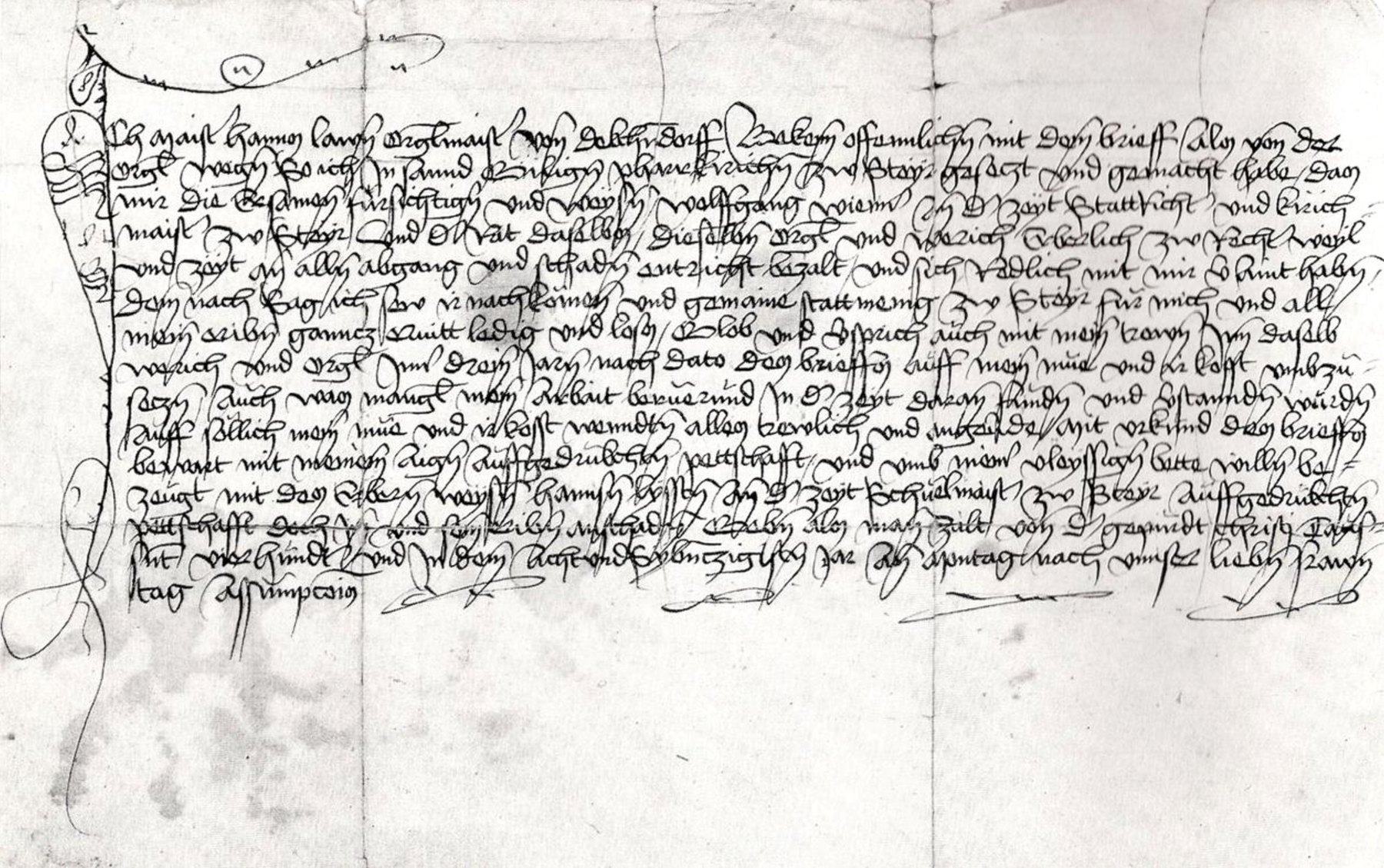
Han(ne)s Law(e)n, Orgelmeister aus Deggendorf, bestätigt die Bezahlung der neuen Orgel in der Stadtpfarrkirche zu Steyr durch den Stadtrichter und Kirchenmeister Wolfgang Wienner (1478 VIII 19) (Fiala 2013, 141, Abb. 27; Bildzitat). /
Han(ne)s Lawen, organ master from Deggendorf, confirms payment for the new organ of the town parish church of Steyr through the town judge and church warden Wolfgang Wienner (1478 VIII 19) (Fiala 2013, 141, Abb. 27; image citation).
[9] Of the great Seckau organ of the late fifteenth century, only the case survives; Federhofer 1951, 25.
[10] Bowles 1987, 183.
[11] Oberhuber 1978, 147 f.
[12] Forer 1973, 60, 172 und 196.
[13] One might mention here, among others, the organ at Seckau Abbey, demolished only in 1905; Flotzinger 1980, 23.
[14] Stenzl/Hintermaier/Walterskirchen 2005, 305.
[15] Quoika 1953, 16.
[16] Quoika 1953, 11.
[17] Compiled after Flotzinger/Gruber 1995, 89 f.; Quoika 1953; Eberstaller 1955; Forer 1973, 17–35, und Frieberger 1984, 26–29.
[18] Fiala 2013, 136 f.
[19] Eberstaller 1955, 4.
[1] This is exemplified by the standard work of Apel 1967, whose geographical arrangement is fixed on the German-speaking area and accordingly subsumes all Austrian representatives of keyboard music under the rubric “South German.”
[2] Praetorius 1619, 85.
[3] Edler 1997, 12.
[4] Salmen 1978, 22.
[5] Klotz 1986, 7–123; Edler 1997, 22. Organ building and the appointment of organists are well documented, e.g. in Bozen (E. Bozen).
[7] Klotz 1986, 68 f.
[8] Klotz 1986, 60.
[9] Of the great Seckau organ of the late fifteenth century, only the case survives; Federhofer 1951, 25.
[10] Bowles 1987, 183.
[11] Oberhuber 1978, 147 f.
[12] Forer 1973, 60, 172 und 196.
[13] One might mention here, among others, the organ at Seckau Abbey, demolished only in 1905; Flotzinger 1980, 23.
[14] Stenzl/Hintermaier/Walterskirchen 2005, 305.
[15] Quoika 1953, 16.
[16] Quoika 1953, 11.
[17] Compiled after Flotzinger/Gruber 1995, 89 f.; Quoika 1953; Eberstaller 1955; Forer 1973, 17–35, and Frieberger 1984, 26–29.
[18] Fiala 2013, 136 f.
[19] Eberstaller 1955, 4.
[20] Frieberger 1984, 27 f.
[21] Eberstaller 1955, 11–15. See also » E. Bozen.
[22] Flotzinger/Gruber 1995, 90.
[23] Salmen 1978, 12–26.
[24] Salmen 1978, 15–16.
[25] Meyer 2001, 78.
[26] Meyer 2001, 78.
[27] Quoika 1953, 14.
[29] Salmen 1978, 23.
[31] Flotzinger/Gruber 1995, 198.
[32] Moser 1929, 26 f.; Dammann 1974, 252, 259, 274 ff.; Michel/Sternath 2012, 247 f.
[34] Stenzl/Hintermaier/Walterskirchen 2005, 91, 94.
[35] Pacik 1978, 120–143.
[36] Quoika 1953, 18.
[37] Körndle 2003, 24–30.
[38] Mielke 1993, Bd. 1, 29–67.
[39] Körndle 2001, 225–256.
[40] Schuler 2000, 1191.
[41] Körndle 2001, 228–240; Mielke 1993, vol. 1, 42–55.
[42] Frieberger 1984, 26.