Dulcemelos
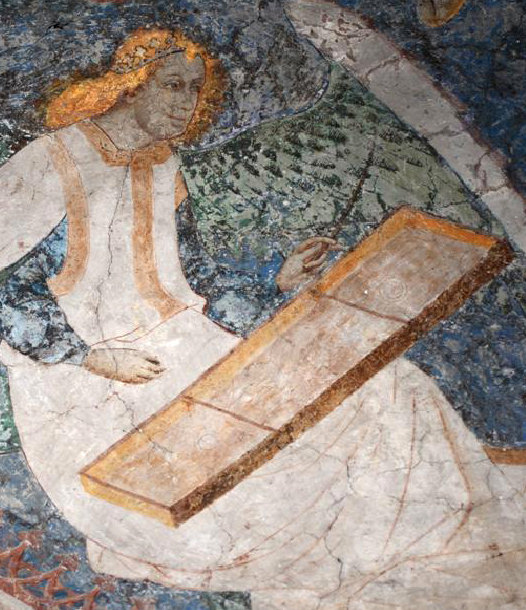
St. Andrew’s Church in Thörl (Carinthia), Master Thomas of Villach, c. 1475.
© Carmen und Heinz Gaggl
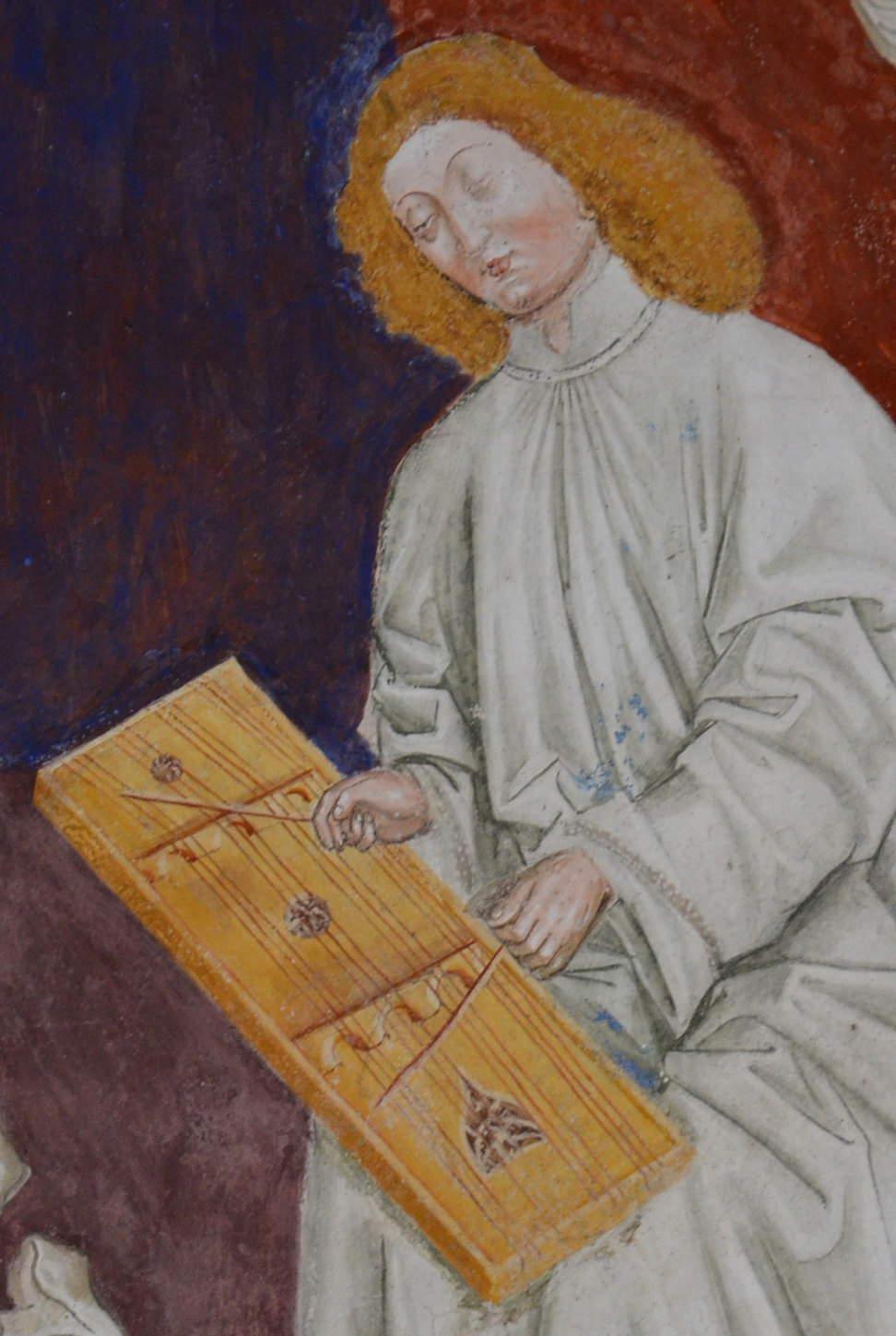
St. Catherine’s Church in Dornbach (Malta Valley, Carinthia), unknown master, c. 1463.
© Carmen und Heinz Gaggl

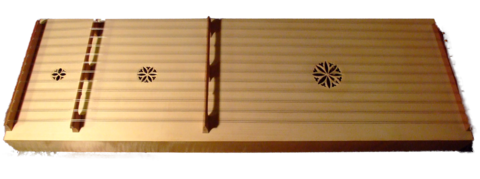
The dulcemelos is a specific type of hammered dulcimer which appears in iconography since the 14th century alongside other, more common forms. What sets it apart from most trapezoidal hammered dulcimers and hammered psalteries is that the strings run across several bridges spaced at intervals of a fifth or an octave. The descriptions by Paulus Paulirinus and Henri Arnaut de Zwolle suggest an instrument with metal strings and a rectangular body, whose strings are grouped in courses and struck with small hammers or mallets made of wood or quills. These hammers may also be wrapped in cloth to produce a softer or sweeter tone. The instrument described by Arnaut has a chromatically tuned octave ranging from B to c, divided by two octave bridges in such a way as to produce three fully chromatic octaves. Arnaut discusses the possibility of adding a keyboard to the instrument, so that the strings are struck or plucked via a mechanism.
The dulcemelos (and other types of hammered dulcimer) feature particularly frequently in the iconography of the Austrian region.
(Recording taken with kind permission from the CD ‘De arte saltandi – The Dances of Domenico da Piacenza (c. 1450)’, Terem-Music 2015.)