Theoretical Writings and Music-Making Books
A two-voice section from Obrecht’s Missa Salve diva parens, the “Qui cum Patre” from the Credo (» Audio example ♫ Qui cum Patre) enjoyed particular popularity. This strict canon at the unison evidently fascinated contemporaries so much[17] that it was transmitted as a standalone movement in at least seven sources from the sixteenth century. These included theoretical treatises such as » Heinrich Glarean’s Dodecachordon (Basel 1547), didactic texts such as » Sebald Heyden’s De arte canendi (Nürnberg 1540), and in practical collections of two-voice sections from larger compositions, compiled for domestic performance or for instructional purposes (“bicinium collections”).[18] One such bicinium collection is the manuscript » A-Wn Mus.Hs. 18832/1–2 of the Austrian National Library (» Fig. Qui cum Patre). Such music-making books appear particularly in the context of music education at Protestant schools in the later sixteenth century.
Abb. Qui cum Patre
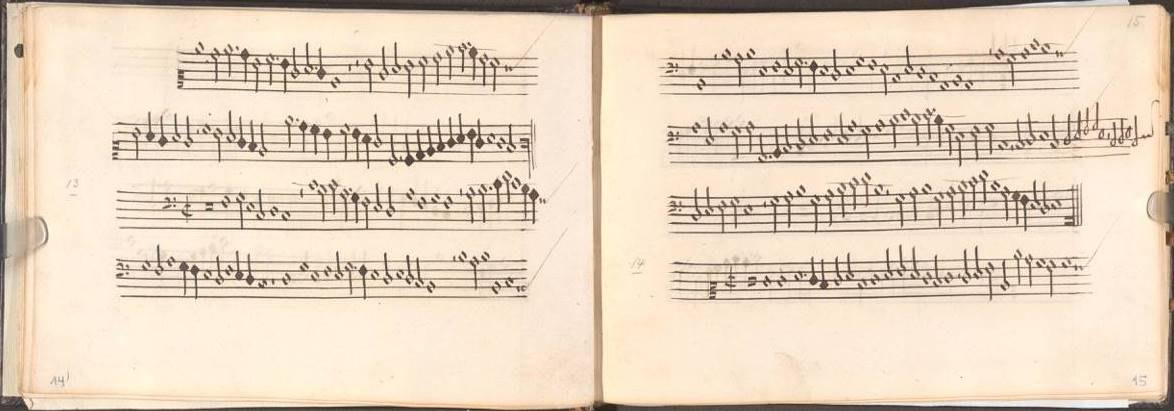
Das „Qui cum Patre“ aus dem Credo von Obrechts Missa Salve diva parens im Stimmbuch für die Oberstimme der Biciniensammlung » A-Wn Mus.Hs. 18832/1–2, fol. 14v–15r. Das Stück beginnt auf der linken Seite in der dritten Notenzeile; davor steht mit Bleistift die moderne Nummerierung „13“.
(Mit Genehmigung der Österreichischen Nationalbibliothek.)
The partbook set shown here, like the lavish choir book » A-Wn Mus.Hs. 15495 (» D. Ch. Ein Geschenk für den frischgebackenen Kaiser: Das Alamire-Chorbuch A-Wn Mus.Hs. 15495), originates from the Alamire scriptorium. It was written in the early 1520s by Petrus Alamire himself for Raimund Fugger the Elder (» E. Musik für die Fugger).The fact that the manuscript names no composers and – with few exceptions – includes neither texts nor incipits suggests that Raimund probably commissioned the books for the instrumental music-making of his children.[19]
[17] As this two-voice section is missing in three important sources, Barton Hudson suggests that it may have been added to the mass later, perhaps not even by Obrecht (Hudson 1990, XXf.).
[18] Similar collections also exist for three voices (“Tricinia”). In Formschneider’s Tricinia collection (Nuremberg 1538), the three-voice Pleni sunt from Obrecht’s Missa Salve diva parens appears among a colourful mix of 100 pieces from various genres.
[19] Jas 1999, 165; see also Verhaar 2014.
[1] Hudson 1990, XI–XXXIV.
[2] See Lodes 2008.
[3] A generally accessible introduction is provided by Lindmayr-Brandl 2014b; concise introductions to mensural notation (Lindmayr-Brandl 2014c), tablature scripts (Aringer 2014) and dance notation (Malkiewicz 2014) can also be found in Lindmayr-Brandl 2014a.
[4] For further details, see Lodes 2009.
[5] After Frederick’s death in 1493, Maximilian took over Frederick’s chapel. Reinhard Strohm, who was the first to compile an inventory of these fragments, places them more in the context of the Innsbruck court music, as Maximilian had taken over administration there in 1490 (Strohm 1984; Strohm 1993, 523). The fragments were digitised by Robert Klugseder as part of the research project Musikalische Quellen (9.–15. Jahrhundert) in der Österreichischen Nationalbibliothek (Musical Sources (9th–15th Century) at the Austrian National Library) and can be viewed at http://www.cantusplanus.at/de-at/austriaca/Linz529/index.htm.
[6] Some new identifications, reconstructions, and editions of individual pieces from the Linz Fragments by Marc Lewon can be found on his blog “Musikleben – Supplement”.
[7] A visualisation of the relationship between the surviving fragment and the original manuscript page has been created by Marc Lewon using the example of J’ay pris amours. See “Musikleben – Supplement”.
[8] Successful editions appeared in anything up to four editions, often within just a few years. See Boorman 2006, esp. 411–413.
[9] See Lodes 2001.
[10] In Petrucci’s printed collections of secular songs (canti), motets, and also frottola, the choir book format was retained for a long time.
[11] For a general discussion, see Genette 1989; Schwindt 2008.
[12] Boorman 2006, 360–366.
[13] The original purpose of use is unfortunately not verifiable for any of these three copies:
The copy held by the Austrian National Library (» A-Wn SA.77.C.13/1–3; Bassus partbook missing; digitised version: http://data.onb.ac.at/rec/AC09200708) was bound together with a total of thirteen other Petrucci Mass collections (one of which is now lost). All Mass settings in the Vienna collection are individually numbered (up to No. 339). Furthermore, the numbering continues in two other Petrucci editions (up to No. 393), which are now in Venice but were apparently once bound with the volume held in Vienna. This may suggest that the Petrucci editions now preserved in Vienna possibly only entered the Austrian National Library in the nineteenth century (see Boorman 2006, 349, 351, 493).
Another copy of the Misse Obreht is now held at the Franciscan Monastery in Güssing, Burgenland (no shelfmark; only the Tenor partbook survives). This too is bound with eight other Petrucci Mass prints. The monastery in Güssing was founded only in 1641, so this is a later acquisition or donation, probably from Carinthia or Hungary (see Federhofer 1963).
The third surviving copy in the southern German-speaking region, now in the Bavarian State Library in Munich (» D-Mbs 4° Mus.pr. 160/1; digitsed version: http://stimmbuecher.digitale-sammlungen.de/view?id=bsb00072010) probably originates from Passau. It is bound with two other Petrucci editions, including a motet collection (Motetti C, 1504) (cf. Boorman 2006, 348 f., 685). Some handwritten annotations indicate that this copy was used by musically knowledgeable individuals. For example, printing errors are corrected by hand, and an additional handwritten “Fuga” (= canon) is added at the end of the Altus partbook).
[14] For the general readership of Petrucci’s editions, see Boorman 2006, 336–349.
[15] See the essays in Lodes 2010.
[16] See Lodes 2001 and Lodes 2002.
[17] As this two-voice section is missing in three important sources, Barton Hudson suggests that it may have been added to the mass later, perhaps not even by Obrecht (Hudson 1990, XXf.).
[18] Similar collections also exist for three voices (“Tricinia”). In Formschneider’s Tricinia collection (Nuremberg 1538), the three-voice Pleni sunt from Obrecht’s Missa Salve diva parens appears among a colourful mix of 100 pieces from various genres.
[19] Jas 1999, 165; see also Verhaar 2014.
Recommended Citation:
Birgit Lodes: „The Media of Polyphonic Vocal Music around 1500. A Case Study: Jacob Obrecht’s Missa Salve diva parens“, in: Musical Life of the Late Middle Ages in the Austrian region, <https://musical-life.net/en/essays/media-polyphonic-vocal-music-around-1500-case-study-jacob-obrechts-missa-salve-diva-parens> (2025); slightly revised AI-assisted translation of the original German essay (2017).