Bagpipe
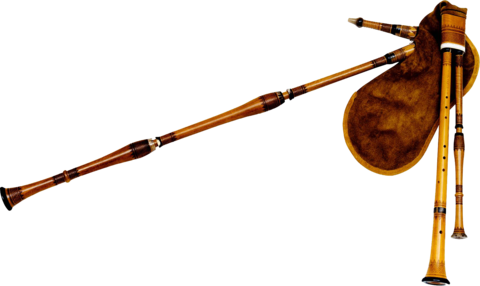
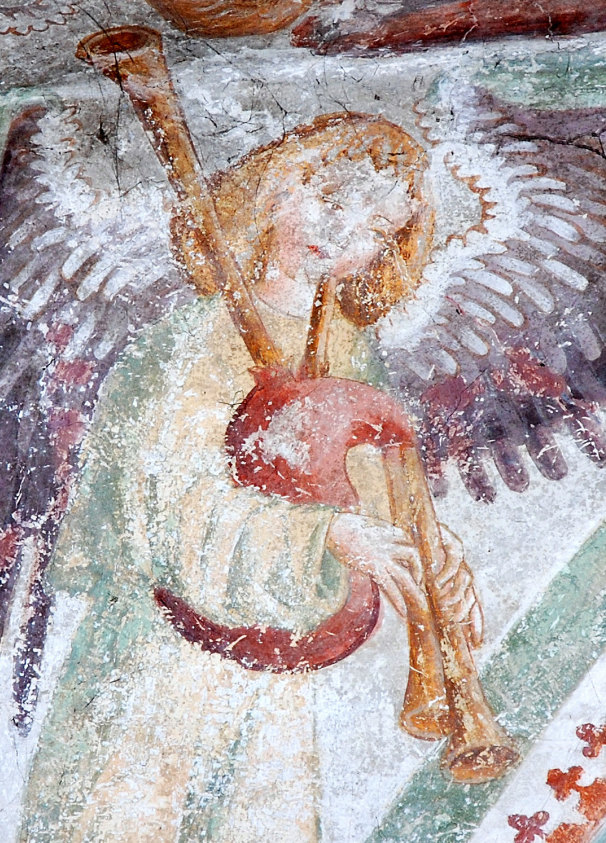
Depiction of an angel with bagpipes (from 1465) by the painter Mojster Bolfgang in the church of Mirna na Dolenjskem.
© Janez Jocif

The principle of the bagpipe (Dudelsack; Sackpfeife) – an airtight bag made of animal skin used as a wind reservoir for a reed pipe – had been known since late antiquity and subsequently spread throughout Europe. A wide variety of forms can still be found today in the continent’s most remote folk traditions. The air reservoir enables uninterrupted playing, which can otherwise only be achieved through circular breathing, where the oral cavity performs the same function. The drones, which are so characteristic of the bagpipe’s sound, first appear in iconography from the 13th century onwards, often with just one, but occasionally with up to four additional pipes. The chanter, fitted with finger holes, is essentially a shawm and may be fitted with single or double reeds. There are also chanters with two parallel bore holes, as well as exemplars with two chanters, which allow for limited two-part playing or changes in the drone pitch.
Ever since the High Middle Ages, the bagpipe have been regarded as a shepherd’s instrument and has been associated with rural or pastoral life. They were frequently used for dance music and as part of an alta cappella ensemble.
(Recording with kind permission from the CD ‘The Cosmopolitan – Songs by Oswald von Wolkenstein’, Ensemble Leones, Christophorus 2014.)
Bagpipe with single chanter and another one with double bore (Boha) on “Geschichtsfenster”: https://www.youtube.com/watch?v=mrAq5WLU91I&t=3567s
Bagpipe with two chanters in combination with shawm on “Geschichtsfenster”: https://www.youtube.com/watch?v=mrAq5WLU91I&t=3940s