Renaissance violin
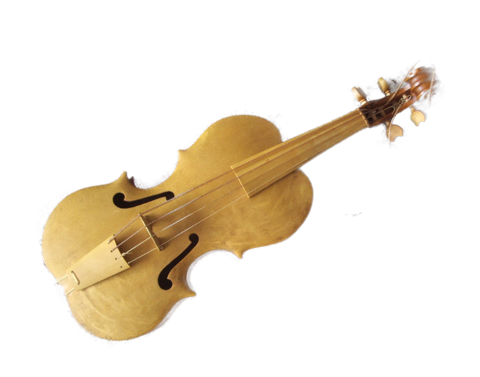

The Renaissance violin (also referred to as the ‘proto-violin’ in specialist circles) appears in the iconography of northern Italy in the early 16th century and takes many different forms. It is a fretless stringed instrument, usually with three or four strings. It is sometimes difficult to distinguish whether an instrument depicted in an illustration is a late form of the fiddle, a lira da braccio or an early violin, which is not surprising, as the instrument combines features of all these instruments and of the rebec. Over the course of the 16th century, a family of instruments comprising members of varying sizes (superius, tenor and bassus) emerged. The Renaissance violin was used for the instrumental performance of polyphonic ensemble music and for dance music.
The instrument played here is monoxylic, like the vielles of the same period; that is, the body was hollowed out from a single block of wood.